Showing posts with label parallel. Show all posts

Tuesday, August 30, 2022

Tuesday Twins from Upper Deck sets

Card Number 1037: Upper Deck Victory, 1999; #339

This is one of those cards where I had the parallel a long time before I acquired the base version. In fact, when I blogged the parallel version I bemoaned the fact I didn't have the base card!


Personally, I feel that is almost a perfect baseball card. I like posed photos where you can actually see what a player looks like. The simple framing and unobtrusive logo give this a high class, timeless feel. 

The cardback is also elegantly laid out, with a bit about the Qualcomm Stadium (as Jack Murphy Stadium was known in 1999) and a bit about Tony. The truncated stats box is fine when there is so much other detail to include. 

The prediction that Tony would reach 3,000 hits in 1999 proved true. The idea that he might reach 3,500 hits turned out to be optimistic. However, it does show how well Tony was hitting in the tail end of the 90s that it was considered a possibility, however remote. 

Card Number 1038: Upper Deck SP 'Superbafoil', 1995; #105

As if SP cards weren't difficult enough to scan anyway, here is the shiny 'superbafoil' version. Unlike the dark blue foil triangle on the regular SP card, this card has a triangle that looks silvery in real life but scans in a fractal ice-blue colour.


A bonus of showing this parallel card is showing the fistbump photo on the back again.


Looking through the roster of the 1994 team, I think the player fistbumping Tony is Bip Roberts. That's a deduction I've based on the mystery fistbumper's complexion,  jawline and ear. Bip was a second baseman so would be reasonably close to Tony when he was in the outfield. If only he had a number on his wristband like Tony did!

I'd be interested to hear what readers think about this. Is it a Bip-Bump? Or could it be someone else? Make your suggestions in the comments!

Total: 1038 cards

Monday, August 29, 2022

Modern Monday - another class of Gold Label

I'm not consistent in how I write the headers for Gold Label cards. The "class" of the card is sometimes in brackets, sometimes not. But I doubt anyone cares too much. I feel people come to my blog to look at the cards rather than read what I'm calling them.

Card Number 1036: Topps Gold Label - class 2, 2021; #12

The class 1 and class 3 cards issued in 2021 are in this post from February, although actually one of those cards is a black parallel, so I think that means I'm missing the standard version...

All three classes of cards in the 2021 issue juxtaposed that ever-so-cool photo of young Tony with an action shot from his later years. In this one elder Tony is running the bases. I also like the juxtaposition of 'San Diego' on elder Tony's uniform and 'Padres' on younger Tony's jacket. (I want a jacket like that!)

The classes in Topps Gold Label, basically mean there are three sets to collect, all with the same numbering and cardbacks. So there isn't much to add to what I've previously said about this cardback. 

Total: 1036 cards

Tuesday, May 10, 2022

Tuesday Quins - Stadium Club Chrome

I've already got three versions of the same card from the Stadium Club set released by Topps last year. (They are the normal card, the red parallel and the black parallel.) This post features two more cards from the Chrome version of the Stadium Club set. That brings me up to five cards in total - hence why this is a Tuesday Quins post not a Tuesday Twins post!

Card Number 1010: Topps Stadium Club Chrome, 2021; #24


In real life this is a bit shinier than the regular version of the card. And it has the Stadium Club Chrome logo on the front. Otherwise there is not much to add to what I've said previously. 

And here's the back...


Card Number 1011: Topps Stadium Club Chrome (refractor), 2021; #24


This card went all shimmering crazy on the scanner. In real life it doesn't look hugely different to the first Chrome card I've posted. 

It says 'refractor' on the back as a handy help for collectors.


My thanks go out to Graham for the base card and to Sam for the refractor. 

Total: 1011 cards


Tuesday, April 12, 2022

SMILE, IT'S CARD #1000

A double milestone today - the 1000th card on the blog in my 500th blog post.

Why did I pick this card to be the 1000th card on the blog? Well I just love it. I loved the original version. And this is the super-shiny parallel.

Card Number 1000: Pinnacle Summit (foil board parallel), 1996; #134


Although the overhead scan captures the almost impossible shininess of this card, the much duller flatbed scan below shows the set logo a bit more clearly. 


The back includes the nicely laid out representation of Tony' performance on a month by month basis. He was very hot at the end of the 1995 season.

Pinnacle and it's various sub-brands are being kept on life support by Panini now. But this card represents everything that was right with baseball cards in the 1990s. I love it and it feels like an exciting and special card to celebrate getting into triple figures on this blog.

As ever, a massive thank you to everyone who has helped me along the way. I am very grateful to you all!

Total: 1000 cards!

Sunday, April 10, 2022

One card only - Swing-o like Van Gogh

Card Number 996: Pinnacle Museum Collection, 1995; #291

This is a parallel version of the base card from the 'Swingmen' subset. It has a 'dufex' finish. Because of the subset design this card takes on a really trippy painted effect with the finish.


I took another scan of this using the overhead scanner. The swirliness really comes alive with more intensity.


The blue and purple swirling really reminds me of some of Vincent Van Gogh's paintings. The 'bumpiness' (technical term) of the dufex finish adds to the feeling that it's painted on. 

On the back, the 'Museum Collection' logo has been added, in case someone didn't realise this card was different to the Pinnacle base cards! The kerning of "1995" above the word Museum is too stretched for my liking. The photo of Tony has him looking right down the camera lens. He doesn't look like he will take any messing about from the photographer.


Back in 1995, the Museum Collection would have been a reasonably tricky parallel set to complete. These cards were inserted 1 in every 4 packs. However, I acquired mine from Jason in Rhode Island - thanks Jason!

Total: 996 cards

Monday, April 4, 2022

Modern Monday - Allen & Ginter shiny bubble

This could be a 'twin' card. It's a "hotbox parallel" card courtesy of Gawain.

Card Number 992: Topps Allen & Ginter [hotbox parallel], 2021; #53

The flatbed scan is remarkably dull.


The overhead scan is a bit brighter. The 'bubble' has an odd pearlescent finish that just doesn't scan very nicely.


I missed this detail when I blogged about the regular base version of this card, but this card is #53 in the set - which is a meaningful number because it was the number Tony wore in Spring Training in 1982 and thus became the number on his shirt in the photo on his Topps rookie card in 1983. 

I would like to think that is a deliberate numbering choice by Topps that would only be spotted by number-obsessed weirdo bloggers, like a little in-joke between us. But it could equally just be a random coincidence. 

The card numbering is the only interesting thing on the back of the as-dull-as-usual cardback. 


Total: 992 cards

Thursday, March 31, 2022

Celebrating the Upper Dec(k)ade

To celebrate their tenth anniversary, Upper Deck released some special baseball cards that have one of my favourite things on the back - pictures of other baseball cards!

Card Number 990: Upper Deck 10th Anniversary Preview, 1998; #55

These shiny inserts appeared in the 1998 Upper Deck flagship set. Design-wise, they ape the design of Upper Deck's first set released in 1989.


On the back is a write-up about what a great batter Tony is, linked to a card that Upper Deck released in 1992, which was notable for being the first Upper Deck insert card with a full-bleed photo design. 

The card was in an insert series supposedly curated by Ted Williams - I blogged about it here.

Card Number 991: Upper Deck 10th Anniversary Team (Double), 1999; #X8

I received this card back in January from Riley in Nashville - thanks Riley! The X in the card numbering is the Roman Numeral for 10!

This insert series featured players who were active during the Upper Deck era, and the team selection was made through a popular ballot.

Upper Deck produced four different versions of their 10th Anniversary Team insert cards - there was a regular version, this version that was called a 'double' and numbered to 4,000, a 'triple' version numbered to 100 and a 'home run' version that had a print run of 1! All the versions are numbered X8 and it's only the serial numbering that really differentiates this from the vanilla version. The triples have silver foil stamps on the front. There are no reference pictures on Trading Card Database, but I imagine the home run versions had gold stamps on the front.


On the back is one of my favourite Upper Deck cards, featuring Tony fishing!


I blogged about that card showing Tony fishing way back in August 2020! The serial number is big and bold. I can't think of a meaningful link between Tony and the number 497.

Upper Deck had a hobby-changing impact when the first cards landed in 1989. I've written a bit about how the "UD asteroid" wiped out the cardboard dinosaurs that had ruled the hobby in the 1980s. By the end of the 1990s, the other card companies were no longer playing catch up. Almost all of Upper Deck's innovations became standard across the industry - from foil stamps, to parallels, to relic cards, to autographed cards inserted in packs. Even now, a couple of decades later, it feels really fitting to celebrate the decade of innovation that Upper Deck brought to the world of baseball cards. 

Total: 991 cards


Sunday, February 27, 2022

One Card Only - cyber stats

A couple of days ago I read a post on Fuji's blog about these cards. Mine has been sitting in my 'to blog' pile for a while and Fuji's post made me realise that I could blog a card that is weirdly totally relevant to what is going on in baseball now.

As most fans know, currently there is an impasse between the franchise owners and the players. Spring Training has been cancelled and soon they will start cancelling games unless a compromise is found. There is a possibility of no baseball at all in 2022.

In 1994, a similar breakdown in relations meant the season was cut short. Tony was batting .394 at that point and it remains the highest batting average since the Second World War. But it was a shortened season and the unanswered question is - what would Tony have batted if the season had run to a full conclusion?

Tony was just 7 hits off .400 at the point where the season was cancelled. Could he have recovered that deficit in his remaining games?

In 1995 Topps produced a parallel that used a "computer" to predict what a player's totals would have been if the full season had been completed in the previous season. Topps called these parallels "cyber stats". The regular base card is blogged here.

Card Number 974: Topps Cyber Stats parallel, 1995; #228

These cards have different numbers to the base cards. Tony's base card in 1995 was #431. The front is shiny and this is an admittedly poor scan.


On the back is the "computer generated" stats, which predicted a drop off in the final 6 weeks of the season from .394 to .391. I dispute this but accept that the processing power available back in 1994-1995 was pretty low and this may have made sense within the parameters they were working with.


However, there are some additional aspects of Tony's batting in 1994 that need to be taken into account. These were brought to my attention initially by some Upper Deck SP cards. 

Firstly, if you take the last few games of the 1993 season, and add them to the games of the 1994 season to make a complete 162 games played, Tony batted .396 across those games. Now, this is a bit moot because Tony never actually batted a complete 162-game season. But he was hot at the end of the 1993 season and there is no reason to believe he wouldn't have been hot at the end of the 1994 season, had it happened. 

Secondly, if you look at Tony's performance across the 1994 season, he was getting stronger as the season went on. In the 30 games before the season was halted, Tony was hitting .433, dragging his average up considerably. If he had carried on batting at that rate for the remainder of the season he would have gone past .400 quite easily. 

I very much doubt the computer algorithm that Topps used to calculate Tony's potential scores took either of those factors into account. 

And another thing occurred to me about this card, and it supports my thesis that the social changes of the Nineties were seismic compared to previous decades. This was the beginning of the desktop computer era, where suddenly everything transitioned to computer-based working and the foundations were laid for the Internet and life online. 

This is reflected in baseball cards in a number of ways. Obviously one of the most noticeable changes is the impact on the design of baseball cards. But in this case, the impact of computers is on the content of the card. 

It's testament to a time where computers were rapidly becoming a normal part of life, so of course it would be a "computer generated" prediction of what would have happened - it almost had to be a "cyber stat" because cyber was the imminent future.

Total: 974 cards

Tuesday, February 22, 2022

Tuesday Twins - more Gold Label parallels

Following on from yesterday's Gold Label cards from 2021, here are some more from the Topps range that perpetuates the class system.

Card Number 963: Topps Gold Label Class 1, 2019; #92

As with the more recent cards that I blogged yesterday, this card juxtaposes an older photo of Tony with a more recent one. In this case it's a photo from either 1985 or 1986 and a photo that's probably from 2001.


Like the cards from 2021, the cardback has Tony's 'average season' stats and states that Tony's season best batting average was .372. I still can't decide if this is an error by Topps or just someone behind the scenes being a pedantic dork and discounting the stats from 1994 because it wasn't a 162 game season. Whatever the reason, Topps has been printing this stat for a while. 


The factoid is a useful illustration of how well Tony hit in the clutch. He didn't often get to two strikes as he liked to swing at the first pitch if he could. But when he got to two strikes, it was very rare that he would get to three.

Card Number 963: Topps Gold Label Class 1 (black parallel), 2019; #92

Like yesterday, here is a black parallel to compare with the regular class 1 card.


The black parallel looks much more striking as a card, and also makes the 'class 1' lettering much more obvious in the scan.

I have a confession - the cardback I showed you previously could have been from either the regular or the parallel. I scanned them together and can't tell them apart. Here's a scan of both of them to show what I mean.


And, as a bonus, another card from the same set and same year...

Card Number 965: Topps Gold Label Class 2, 2019; #92


I really like the white Padres uniform with the yellow, orange and brown accents. That uniform is the one worn by the team in the 1984 World Series, and replaced almost immediately with the switch to pinstripes for the 1985 season. (Maybe it's because I'm a child of the seventies, but it feels to me that the move to pinstripes in the 1980s was a boring choice!)

The cardback is the same again, complete with the description of Tony's batting after two strikes as "preposterous", and a mention of Wade Boggs.

With baseball itself very much in the balance for 2022, I don't know if Gold Label is scheduled to appear again. I'm waiting to see if Topps persist with claiming Tony's best batting average is .372. If Topps do, then I might get in touch with them and ask what their reasoning is. 

Total: 965 cards

Monday, February 21, 2022

Modern Monday - smudgy Gold Labels

A couple more cards from last year, which arrived via Michael who is a member of the UK collectors group on Facebook.

Card Number 961: Topps Gold Label Class 1 (black parallel), 2021; #12

Topps separate their Gold Label sets into three classes of increasing scarcity. Each class has a variety of different colour parallels going on. Basically, this is one of those sets with multiple similar cards of any given player. This is class 1, so the most common, but the black parallel, so less common.


The juxtaposition of Tony as a young player rocking the old brown and orange Padres look from the early 80s, with older Tony in the pinstripes and blue makes for a nice effect on the card. It's also shiny, hence the slight dappling effect around the logo in the scan. The lettering on the silver foil is in black and there are black solid patches in the various corners. That's how to tell it's a black parallel. 

On the back there are some smudges as if the card has hit some printer ink. I don't think this happened in transit becase they arrived in a penny sleeve and in a toploader. I think the ink is from the printing process. 


The term "live-ball era" was a new one to me. A quick Google revealed it is referring to baseball after 1920 when a load of rule changes were introduced to make baseball more "lively". I've frequently said that comparing Tony to pre-war playes is a bit futile, because of how much the game has changed, but I like this stat that says you have to go back to 1931 to find another player who was as consistently good at hitting the ball and not striking out as Tony. It's yet another way to cut the statistical cake to show that Tony was the greatest hitter of his lifetime. 

Card Number 962: Topps Gold Label Class 3, 2021; #12


Topps change one of the photos on the front in each of the different classes of cards. Topps has also been considerate for once, and included the class number in the foil print on the front of the card so it's easy to tell which version of the card this is.

The cardback is pretty much the same. 


Just a word on that stats box because there is an unusual line in there for 'average season'. That's not a common stat on cardbacks, and makes for some impressive reading. I would not have guessed that Tony averaged over 200 hits a season. The asterisks denote it's based on a 162-game season, so I presume it doesn't count 1982 or 1983 when he spent some time in the minor leagues, or 1994 when the season was cut short by a strike. Removing 1994 from their calculations would also explain why Topps printed his career best average as .372 instead of .394.

Or, knowing Topps, they just got it wrong!

Total: 962 cards

Friday, February 11, 2022

Friday Flair in Fleer Fortnight

Flair was Fleer's high brow range of cards for much of the 90s. I've accumulated a few in the collection and here are some that haven't appeared on the blog previously.

When I previously blogged about Flair cards, I posted the card from 1993 and the card from 1995, but didn't have the card from 1994. So, let's set that right.

Card Number 938: Fleer Flair, 1994; #436

This card is everything you might expect from a premium card in the mid-90s. Full bleed picture, gold foil tints, elaborate swirly fonts. It's also everything you would expect from a Fleer card in the mid-90s. Confusing juxtaposition of photos, cropped off feet...


There is a full photo background on the back, with a Topps-esque shot half showing Tony's face and with his butt pointing towards the camera! However, it is unusual to have an action shot with Tony wearing his trademark wraparound shades.

For the first few years that Fleer produced Flair, they were relatively uncomplicated sets. Then towards the end of the 90s they started getting more complex, with parallels, rebrands and strange numbering systems.

Card Number 939 Fleer Flair Gold version, 1996; #174

In 1996, every Flair base card came in either a silver version or a gold version. The silver versions had gold lettering, and the gold versions has silver lettering. The cards were all shiny, using the Fleer 'etched foil' approach that gave the cards a gritty sort of surface feel. 

As with other Flair sets, this card has a composited image of pictures of Tony on the front.


Despite the abundant use of photoshop on the card, the designers left the grass stain on Tony's knee. 

There are two photos on the back as well, and a huge stats box.


After 1996, Flair was rebranded as Flair Showcase. That was when things started to get weird with the brand. In 1998 Flair Showcase was released as a 'tiered product' with four different versions of each card released, numbered from Row 3 to Row 0, with 3 being the most common and 0 the most scarce. Furthermore, each row was divided into 30-card sections, which were also of unequal scarcity. It's all very complicated. Even Baseballcardpedia has difficulty explaining it.

Card Number 940: Fleer Flair Showcase (Flair), 1998; #Section 2 Row 3, Seat 19

I'm going to count this as a #19 card! Row 3 means it was the most common version of Tony's cards in the set.

This was a really difficult card to scan. This was captured using my overhead scanner and is slightly over-exposed.The line on it is in the etched foil coating.


At least when they made an unnecessarily complicated set, Fleer had the decency to add the word 'Flair' under the set name so collectors could instantly tell which bit of the set the card was from. Although, they could have been more original and used a different word than Flair, which was the brand!

The cardback looks a bit, well, creepy, to be honest. It's the combination of the colours and Tony's hyper-focussed facial expression.


The word 'showtime' on the back indicates which subsection this card is from. "Flair Showtime Flair Showtime" are the most commonly occuring cards in the set. You were more likely to get more than one of these cards in a packet than none at all (if I've worked out the ratios on Baseballcardpedia correctly).

Card Number 941: Fleer Flair Showcase (Style), 1998; #Section 2, Row 2, Seat 19

Another #19 card. Or the same one? These 'Row 2' cards were the second most common cards in the set.


This card looks better. There is a big 'e' on the red advertising hoarding behind Tony. It looks really familiar but I don't think it's the e in Budweiser. It might be the e from the word Coke. 

It's the same photo on the back. The entire background has been wiped but because the whole picture hasn't been tinted blue, it's less freaky looking. 


This card is in the Showstopper division of row 2 cards. Again, that makes it one of the most common of the Row 2 cards, with these cards appearing at a rate of 1 every 2 packs.

I don't have the rarer Flair Showcase cards from 1998. But Flair continued their weird numbering system the following year, although there were only 3 rows. (They dispensed with row 0.) They also dropped the number of subdivisions across each row down to 3. The reduction in complexity may be an indicator the range was having problems so it's no surprise that Flair went on hiatus after the 1999 set before being brought back in 2002 for a new run.

Card Number 942: Fleer Flair Showcase (Power), 1999; #Row 3, Seat 9

The 'power' cards are the most common version of the card - this is in the 'Showtime' subdivision, which was the most common subdivision, making it one of the most common cards in the set overall. 


Fleer seemed to like having a picture of Tony running towards the camera on the cardback as they used a picture of him like that for the second year running. 


The green bar for the factoid is very prominent. It's a good factoid too, retelling the story of Tony's draft day when he was also offered a place with the Clippers in the NBA.

That's all the flair I have available to blog at the moment. At some point I will have to go a-hunting for rare flair to share.

Total: 942 cards

Tuesday, February 8, 2022

Tuesday Twins - Familiar Fleer

For today's 'twins' post in Fabulous Fleer Fortnight, here are are some Fleer cards which may look familiar...

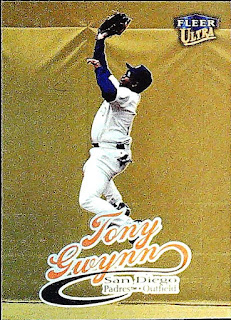
Card Number 930: Fleer Ultra Gold Medallion Edition, 1999; #596


The original version of this card (below) was very dark. This card is very shiny very gold!


On the back, Fleer have handily added a note that it's the gold medallion edition. There was one gold medallion parallel version in every pack.


Card Number 931: Fruit of the Loom / Fleer, 1993; #28

The only differences between this card and the normal base card was the small 'Fruit of the Loom' logo on the front, and a different number on the back.


These cards were available in packs of underwear produced by clothing company Fruit of the Loom. They were included in little packs of 6 cards in with briefs and boxer shorts. It's a quirky little parallel that is truly representative of the card collecting bubble in the late 80s and early 90s when just about any product imaginable could have baseball cards in it.


In the previous year, Fleer had produced cards for 7-Eleven (blogged with some heady nostalgia for my boyhood memories of 7-Eleven here) and in that promo set they changed the images on the front and back of the card. This time they didn't change the image on either side. Apart from the set number, this is exactly the same as the regular release. 

Card Number 932: Fleer Ultra Gold Medallion Edition checklist, 1996; #4

As I mentioned a couple of days ago, Junior Junkie has a good write up of Fleer's gold medallion parallels in 1996 and explains how Fleer did a gold medal version of everything. Including checklists.

The main difference is a teeny foil stamp on the front. It doesn't scan very well.


These cards were available at a rate of 1 per pack. There was also one insert per pack and every ten packs contained a gold medallion version of an insert. As per Junior Junkie's post, that means some rarer inserts have an exponentially higher scarcity value in the gold medallion version. However, this checklist would have been comparatively common.

Just in case a collector didn't see the large word 'CHECKLIST' on the front, Fleer wrote it repeatedly over the back as well.


Fleer often divided their sets up by numbering players from the same team consecutively. I've complained before that this was a missed opportunity not to align the player on the front with the team on the back. As ever with these checklists from the 90s, there are names that jump out as recognisable and a load of players who have disappeared into sporting obscurity now. (When I blogged the regular version of this checklist, I mentioned Wonderful Monds. I still wish he had made it in the bigs. What a name!)

Total: 932 cards