Showing posts with label errors on cards. Show all posts

Tuesday, March 29, 2022

Tuesday Twins - some cards we've seen before

As is customary for Tuesdays, here are some "twins" - cards that look a lot like other cards in the collection.

Let's start off with a card where Topps made the kind of mistakes the market-leading brand shouldn't be making.

Card Number 986: Topps Update, 2016; #3000H-12

Previously seen as the shiny Chrome version.


When I blogged about the Chrome version of this card I noted there were two mistakes on this cardback. See if you can spot them (or remember them!) - check your answers here.


Card Number 987: Topps Chrome, 1999; #LD12

I have no idea why Topps would bother reproducing shiny inserts in their Chrome sets, but back in the late 90s they did.

I scanned the front on a black background, which really shows up the pointy die-cut at the top of this card.


But I scanned the back on a white background because I used the flatbed for the back.


As noted when I blogged the vanilla flagship version of this card, the copyright year says 1998, but this was released in 1999.

There is another version of this card as well - Topps put refractors in their Chrome sets so maybe one day this twin will turn into a triplet. 

Card number 988: Topps, 1997; #SB-1

Another shiny insert card previously seen as an unnecessary Chrome version.


Compared to the front, the back is under-stated. The photo is another example of Topps excelling at logoless cards despite being fully licensed. 

There isn't much more to add about this selection of twins, except to point out how chroming some cards is pointless when they are already super-shiny foil. 

Total: 988 cards

Tuesday, February 22, 2022

Tuesday Twins - more Gold Label parallels

Following on from yesterday's Gold Label cards from 2021, here are some more from the Topps range that perpetuates the class system.

Card Number 963: Topps Gold Label Class 1, 2019; #92

As with the more recent cards that I blogged yesterday, this card juxtaposes an older photo of Tony with a more recent one. In this case it's a photo from either 1985 or 1986 and a photo that's probably from 2001.


Like the cards from 2021, the cardback has Tony's 'average season' stats and states that Tony's season best batting average was .372. I still can't decide if this is an error by Topps or just someone behind the scenes being a pedantic dork and discounting the stats from 1994 because it wasn't a 162 game season. Whatever the reason, Topps has been printing this stat for a while. 


The factoid is a useful illustration of how well Tony hit in the clutch. He didn't often get to two strikes as he liked to swing at the first pitch if he could. But when he got to two strikes, it was very rare that he would get to three.

Card Number 963: Topps Gold Label Class 1 (black parallel), 2019; #92

Like yesterday, here is a black parallel to compare with the regular class 1 card.


The black parallel looks much more striking as a card, and also makes the 'class 1' lettering much more obvious in the scan.

I have a confession - the cardback I showed you previously could have been from either the regular or the parallel. I scanned them together and can't tell them apart. Here's a scan of both of them to show what I mean.


And, as a bonus, another card from the same set and same year...

Card Number 965: Topps Gold Label Class 2, 2019; #92


I really like the white Padres uniform with the yellow, orange and brown accents. That uniform is the one worn by the team in the 1984 World Series, and replaced almost immediately with the switch to pinstripes for the 1985 season. (Maybe it's because I'm a child of the seventies, but it feels to me that the move to pinstripes in the 1980s was a boring choice!)

The cardback is the same again, complete with the description of Tony's batting after two strikes as "preposterous", and a mention of Wade Boggs.

With baseball itself very much in the balance for 2022, I don't know if Gold Label is scheduled to appear again. I'm waiting to see if Topps persist with claiming Tony's best batting average is .372. If Topps do, then I might get in touch with them and ask what their reasoning is. 

Total: 965 cards

Saturday, October 30, 2021

A classic howler

Classic cards were ostensibly part of a trivia game, which always strikes me as a bit of a ruse to get around licensing agreements. Like all cards they evolved quickly in the early 90s, although they never really lost that flimsy card game feel.

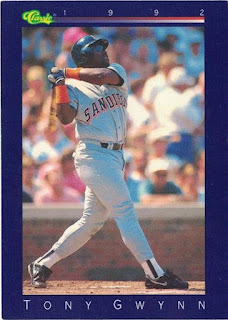
Card Number 812: Classic Baseball, 1992; #61

Design note: It's the 90s. Let's stretch the year across the width of the card! This kind of kerning is a mark of a card being designed on a computer. 

I would argue this photo is quintessential early 1990s Tony Gwynn. Helmet and shades, watching the trajectory of a ball he has just belted up into the sunny sky, wearing the grey Padres road uniform that always looks a bit like pyjamas. The bright orange wrist guards match the orange in the San Diego name on his shirt. 

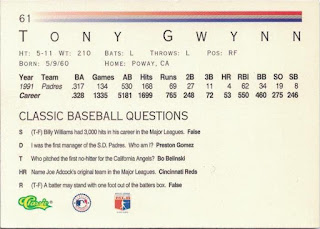
The back is a change for Classic cards. Gone are the old ropey-looking cheap card backs. Note the extended kerning for Tony's name again. Justified text! Plus, five questions for you to test your knowledge.


Over time, I have grown fonder of one line stats boxes. I also think it's incredibly cool that Tony only struck out 19 times in the season - what with that being his shirt number!

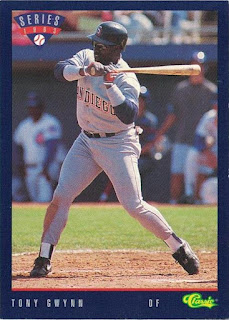
Card Number 813: Classic Baseball, 1993; #T41

This card was one of the 99 that came in the actual Classic game.


The photo in 1993 was not as good as the previous year. Tony's bat is occluding a background person's face in almost comical style. 

The back has one line of stats and five more questions to answer. Plus a major howler - instead of the Padres logo there is the Angels logo!


This error hadn't been previously noted on Trading Card Database. I've reported it now!

Total: 813 cards


Thursday, April 1, 2021

Foolish mistakes on April 1st

Nobody reads cardbacks. That's my explanation for why Topps can produce baseball cards with nonsense on the back. As today is April Fools Day, it feels relevant to feature some foolish mistakes.

Card Number 627: Topps Gypsy Queen, 2011; #28

This was the from the first Gypsy Queen set. The range is a decade old now. 


It's not a particularly exciting card design. And then turn it over and witness how lacksadaisical Topps can be with regard to fact-checking their cards.


My first reaction was "Eh?" Then I remembered Tony Gwynn Jr was playing for the Padres in 2010. Maybe some stat compiler mistook Tony Jr for his dad. Tony Jr did play 117 games for the Padres in 2010, and it was a winning season for the team (90-72; second in the division with a win percentage of .556). But the team didn't play an additional 73 games without him. Those figures on the card add up to 190 games, and the Padres only played 162 games that season.

For the record, the two seasons the Padres have played the most games were the World Series seasons of 1984 and 1998, where they played in 171 and 176 games respectively. Nowhere near the 190 total listed here. Maybe Topps added in Spring Training games.

So, to sum up, it looks like Topps confused Tony Sr and Jr on this card. The picture is clearly Tony Sr even though his son does look like him in a lot of photos. But physically, Tony Jr was very lean in his seasons with San Diego. Then to compound the error, Topps just chucked some random figures on a page that add up to more games than is physically possible to play. (By my calculation, the most games a team could play if they maxed out the post-season series would be 181.)

I know I am sometimes overly-critical of Topps, but these are just weird mistakes that the market leading company really shouldn't be making. 

There was a second Gypsy Queen card in my recent eBay purchase and it highlights something that is becoming more prevelant with Topps - the reuse of images. 

Card Number 628: Topps Gypsy Queen, 2014; #53

(Hey, #53 - that was Tony's first ever number with the Padres.)


Recognise that photo? Well, last week I blogged about a card from 2020 that used it.


It also appeared in sets in 2019. This is the Chrome version.


They've photoshopped it a bit on the Gypsy Queen release, but it's clearly the same photo. I have seen other collectors complain that Topps are using the same images for players again and again. I'm willing to give Topps a bit of leeway on this for players like Tony who played before the era of digital photography. I don't think there can be any excuse for continually reusing photos of any players who are active now. But there is a more limited bank of photos available for stars from the last century.

However, Topps might need to think carefully about how often they reuse images. 2014 to 2019 is an acceptable gap in use. But using this image in two insert series in consecutive years makes it much more obvious.

The cardback is fairly dull, but at least the factoid is about the right Tony Gwynn and the numbers are right. 


I was a bit surprised recently when I made an off-hand comment on Facebook about Gypsy Queen that there are a number of collectors who still really like it. Personally, I think it's feeling a bit tired, but it's still popular with the people who like to rip packs and build sets and as long as it sells I have a feeling Topps will keep producing it.

Total: 628 cards


Monday, January 18, 2021

Modern Monday - Topps Tribute

Last week I signed off on hiatus with my 250th blog post featuring the last of my unblogged cards. I posted to the same effect on Facebook and Paul heeded my subtle cry for help and got in touch offering me some cards I didn't have. So, the hiatus didn't last long!

Card Number 575: Topps Tribute, 2020; #59

This isn't a set I saw that often in the Facebook card groups. The base cards are printed on 2mm cardboard so they are hefty!


There is a pearlescent sheen to the border on this, which means it scans very nicely. The photo is classic Tony-at-bat, presumably not his first at bat in the game given the muddy leg from a knee slide. The pinstripes and blue helmet combination means this is from the early-mid 90s. 

The back is impressive. There are four factoids and three of them are ones I didn't know before reading the back of the card. That's three bonus points for this card right there!


I think it's testament to Tony's prowess with the bat and his demeanour approaching the game that he didn't let a strike faze him. Even if he did give up a strike he would still make a hit over three times in every 10 at bats. 

However, there's a reason I didn't know that second factoid. It didn't actually happen like that. The only game when Tony struck out three times was on the 14th April 1986 against the Dodgers. (The pitcher was Bob Welch.) In the tenth inning, Tony reached second base on an error and then ran in the tying run off a John Kruk single, but it was Bruce Bochy who hit the home run that won the game for the Padres in the eleventh inning. Here's an article all about the game.

So, only the two bonus points. I have a feeling I should go and check the other statistics but I don't really want to be that guy.

Many thanks again to Paul, who also sent me a card to be featured tomorrow!

Total: 575 cards

Tuesday, December 15, 2020

Tuesday Twins - a corrected error

Way back in May when I did a post about the cards DonRuss released in 1990, I included Tony's All-Star card, which was the uncorrected error version. I didn't remark on that at the time, although I did notice that the stats box contained his stats from the All-Star game, even though the header said 'Recent Major League Performance', and noted the juxtaposition. What I didn't know then, but realised soon after, was that this was a known error and a corrected version was also released.

A few weeks back I took delivery of a joblot of 80s and 90s Tony Gwynn cards, which I knew contained a DonRuss 1990 All-Star card. It didn't have a photo of the cardback, so when it arrived, I crossed my fingers and flipped it over.

It was the corrected version!

Card Number 534: DonRuss (corrected version), 1990; #705

The front is exactly the same.

But on the back you can see that the stats box is headed 'All-Star Game Performance'.


It's not the most exciting variation in my collection, but...

a) I'm pleased to have both versions as it gives me a sense of completeness, 

b) it's a genuine error and correction unlike the silly fake 'errors' that are deliberately put into sets as parallels these days, and 

c) it gives me another card with a red border for when I put together my sub-theme collection of Tony Gwynn cards with red borders.

So, that's three reasons why it's a welcome addition to the collection.

Total: 534 cards

Tuesday, November 17, 2020

80s week: Dynamite DonRuss designs

I feel a bit embarrassed to admit this, but for a long time I judged DonRuss on the quality of their ubiquitous late 80s cards, particularly the 1988 cards that are the cards most people would think of first when they hear the term "junk wax". But in the build up towards the saturation of the market, DonRuss had some very nice card designs that aren't as easy to track down (at least not here in the UK).

Of the two Tony Gwynn rookie cards I own, the DonRuss 1983 card is by far my favourite. It's even incorporated into the header of this blog. The 1984 card is still on my wants list. So, this post starts with Tony's DonRuss card from 1985.

Card Number 485: DonRuss, 1985; #63

It's a bunt card!


This is a photo taken in the 1984 season as the Padres switched to pinstripes in 1985. However the new arched lettering logo is on the card. I think the person sat in the dugout, perfectly framed between Tony's legs, is the Padres manager, Dick Williams.

DonRuss had the most consistent cardbacks of the 80s. It worked so they never really changed anything.


As I said yesterday when writing about the Fleer cards from this era, the factoids capture elements of Tony's career that are often forgotten. Most players who batted .263 in a World Series would have that as a 'permafact' on the back of their cards in perpetuity. However, compared to Tony's normal batting standards, that was disappointing.

Sometimes factoids trigger new questions as well. I wonder how Tony broke his wrist in 1983 - and was that the reason he had a stint in AAA in Las Vegas?

Card Number 486: DonRuss 1986; #112
This card design was re-used this year by Panini, who now own the DonRuss brands.


My guess here is that Tony is watching the pitcher. That was his top tip to batters - spend as much time as possible watching the pitcher before you go out to bat. He recommended watching their warm-up throws as well, to try and work out their release points.


The cardback mentions an ongoing wrist injury in 1985, but it's not clear if that's a holdover from the broken wrist in 1983.

Tony's DonRuss base card from 1987 has already featured on the blog, however, a couple of new cards that arrived in the recent package were from the same year.

Card Number 487: DonRuss Opening Day. 1987; #146
This was a 272-card factory set, which used the "tyre tread" design of the regular base cards with a grape colour instead of black. From my research, this Opening Day set predates Topps Opening Day sets by eight years.


Tony's longer hair is a very middle-of-the-80s look.

The cardback describes Tony as the "Padres' best hitter". Already his ability to consistently bat above .300 every season was being noted. That opening day game sounds like an epic battle.


One thing that stands out to me in the career performance box is Tony's very low number of strike outs. At this point in his career he was striking out once every 4.75 games. So if you wanted to see him strike out you would need to go and watch the Padres at least five times to give you the best statistical chance of seeing it.


Card Number 488: DonRuss Highlights, 1987; #12
The 'Highlights' series was a 56-card boxed set. The 'tyre tread' is over a royal blue background.


This is probably the wordiest DonRuss cardback from the 80s.


There's a mistake there - it says he collected over 20 hits, when it should probably say over 200 hits. Although to be fair, to collect over 200 hits, he would need to collect over 20 hits on the way. June was definitely a hot month for him. Those were some figures!

Total: 488 cards

Saturday, October 17, 2020

It's even more Tradition!

And a treat today, as Fleer inadvertently revive a great tradition of baseball card production.

Card Number 418: Fleer Tradition, 2000; #346

Fleer ditched the base set that looked like every other card set and instead rendered all 450 cards in a retro look that wasn't based on a Fleer set, as much as the Topps set from 1954 (judge for yourself)


One thing I really like about the back is that the watermark logo looks like a proper gum stain!


But the "gum stain" isn't the great tradition of card production from back in the day that I was referring to. (Although, as an aside, it surely won't be long before Topps start adding faux gum stains or tobacco stains to their retro products!)

Card Number 419: Fleer Tradition, 2001; #141

No, the tradition I was talking about was the good old miscut card! I bought these at the same time, just because! I've also scanned them together.


You can see how on the bottom one the ribbon is much closer to the bottom of the card. The dark line on the top edge is actually part of the image from the next card on the printing plate.


The misalignment is also noticeable on the cardbacks.

It's not obvious which set this is meant to be, so I think it's an attempt at a totally new retro-looking set. It also earns itself bonus points for having a cartoon on the back.

Little things like miscut cards amuse me. In one sense this kind of mistake helped Fleer succeed in making a genuinely retro product.

Total: 419 cards.


Wednesday, September 23, 2020

Know the Score Part 2

This is a sequel of sorts to "Know the Score" which I published way back in May. In that first post I said that Score cards tended to have more interesting card backs than fronts, and I feel the same is true of the cards in this post. So I am going to show them back to front.

Card Number 365: Score Baseball's Hottest 100, 1989; #40

Even though he had spent 1988 dogged by injury, Tony Gwynn was included in the 100 players featured in this set from Score. It was sold as a complete set along with a book and some "magic motion trivia cards" that were about Hall of Famers rookie seasons. (Checklist)


There's a solid portrait photo on the cardback. The way the write up is phrased makes it sound like he had just two gold gloves and batting titles at this stage in his career, but in fact he had three batting titles by 1989 (and he earned his fourth in 1989).

The front is fairly run-of-the-mill. The red border is nice and there is a presage of 90s card design with the different font for the T in Tony compared to the rest of his name.


But red border apart, I think this is still one where the back is better than the front. 

Card Number 366: Score, 1990; 685
This is one of the "Dream Team" subsets within the Score base series. You may well be thinking there is no way that this cardback is more interesting than the front. 


But this is the front.


The photo on this card is bizarre. Recently I read a Facebook post from someone who busted a box of Score '90 and they raved about the Dream Team subset cards, which all looked like this. But I can't see the appeal. It's kind of fuzzy and washed out and has no context to it. If they were going for trying to capture waking up from a confusing dream, then they succeeded.

The write up on the back about Tony's scrutiny of video replay as a use of cutting edge technology feels amusingly quaint now. It doesn't mention how he bought the first VCR for the club to use because they wouldn't shell out for it. The descriptions of him compiling his own highlight reels against certain pitchers intrigues me. I wonder where those video tapes ended up.

Also, there's an amusing typo. Four lines from the bottom it talks about Tony winning his third straight "battling title". Now, I'm guilty of my own fair share of typos, but it is funny to see one on a card. And it's another reason why the cardback overcomes its plain-ness and is more interesting than the front.

Card Number 367: Score 100 Superstars, 1991; #94
Tony isn't quite looking down the lens in the photo on the back, but it's still a nice card. This is from another one of the sets that Score sold as a complete unit. 


I'm going to add the description by his team-mate Joe Carter to my list of unique descriptions on cardbacks: "He's on a cloud by himself!" Joe Carter, incidentally, was playing for the Blue Jays in 1991, having only been a team-mate of Tony's in San Diego for one year in 1989. Score didn't reference Joe being Tony's former team-mate, or give a date or context for that quote. How long were they sitting on it before they used it?

The front features Tony fielding. It almost looks like he's pitching in the photo. The whole pose is so ungainly and the composition of the photo, with a team mate behind him, is awkward. The designer didn't help by plopping the Padres logo in the corner up by his hand, when there is loads of dead space below it.


And now a pop quiz.
a) Which powerful hitter travelled the other way in the trade that took Joe Carter from San Diego to Toronto?
b) What did Joe Carter do in the last game he played in 1993 that contributed to his induction in the Canadian Baseball Hall of Fame (despite not being Canadian)?
c) Both Joe Carter and Tony Gwynn were born in 1960, but who was older by two months and two days?

I'll pop the answers in tomorrow's post!

Total: 367/394

Tuesday, August 18, 2020

Tuesday Twins - base card parallels

Two more sets of twins featuring parallel sets of regular base cards.

Card Number 276: DonRuss, 1994; #10


There's nothing particularly remarkable about this card, but DonRuss get a bonus point for having the set year on the front. Tony is just about to run the bases here.

There's a wild backswing photo on the cardback.

For a regular base card, that is minimal information and statistical data on the back. 

Card Number 277: DonRuss Special Edition, 1994; #10

This card is for everyone who thought that the base card would be enhanced by adding a block of unscannable gold foil to the front.


And a small block of foil for the card number on the back...

The Special Edition cards were inserted into jumbo packs of DonRuss cards and may have been available in regular packs as an insert as well.

Today's second set of twins is another card range that decided to add a big block of foil to their regular base cards.

Card Number 278: Score, 1997; #249

Card Number 279: Score Premium Stock, 1997; #249

I scanned these at the same time so you can see the differences - the Premium Stock card had a grey border and the big gold foil stamp. 

The cardbacks are exactly the same and almost the complete opposite of the DonRuss minimalist look from 1994. So. Many. Stats!


The back has a factual error on it. Tony was National League batting champion in 1996. However, he wasn't the overall Major League batting champion. Alex Rodriguez beat Tony's score of .353 with a batting average of .358 that year. It was the only time in the 1990s that Tony won the National League batting title but was out-hit by the American League champion.

In 1996 Tony also missed out on a Silver Slugger Award, which are given out in both the leagues to each player who are considered to have had the best offensive performance in each position - although three are given to "outfielders" regardless of where they play in the outfield. The silver slugger awards are a bit less clear-cut than the batting champion, which is based just on batting average, but obviously getting a lot of hits increases a player's chance of getting one. Tony won seven in his career - with his seventh coming in 1997 when he also wrapped up the overall batting title.

Total: 279/394