Showing posts with label predictions. Show all posts

Sunday, February 27, 2022

One Card Only - cyber stats

A couple of days ago I read a post on Fuji's blog about these cards. Mine has been sitting in my 'to blog' pile for a while and Fuji's post made me realise that I could blog a card that is weirdly totally relevant to what is going on in baseball now.

As most fans know, currently there is an impasse between the franchise owners and the players. Spring Training has been cancelled and soon they will start cancelling games unless a compromise is found. There is a possibility of no baseball at all in 2022.

In 1994, a similar breakdown in relations meant the season was cut short. Tony was batting .394 at that point and it remains the highest batting average since the Second World War. But it was a shortened season and the unanswered question is - what would Tony have batted if the season had run to a full conclusion?

Tony was just 7 hits off .400 at the point where the season was cancelled. Could he have recovered that deficit in his remaining games?

In 1995 Topps produced a parallel that used a "computer" to predict what a player's totals would have been if the full season had been completed in the previous season. Topps called these parallels "cyber stats". The regular base card is blogged here.

Card Number 974: Topps Cyber Stats parallel, 1995; #228

These cards have different numbers to the base cards. Tony's base card in 1995 was #431. The front is shiny and this is an admittedly poor scan.


On the back is the "computer generated" stats, which predicted a drop off in the final 6 weeks of the season from .394 to .391. I dispute this but accept that the processing power available back in 1994-1995 was pretty low and this may have made sense within the parameters they were working with.


However, there are some additional aspects of Tony's batting in 1994 that need to be taken into account. These were brought to my attention initially by some Upper Deck SP cards. 

Firstly, if you take the last few games of the 1993 season, and add them to the games of the 1994 season to make a complete 162 games played, Tony batted .396 across those games. Now, this is a bit moot because Tony never actually batted a complete 162-game season. But he was hot at the end of the 1993 season and there is no reason to believe he wouldn't have been hot at the end of the 1994 season, had it happened. 

Secondly, if you look at Tony's performance across the 1994 season, he was getting stronger as the season went on. In the 30 games before the season was halted, Tony was hitting .433, dragging his average up considerably. If he had carried on batting at that rate for the remainder of the season he would have gone past .400 quite easily. 

I very much doubt the computer algorithm that Topps used to calculate Tony's potential scores took either of those factors into account. 

And another thing occurred to me about this card, and it supports my thesis that the social changes of the Nineties were seismic compared to previous decades. This was the beginning of the desktop computer era, where suddenly everything transitioned to computer-based working and the foundations were laid for the Internet and life online. 

This is reflected in baseball cards in a number of ways. Obviously one of the most noticeable changes is the impact on the design of baseball cards. But in this case, the impact of computers is on the content of the card. 

It's testament to a time where computers were rapidly becoming a normal part of life, so of course it would be a "computer generated" prediction of what would have happened - it almost had to be a "cyber stat" because cyber was the imminent future.

Total: 974 cards

Thursday, December 9, 2021

Filling the pages of Sports Illustrated

At the end of the 90s, Fleer teamed up to release sets under the Sports Illustrated brand name. I've previously blogged about the decline of Sports Illustrated when blogging about these sets. In 1998, Tony featured on at least six Sports Illustrated cards and a mini-poster. I've previously blogged one card - here are five more!

Card Number 869: Sports Illustrated, 1998; #55


The picture on the front reminds me of all those photos from the same game used by multiple companies in 1995.

The back is, well, a boring photo of a scoreboard behind a boring stats box.


The predicted stats are a novel twist though. How did Tony do compared to the predictions?


Actually, not that well. He played fewer games than predicted by the end of the year and the only metric where he beat the predictions was on home runs (16 instead of the predicted 12).

The main Sports Illustrated set had some subsets as well.

Card Number 870: Sports Illustrated, 1998; #131


In the 'Baseball's Best' subset, Sports Illustrated selected Tony as "Baseball's Best Contact Hitter". No further comments are necessary. They were one hundred per cent correct. 


The blurb on the back explains the reason for their selection, in case there were any doubters.

Card Number 871: Sports Illustrated, 1998; #189

Tony was also included in the 'Year in Review' subset towards the end of the set's checklist.


Sports Illustrated liked their 'scoreboard' backgrounds in their multiple layers of photos. They liked it so much they did it on both sides of this card. 


The review of the season is succinct.

In addition to the 200-card main set, there were two more sets relased under the Sports Illustrated brand in 1998.

Card Number 872: Sports Illustrated World Series Fever, 1998; #56

This was a 150 card set. Tony's inclusion was appropriate, as he played in the World Series that year.


This photo is straight out of the Topps school of  'don't show the player's face, name or number'. But the pinstripes are bright!

Base card dullness on the back.


Card Number 873: Sports Illustrated Then & Now, 1998; #90

This 150-card set was split into three sections. The Sports Illustrated card from 1998 that I previously blogged about was from the 'A Place in History' subset. This card is from the 'Legends of Today' section, which was actually most of the cards in the set.


It's a batting donut photo. This one is included in Fuji's list.

I have no idea what the Fleer designers were trying to do on the back. It looks like an attempt to compare Tony with Hall of Famers in certain aspects of the game. 


If I've interpreted this correctly - and that's a big if! - this is saying that Tony has 3/5 the batting power of Harmon Killebrew. 3/5 the speed of Lou Brock and 4/5 the fielding skills of Brooks Robinson. It all seems very unscientific and more the sort of thing produced in a pub argument over who was the better ball player. It looks nice though. And if anyone collects those players, then this is a cameo card for them!

Total: 873 cards


Thursday, December 2, 2021

Running through the 1988 Star set part 3

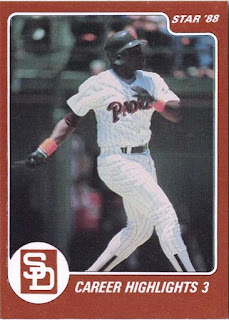
The final cards in the Star set to finish off this run-through.

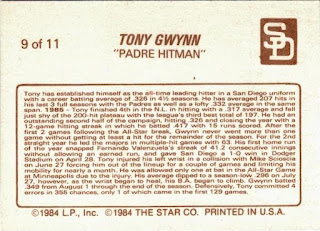
Card Number 851: Star Tony Gwynn "Padre Hitman", 1988; #9


This is the third 'career highlights' card, and the third with a huge amount of text on the back. This one has a brief intro then talks about what Tony did in the 1985 season.


That's a great stat in the final line - 4 errors in 355 fielding actions. No wonder he picked up five gold gloves in his career.

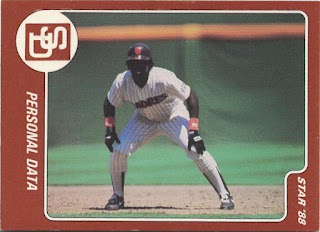
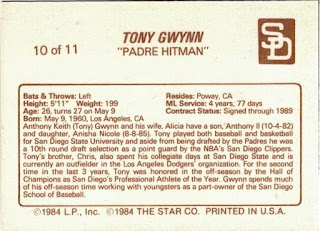
Card Number 852: Star Tony Gwynn "Padre Hitman", 1988; #10


Yet again, Star decided to use a landscape-oriented photo and did nothing about the orientation of the logo. To add to the quirkiness, this time they rotated the template the opposite way round to the way they rotated it on the other card with a landscape photo. 

The cardback is more about Tony as a person rather than summarising his career. 


There isn't much in there that is news to me, except for him being named San Diego Professional Athlete of the Year twice. Back when San Diego had NFL and NBA teams, there would be some competition for that.

And so, on to the final card in the set...

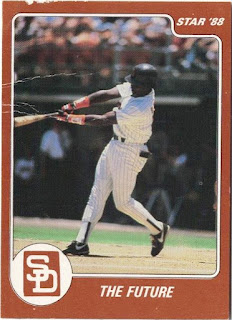
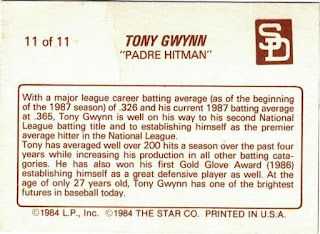
Card Number 853: Star Tony Gwynn "Padre Hitman", 1988; #11


This card is slightly damaged. Maybe one day I will replace it.

What did the future hold for Tony way back in, wait, hang on, part way through 1987?


I mean, that's what the first sentence implies when it talks about Tony's "current" average. This explains why the stats on his Major League Stats card only went up to 1986. So, this set from 1988, was put together in 1987, only included stats up to 1986, and had a copyright notice saying 1984. Gotta love an oddball set!

However, their comment about Tony having one of the brightest futures in baseball was prescient. While this set was being compiled, Tony was on his way to picking up his second batting title. He would, of course, go on to win many more!

Total: 853 cards


Sunday, September 19, 2021

One Card Only - Topps Tek

I occasionally mention the glut of parallels in the hobby currently. Okay, I mention it more than occasionally. But it's not a new phenomonon. Today's card is from perhaps the most overblown set ever produced in terms of the sheer number of parallels. 

It's well over the top. It's Topps Tek.

Card Number 736: Topps Tek (pattern 22), 1998; #23

There were 90 base cards in this card set which was printed on acetate, and each card was printed with 90 different 'patterns' on the acetate. That's 8,100 different cards, if anyone was committed enough to try and collect them all. But then there were also 'diffractor' versions of each pattern of each card as well - another 90 parallels of the 90s cards, and another 8,100 cards in the set! 

That set bloat might explain why there are only 1.1% of the images on Trading Card Database. This card wasn't pictured on there, so I have submitted it.


Compared to some of the other designs, this is a lot less snazzy. It's a ripple effect. 

Because it's acetate, they've flipped the image of Tony on the back to match the shape of his head and bat. We have yet another serious photo - hey, it's a card from 1998. That's what they did.

The cardback threw me a bit because it had milestones for Tony in 1999 and 2000. But this is definitely a card from 1998 - I have triple-checked! (Thank you, YoRicha, for uploading some pictures on to TCDb!) So I think those were Topps trying to predict when Tony would achieve the milestones. 

Tony reached 3000 hits in 1999, and hit his 500th double the same year. The target of 1,500 runs was aspirational, and Tony didn't manage to reach it in 2000, or at all. He finished his career on 1,383 at the end of the 2001 season. I guess two predictions from three isn't bad.

Getting a Topps Tek card for the collection had been one of my aims for a while. Collecting all 90 is very unlikely. 

Total: 736 cards

Saturday, September 18, 2021

Hall of Famer - 14 years early

In 2007 Tony Gwynn was elected to the National Baseball Hall of Fame in Cooperstown, New York, in the first year he was eligible for the ballot. However, two card companies made an early case for his election, fourteen years previously.

Card Number 734: Leaf Heading for the Hall insert, 1993; #2


I really like the logo for this insert series with the little road heading towards a line drawing of the Hall of Fame. There are some sparkles under his name as well. 

The back is outstanding. Leaf had fantastic cardbacks in their 1993 set and this insert series is no different. The combination of the picture of the National Baseball Museum that houses the Hall of Fame, a map of the area and a mocked up plaque shows some exceptional care from the designers.


Here's what the actual plaque looks like, of course!


On that map you can see Lake Otsuga. Nobody ever really mentions Lake Otsuga when they talk about Cooperstown. This is a photo of it that is also my desktop background so I see it every time I write blog posts!


My wife Cathy and I spent two nights in Cooperstown on our road trip in 2016. I would happily say that the day in Museum and Hall of Fame was one of the best days of my life so far. It probably makes the top 3! 

There was an exhibit in the museum about the player's strike in 1994 that cut the season short. That was the season when Tony was tantalisingly close to breaking .400. (Which is why this blog is called .394!)  That exhibit has one of Tony's shirts from the 1994 season in it.


I also met another very famous celebrity from San Diego!


Anyway,. that's enough about the wonderful experience of going to the National Museum and Hall of Fame. Let's get back to baseball cards. Pinnacle were also considering future contenders for Cooperstown back in 1993...

Card Number 735: Pinnacle Cooperstown Card insert, 1993; #20


One day I am going to count up how many cards I have of Tony in this pose, preparing to sprint to first base, with his discarded bat disappearing off the edge of the card.

There's no map on the back, just another photo in his familiar anticipatory batting stance. 


Pinnacle felt Tony was "well on his way to Cooperstown". He added another four batting titles before he finally got there. 

It feels like both these card companies recognised Tony's greatness well before he retired and was officially inducted into the Hall of Fame. That is a genuine indication of his ability and attitude at the height of his career.

Total: 735 cards