Showing posts with label Fuji. Show all posts

Wednesday, August 31, 2022

Blue DonRuss

Have you ever bought a complete set just to get one card? A couple of months ago, I did.


The 1990 set by DonRuss is one of those incredibly common junk wax sets that I quite like. I think it's the red borders. I have a few cards from it (which I blogged about in the very early days of this blog) but I hadn't seen blue versions of the cards before (even though Fuji had mentioned them in a comment on that post from the early days of this blog!) Some junk wax is harder to find, especially here in Wales.

But then this sealed factory set of the 'Best of the National League' turned up in the UK collectors group on Facebook. Adrian, the seller, had three of them. I had a think about it and then decided to take one off his hands. Mainly because when the player you collect is listed on the back, you kind of have to, right?


Opening up the box, there was an inner tray with three blocks of shrink-wrapped cards.


The 'puzzles' that are mentioned on the outside of the box were underneath the blocks of cards. Does anyone care about puzzles?


Anyway, I had to open all three shrink-wrapped blocks to find Tony's card, but here it is!

Card Number 1039: DonRuss Best of the National League, 1990; #11


It's not the greatest photo of Tony at the plate, but it's a close up cropped shot rather than the photos that were used on the cards in the regular set released by DonRuss that year. The photo clearly shows the Mimsbandz anti-drugs wristguards that Tony wore.

The back is a bit dull, but the yellow means they look very different to cards from the regular release. 


I have taken this card out of the set and put it in my binders. I have no plans for the rest of the cards. I know a few people who collect other players from that era, so I might send a few cards out. In the unlikely event that any regular readers want one (or more) of these cards, please let me know!

Total: 1039 cards


Sunday, February 27, 2022

One Card Only - cyber stats

A couple of days ago I read a post on Fuji's blog about these cards. Mine has been sitting in my 'to blog' pile for a while and Fuji's post made me realise that I could blog a card that is weirdly totally relevant to what is going on in baseball now.

As most fans know, currently there is an impasse between the franchise owners and the players. Spring Training has been cancelled and soon they will start cancelling games unless a compromise is found. There is a possibility of no baseball at all in 2022.

In 1994, a similar breakdown in relations meant the season was cut short. Tony was batting .394 at that point and it remains the highest batting average since the Second World War. But it was a shortened season and the unanswered question is - what would Tony have batted if the season had run to a full conclusion?

Tony was just 7 hits off .400 at the point where the season was cancelled. Could he have recovered that deficit in his remaining games?

In 1995 Topps produced a parallel that used a "computer" to predict what a player's totals would have been if the full season had been completed in the previous season. Topps called these parallels "cyber stats". The regular base card is blogged here.

Card Number 974: Topps Cyber Stats parallel, 1995; #228

These cards have different numbers to the base cards. Tony's base card in 1995 was #431. The front is shiny and this is an admittedly poor scan.


On the back is the "computer generated" stats, which predicted a drop off in the final 6 weeks of the season from .394 to .391. I dispute this but accept that the processing power available back in 1994-1995 was pretty low and this may have made sense within the parameters they were working with.


However, there are some additional aspects of Tony's batting in 1994 that need to be taken into account. These were brought to my attention initially by some Upper Deck SP cards

Firstly, if you take the last few games of the 1993 season, and add them to the games of the 1994 season to make a complete 162 games played, Tony batted .396 across those games. Now, this is a bit moot because Tony never actually batted a complete 162-game season. But he was hot at the end of the 1993 season and there is no reason to believe he wouldn't have been hot at the end of the 1994 season, had it happened. 

Secondly, if you look at Tony's performance across the 1994 season, he was getting stronger as the season went on. In the 30 games before the season was halted, Tony was hitting .433, dragging his average up considerably. If he had carried on batting at that rate for the remainder of the season he would have gone past .400 quite easily. 

I very much doubt the computer algorithm that Topps used to calculate Tony's potential scores took either of those factors into account. 

And another thing occurred to me about this card, and it supports my thesis that the social changes of the Nineties were seismic compared to previous decades. This was the beginning of the desktop computer era, where suddenly everything transitioned to computer-based working and the foundations were laid for the Internet and life online. 

This is reflected in baseball cards in a number of ways. Obviously one of the most noticeable changes is the impact on the design of baseball cards. But in this case, the impact of computers is on the content of the card. 

It's testament to a time where computers were rapidly becoming a normal part of life, so of course it would be a "computer generated" prediction of what would have happened - it almost had to be a "cyber stat" because cyber was the imminent future.

Total: 974 cards

Thursday, February 24, 2022

Some older Gold Label cards

I selected today's cards with Fuji and YoRicha in  mind, because they said they liked the Gold Label cards that I posted at the beginning of the week. All these cards are slightly pearlescent so I used the overhead scanner on them. The results are a bit flakey, but at least the design is visible. 

Card Number 968: Topps Gold label, 1998; #14

Awkward photo juxtaposition ahoy!


Seriously, that photo arrangement makes it look like Tony is kneecapping his larger self.

These 'cards' are printed on quite thick plasticky card - much thicker than usual card stock. The material they are printed on contributes to the sheen on the card. It also warps slightly. 

The candid photo on the back should have a thought bubble saying "Huh!?" next to it. 


Right, okay, back on Tuesday I questioned what Topps was doing by discounting the 1994 season and the .394 batting average that everyone associates with Tony on their modern Gold Label cards. Back in 1998, Topps didn't have an issue with Tony hitting .394 in a season that was shortened by strike action. Here they have it as his career best batting average. They also explain how they calculated the 'average season' using 'at bats' rather than the number of games. That makes more sense and just adds to my suspicion that the company's employees knew what they were doing back in the late 90s compared to the people working there now. 

I have one of the books mentioned in the factoid - Tony Gwynn's Total Baseball Player. One day I hope to get hold of The Art of Hitting as well. 

Card Number 969: Topps Gold Label Class 1, 1999; #6
Topps introduced the class system to the range in 1999 and the shine on the cards was even more iridescent.


That fielding photo looks really familiar, but I don't think it was on a Topps card.

On the back there is another cameo portrait of Tony with a quizzical expression. 


The factoid about Tony's loyalty doesn't mention that apparently other top players were annoyed with him for staying with the Padres because it was dragging down the market value of all the other players. (Did that really happen? Now it's all part of the mythos.)

For those taking notes, the career best batting average on this card is .394. Also, a bonus point for this card having the class number on the back (by the team logo) - which makes it a lot easier for people like me trying to work out which cardback is which!

Card Number 970: Topps Gold Label Class 2, 1999; #6
One of the photos has been changed on the front, along with the team logo behind Tony.


The cardback is virtually identical apart from the class number.


Card Number 971: Topps Gold Label Class 2, 2000; #11
In this year's set the class is printed on the front of the card, etched into the foil.


That photo on the back is from the photoshoot that Topps used on some of their tribute cards in the 2000 flagship set, except this time, Tony isn't looking straight down the camera lens.


So a couple of things about this cardback. Firstly, the important career batting average high point stat is correct! Secondly, a factoid about walks! This is a really rare topic for factoids, because although Tony drew a fair few walks (as is obvious by the factoid!), generally he made contact at the plate. Except when opponents opted not to pitch at all! 

I always love learning something new from a card - so kudos to Topps for this!

Total: 971 cards


Wednesday, December 8, 2021

Back to (Shiny) Base - Bowman's Best

Back in the 90s, Bowman was Topps's other, unassuming brand. But as sets proliferated and shiny cards became highly prized, Bowman's Best offered collectors with magpie tendencies another premium band to get their fix of shininess. (And if the base cards weren't shiny enough there were also parallel refractors to be had!)

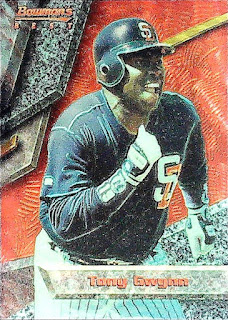
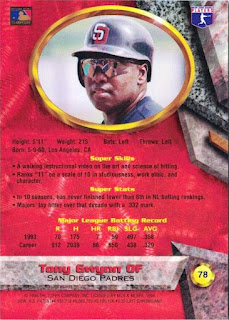
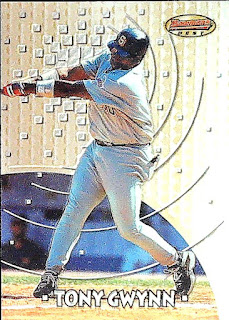
Card Number 864: Bowman's Best, 1994; #78


The red foil background on this card didn't scan very well, even using my overhead scanner. It's an aggressive looking photo of Tony. He looks cooler on the back.


Bowman cards are often a source of interesting cardback factoids. In tiny font this descriubes Tony as "A walking instructional video in the art and science of hitting." (That sounds a bit dull really.) Tony's other super skill is apparently that he "Ranks 11 on a scale of 10 in studiousness, work ethic and character." That makes him sound like Spinal Tap's special amplifier

If the "Special Skills" are a bit jokey, maybe the "Super Stats" will be better. The first one says that in the 10 preceding seasons he was never below 5th in the batting averages - that's a good stat. Then we have the arbitrary stat that in that 10-season selection his batting average was .332. That made him the top hitter in the Major Leagues, presumably among players who were also playing for those ten seasons.

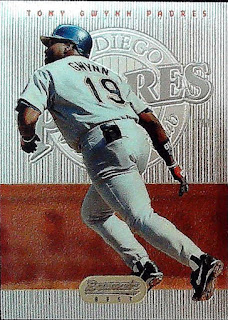
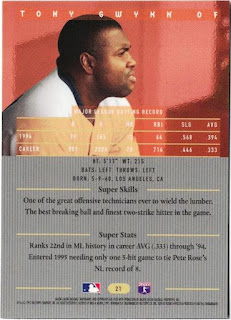
Card Number 865: Bowman's Best, 1995; #21


Shiny silver on the front. The card looks like it should be textured but it isn't.

Plenty of matt silver on the back as well.


The super skills and super stats are both more sensible and more readable. Tony went on to beat Pete Rose's record for five-hit games, finishing his career with nine 5-hit games in total. 


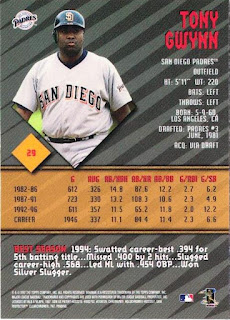
Card Number 866: Bowman's Best, 1997; #29


The swirls on this shiny card make it look like someone has added cartoon-style movement lines to Tony's swing. This is probably the most extreme example of bat-cropping in a card photo - practically the whole bat is out of the frame. There was an interesting cropping design choice for the photo on the back too.


The stats box separates Tony's career into five year chunks that really illustrates how his batting average improved as his career progressed. The most crucial stat in Tony's career is hidden in the account of his best ever season - he was just 2 hits off scoring .400 in the truncated 1994 season.

Annoyingly, I am missing Tony's Bowman's Best card from 1998. However, I have two from 1999 to make up for it.

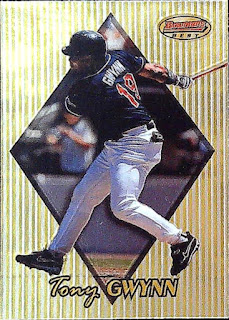
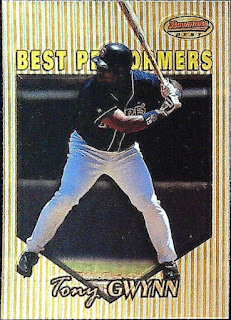
Card Number 867: Bowman's Best, 1999; #57


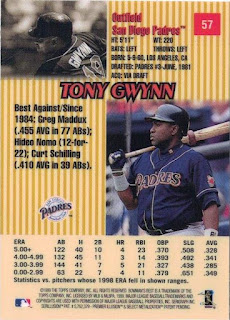
Super stripy golden shininess on the front. Lots of stripes on the back as well.


And look! In the second photo, there's a batting donut. Time to check out Fuji's list of Tony Gwynn cards featuring batting donuts aaaaaaaand..... this isn't on Fuji's list. There are two other Bowman cards there though. Whoever picked the photos for Bowman liked donuts. 

The factoid is about Tony's performance against certain pitchers. His best record was against Greg Maddux, who has been quoted as saying
“Sometimes hitters can pick up differences in spin. They can identify pitches if there are different release points or if a curveball starts with an upward hump as it leaves the pitcher’s hand. But if a pitcher can change speeds, every hitter is helpless, limited by human vision. Except for that f---ing Tony Gwynn.”

By the end of his career, Tony had faced Maddux 107 times. Maddux didn't strike him out once. 

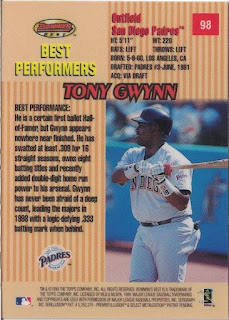
Tony had two cards in the 1999 set, appearing in the "Best Performers" subset as well. 

Card Number 868: Bowman's Best, 1999; #98


Stripy shininess again on the front. More stripes on the back and, wait, what's that? Another batting donut?


That's two pictures with donuts in the same set, with the pictures taken in different games judging by the uniforms. The picture lay-out guys at Bowman really loved their donuts!!

In the factoid, Bowman predicted Tony would be elected to the Hall of fame in his first year of eligibility. The prediction came true in 2007.

Total: 868 cards

Wednesday, February 17, 2021

Cameo blogger

A little diversion today, to redirect readers to a guest post I wrote for Baseball Fans Only. Dave from the UK Collectors Group on Facebook runs the blog and asked me to write something about collecting Tony Gwynn cards. You can read the post here (and see a picture of me looking a bit tired in the Hall of Fame!)

A couple of weeks back Fuji described a card I showed as a "cameo card" - that's when a player appears on another card that isn't really "theirs". The card in question was this card from the Topps 1989 set which features Tony sliding in to second base on the 'Pirates Leaders' card.


The year prior to this, Tony featured on the Padres Leaders card, alongside Benny Santiago. I'm not sure whether this is really a 'cameo', but it was listed on the checklist just as Padres Leaders and it doesn't have Tony or Benny named on the front.


This is another card that I have already blogged about, which arrived in a joblot of Tony Gwynn cards, but wasn't a Tony Gwynn card. He is high-fiving, and partially obscuring, his team-mate Greg Vaughn.


And here's another card that arrived in a similar lot of Tony Gwynn cards. Like on the first card in this post, he is sliding in to second base. This time it's Astros second baseman Bill Doran trying to avoid a Tony Gwynn slide. 


I admit I'm inconsistent with these cameo cards. The first two I count in the collection, the latter two I don't. I think if it has another player's name on the front then it can't really count as a Tony Gwynn card. 

I hope you enjoyed the cameos - sorry, no new cards today. If you want to see my cameo on Dave's blog, then here's the link again!


Wednesday, October 28, 2020

Examples of samples

It was Fuji who first alerted me to how much promotional work Tony Gwynn did with the Pacific Card Company, and how he was the subject of sample cards distributed to card shops. 

You can read Fuji's entertaining post here, and see his 10 Tony Gwynn sample cards. I didn't think I would ever get to own any myself. But then Gawain sourced me a mammoth stack of cards and there were two sample cards in there. One of them is even one that isn't in Fuji's blog post. Does that mean I have one that he doesn't have?

This is one I know he has:

Card Number 441: Pacific, 2000; #SAMPLE


See if you can spot how to tell it's a sample card.

As is ever the case with Pacific, nothing is simple. This is a sample of one version of Tony's base card. I blogged about the different version of this card on the anniversary of Tony's first hit in the big leagues, although I didn't note at the time that it was a variant version. 

Sadly, I don't have the regular numbered version of this version of this card, so that's one to try and add to the collection at some point.

Card Number 442: Pacific Omega, 1999; #SAMPLE
I didn't see this on Fuji's blog, although there were 4 other sample cards from 1999 in his post.


The silver foil panel has a sort of outline of Tony in as well.


Omega was one of Pacific's posher lines, although the cards look a lot like other Pacific cards. It has a very simple 'totals' stats box, and earns a bonus point for having the year in the set logo. That's always useful.

I also don't have the regular version of this card, so it's another one I will be keeping an eye out for.

Total: 442 cards

Saturday, September 19, 2020

A dip in the Pacific

I remember the first time I really saw the Pacific Ocean. It was on a beach the other side of Golden Gate Park in San Francisco a couple of days after we landed in California for a big holiday. Later we drove down Highway 1 all the way to San Diego with the ocean on our right hand side. 

It was much later that I learned that there was a trading card company called Pacific too. Starting out targeting Spanish speakers, it quickly expanded during the heyday of the baseball card hobby in the 1990s, issuing lots of different sets. At one point Tony Gwynn was doing lots of promotional work for the company. As a result, he ended up being on lots of sample cards (as outlined in this blog post by Fuji) and also featured in several sets, often multiple times. 

Today's dip in the Pacific takes us back to 1997, with three cards featuring Tony.

Card Number 358: Pacific, 1997; #424

This set is listed on Trading Card Database as Pacific Crown Collection, but as far as I can work out, that was just the full name of Pacific's flagship card range.

The front also has a big free advert for AT&T, looking a bit like the Death Star from Star Wars.


There's a lot of gold on the front, the entire top sixth of the card is foil. Pacific were very big on shiny foil cards for a couple of years, and rivaled Pinnacle for gaudiness

The back is bilingual, with the Spanish coming first and an English translation in smaller font. 

There's a nice addition to the list of descriptions I'm compiling on the back: "imagen deportivo de San Diego / San Diego sports icon". Having two languages on the cardback means there isn't much room for a stats box, so they include just the stats from the previous year and career totals. There is space for a portrait photo, in a frame that I think is unique on a baseball card.

Card Number 359: Pacific Prism Invincible, 1997; #144

Long before Panini Prizm cards, there were Pacific Prism cards. The 150 base cards in this set all had an acetate window featuring the player's portrait. The design of the card is peak 1990s.


The back is bilingual. As I've mentioned previously when I reviewed one of these cards in my first ever Monday Mixer, the acetate window means the player's image is flipped when looking at the reverse of the card. This is how Tony would have seen himself when he looked in a mirror. 


There isn't a stats box at all on the back, but the write up is all about Tony's stats to date. He's also lining up an outfield catch in the photo.

Card Number 360: Pacific Prism Invincible Gems of the Diamond, 1997; #GD-207

As a sign of how mad the baseball card hobby was in the 1990s, this "insert series" actually had 220 cards in it making it a larger set than the Prism base set.

There's a big gemstone shape with the Padres logo in it centred at the bottom of the card. Other companies had gold and diamonds, Pacific had gems.

The back describes Tony's achievements in the 1996 season in Spanish and English. The sparkle effect with the rays emanating from behind his head reminds me of religious iconography.


The portrait photo looks like it's from the same photoshoot as on the card in the Crown Collection flagship range. It certainly looks like Tony is wearing the same gear and there's a blurred building in the background on both cards.

I hope you enjoyed this dip in the Pacific!

Total: 360/394

Saturday, September 12, 2020

At the Zenith

I thought I'd discovered two different companies using the same name for a card set until I delved a bit into the murky world of baseball cards companies and found out that actually what I had got was a brand resurfacing under new ownership.

Zenith is the brand. In 1997, it was a set produced by Pinnacle.

Card Number 341: Pinnacle Zenith, 1997; #2


OK, this goes against everything Fuji likes in a photo. Only half the player is in the shot, and a good  portion of the bat is cropped off. In fact, it also ticks the boxes for my chief gripe about Topps cards - it doesn't show Tony's face or his name on the shirt. But if someone is going to produce a card that upsets both my and Fuji's aesthetic principles, what a card to do it! 

That is a ball flying towards him! You can see the muscles in his arm tensing ready to hit it.

Also, I can't think of another card in my collection that shows the little #19 on the back of Tony's helmet. That's just cool!

Then flip it over, and what have we here?


That's a hit location chart. Want to know where to sit to catch a Tony Gwynn home run? The answer is out behind right field. 66% of his home runs landed there. That sounds like good odds, but you'd have to be lucky, because he only hit three home runs all season!

I'm feeling a bit tired of stats boxes. This is a nifty graphic, although it's not so joyously colourful as the one on the Zenith card in 1995. It conveys data in a fun, different way. Twenty bonus points!

Pinnacle went bust the season after this set came out and their assets were bought by the Playoff company, owners of DonRuss. So when a Zenith set appeared in 2005, it was a DonRuss product.

Card Number 342: DonRuss Zenith, 2005; #234

This came out 3 years after Tony retired. The last 20 cards in the set were notable retired players, including the late Tom Seaver as a Cincinatti Reds player. 

It's an attractive card, and meets the Fuji aesthetic as none of Tony has been cropped off by the picture editor.

The back is mainly a summary and a one line stats box. Sadly there are no nifty graphics. 


Overall, it's a nice looking card. The cards produced by DonRuss while they were operated by Playoff and before they were absorbed into the Panini conglomerate are underrated in my opinion. In terms of quality and design they more than hold their own. To date the Zenith brand hasn't reappeared since 2005. If it does, I hope they adopt the data representation approach of the original Pinnacle Zenith cardbacks.

Total: 342/394