Showing posts with label 1999. Show all posts

Tuesday, August 30, 2022

Tuesday Twins from Upper Deck sets

Card Number 1037: Upper Deck Victory, 1999; #339

This is one of those cards where I had the parallel a long time before I acquired the base version. In fact, when I blogged the parallel version I bemoaned the fact I didn't have the base card!


Personally, I feel that is almost a perfect baseball card. I like posed photos where you can actually see what a player looks like. The simple framing and unobtrusive logo give this a high class, timeless feel. 

The cardback is also elegantly laid out, with a bit about the Qualcomm Stadium (as Jack Murphy Stadium was known in 1999) and a bit about Tony. The truncated stats box is fine when there is so much other detail to include. 

The prediction that Tony would reach 3,000 hits in 1999 proved true. The idea that he might reach 3,500 hits turned out to be optimistic. However, it does show how well Tony was hitting in the tail end of the 90s that it was considered a possibility, however remote. 

Card Number 1038: Upper Deck SP 'Superbafoil', 1995; #105

As if SP cards weren't difficult enough to scan anyway, here is the shiny 'superbafoil' version. Unlike the dark blue foil triangle on the regular SP card, this card has a triangle that looks silvery in real life but scans in a fractal ice-blue colour.


A bonus of showing this parallel card is showing the fistbump photo on the back again.


Looking through the roster of the 1994 team, I think the player fistbumping Tony is Bip Roberts. That's a deduction I've based on the mystery fistbumper's complexion,  jawline and ear. Bip was a second baseman so would be reasonably close to Tony when he was in the outfield. If only he had a number on his wristband like Tony did!

I'd be interested to hear what readers think about this. Is it a Bip-Bump? Or could it be someone else? Make your suggestions in the comments!

Total: 1038 cards

Friday, August 26, 2022

Another royal title

DonRuss repeatedly honoured Tony as a Diamond King during the 80s and 90s but Fleer crowned him as a different kind of king in 1999.

Card Number 1033: Fleer Ultra, 1999; #13RK


The spectacular design on the front of this insert card masks the complete lack of logos or identifying features on the picture. Like the Leaf Legacy card I blogged yesterday, this could be a card from the era of unlicensed cards if it wasn't for the full team name included at the bottom. 

The photo of Tony on the back was taken in that brief window when he experimented with a beard in the late 90s. 


The shadow that has been added to the photo is weird and unnecessary - nobody would think Tony is actually standing in front of a big swirly mandala thing.

As noted in the write up, Tony had taken the lead in the Padres all-time franchise stats for RBI by the end of the 1998 season. He is still the Padres all time RBI leader with a career total of 1,138. (He is also the all-time Padres leader in walks with 790, which I didn't know until I looked up the RBI stat!)

Additional bonus point for this card doing what Fleer always did on their late 20th / early 21st century cards and include the year of issue under the logo. 

Total: 1033 cards

Wednesday, August 24, 2022

Back to base: SP in the late 90s

A short run of base cards from the Upper Deck SP ranges. These days "SP" means "Short print". I've previously tried to discover what 'SP' meant when Upper Deck was using it, but haven't had any joy. The cards were a premium range for Upper Deck, which means some are printed on foil board... on both sides! That's fancy, and annoying to scan. 

Anyway, enough preamble, let's get back to base!

Card Number 1029: Upper Deck SP, 1996; #160

This is one of the cards that's printed on foilboard on both sides, so I had to use the overhead scanner twice for it. There's also double photo use on the front, although the head and shoulders photo is placed oddly in line with Tony's backside in the main photo.


The foilboard on the back gives the plastic coated outfield wall in the background an authentic sheen.


The write up amusingly describes Tony's sequence of batting title wins as a "habit". That's some habit!

Card Number 1030: Upper Deck SP, 1997; #155

This card has a shiny front and a matt back. The rather odd silver wedge on the left hand side gives this card an odd vibe. For some reason it reminds of the sets that card companies put out aiming at kids, like Triple Play or Fun Pack


This set has the head and shoulders photo on the back. It's a really good photo that has appeared on some other cards - like one of the Collector's Choice cards in this post.


The description is less amusing than the previous year, almost mundane in comparison.

Card Number 1031: Upper Deck SPx, 1999; #44

There were several different 'SP' sets in 1999, including SP Authentic, which was the new name for the main SP set. SPx was another range in the SP stable, with the first sets including holograms as chase cards  although there weren't any in the 1999 set.

This base card has a big embossed foil panel on it. And a design that reminds me of Meccano.


Having two photos on the back is less impressive when one of them is the same one that appeared on the front of the card, and is being used like a watermark.


This time it's the batting average above .300 that's "routine". Tony's run of batting titles had come to an end in 1998. But he did get to play in the World Series, and, as the card notes, he passed the 1000 mark for runs batted in. 

Total: 1031 cards

Thursday, March 31, 2022

Celebrating the Upper Dec(k)ade

To celebrate their tenth anniversary, Upper Deck released some special baseball cards that have one of my favourite things on the back - pictures of other baseball cards!

Card Number 990: Upper Deck 10th Anniversary Preview, 1998; #55

These shiny inserts appeared in the 1998 Upper Deck flagship set. Design-wise, they ape the design of Upper Deck's first set released in 1989.


On the back is a write-up about what a great batter Tony is, linked to a card that Upper Deck released in 1992, which was notable for being the first Upper Deck insert card with a full-bleed photo design. 

The card was in an insert series supposedly curated by Ted Williams - I blogged about it here.

Card Number 991: Upper Deck 10th Anniversary Team (Double), 1999; #X8

I received this card back in January from Riley in Nashville - thanks Riley! The X in the card numbering is the Roman Numeral for 10!

This insert series featured players who were active during the Upper Deck era, and the team selection was made through a popular ballot.

Upper Deck produced four different versions of their 10th Anniversary Team insert cards - there was a regular version, this version that was called a 'double' and numbered to 4,000, a 'triple' version numbered to 100 and a 'home run' version that had a print run of 1! All the versions are numbered X8 and it's only the serial numbering that really differentiates this from the vanilla version. The triples have silver foil stamps on the front. There are no reference pictures on Trading Card Database, but I imagine the home run versions had gold stamps on the front.


On the back is one of my favourite Upper Deck cards, featuring Tony fishing!


I blogged about that card showing Tony fishing way back in August 2020! The serial number is big and bold. I can't think of a meaningful link between Tony and the number 497.

Upper Deck had a hobby-changing impact when the first cards landed in 1989. I've written a bit about how the "UD asteroid" wiped out the cardboard dinosaurs that had ruled the hobby in the 1980s. By the end of the 1990s, the other card companies were no longer playing catch up. Almost all of Upper Deck's innovations became standard across the industry - from foil stamps, to parallels, to relic cards, to autographed cards inserted in packs. Even now, a couple of decades later, it feels really fitting to celebrate the decade of innovation that Upper Deck brought to the world of baseball cards. 

Total: 991 cards


Tuesday, March 29, 2022

Tuesday Twins - some cards we've seen before

As is customary for Tuesdays, here are some "twins" - cards that look a lot like other cards in the collection.

Let's start off with a card where Topps made the kind of mistakes the market-leading brand shouldn't be making.

Card Number 986: Topps Update, 2016; #3000H-12

Previously seen as the shiny Chrome version.


When I blogged about the Chrome version of this card I noted there were two mistakes on this cardback. See if you can spot them (or remember them!) - check your answers here.


Card Number 987: Topps Chrome, 1999; #LD12

I have no idea why Topps would bother reproducing shiny inserts in their Chrome sets, but back in the late 90s they did.

I scanned the front on a black background, which really shows up the pointy die-cut at the top of this card.


But I scanned the back on a white background because I used the flatbed for the back.


As noted when I blogged the vanilla flagship version of this card, the copyright year says 1998, but this was released in 1999.

There is another version of this card as well - Topps put refractors in their Chrome sets so maybe one day this twin will turn into a triplet. 

Card number 988: Topps, 1997; #SB-1

Another shiny insert card previously seen as an unnecessary Chrome version.


Compared to the front, the back is under-stated. The photo is another example of Topps excelling at logoless cards despite being fully licensed. 

There isn't much more to add about this selection of twins, except to point out how chroming some cards is pointless when they are already super-shiny foil. 

Total: 988 cards

Thursday, February 24, 2022

Some older Gold Label cards

I selected today's cards with Fuji and YoRicha in  mind, because they said they liked the Gold Label cards that I posted at the beginning of the week. All these cards are slightly pearlescent so I used the overhead scanner on them. The results are a bit flakey, but at least the design is visible. 

Card Number 968: Topps Gold label, 1998; #14

Awkward photo juxtaposition ahoy!


Seriously, that photo arrangement makes it look like Tony is kneecapping his larger self.

These 'cards' are printed on quite thick plasticky card - much thicker than usual card stock. The material they are printed on contributes to the sheen on the card. It also warps slightly. 

The candid photo on the back should have a thought bubble saying "Huh!?" next to it. 


Right, okay, back on Tuesday I questioned what Topps was doing by discounting the 1994 season and the .394 batting average that everyone associates with Tony on their modern Gold Label cards. Back in 1998, Topps didn't have an issue with Tony hitting .394 in a season that was shortened by strike action. Here they have it as his career best batting average. They also explain how they calculated the 'average season' using 'at bats' rather than the number of games. That makes more sense and just adds to my suspicion that the company's employees knew what they were doing back in the late 90s compared to the people working there now. 

I have one of the books mentioned in the factoid - Tony Gwynn's Total Baseball Player. One day I hope to get hold of The Art of Hitting as well. 

Card Number 969: Topps Gold Label Class 1, 1999; #6
Topps introduced the class system to the range in 1999 and the shine on the cards was even more iridescent.


That fielding photo looks really familiar, but I don't think it was on a Topps card.

On the back there is another cameo portrait of Tony with a quizzical expression. 


The factoid about Tony's loyalty doesn't mention that apparently other top players were annoyed with him for staying with the Padres because it was dragging down the market value of all the other players. (Did that really happen? Now it's all part of the mythos.)

For those taking notes, the career best batting average on this card is .394. Also, a bonus point for this card having the class number on the back (by the team logo) - which makes it a lot easier for people like me trying to work out which cardback is which!

Card Number 970: Topps Gold Label Class 2, 1999; #6
One of the photos has been changed on the front, along with the team logo behind Tony.


The cardback is virtually identical apart from the class number.


Card Number 971: Topps Gold Label Class 2, 2000; #11
In this year's set the class is printed on the front of the card, etched into the foil.


That photo on the back is from the photoshoot that Topps used on some of their tribute cards in the 2000 flagship set, except this time, Tony isn't looking straight down the camera lens.


So a couple of things about this cardback. Firstly, the important career batting average high point stat is correct! Secondly, a factoid about walks! This is a really rare topic for factoids, because although Tony drew a fair few walks (as is obvious by the factoid!), generally he made contact at the plate. Except when opponents opted not to pitch at all! 

I always love learning something new from a card - so kudos to Topps for this!

Total: 971 cards


Friday, February 18, 2022

Finishing Fleer Fortnight in a Traditional way

Fleer Tradition was the company's retro range at the tail end of the 90s and across the cusp of the millennium. It sometimes combined a mix of fairly ordinary looking cards with vintage style parallels and sometimes just went for a full set of full-on retro designs. Some sets also had some well-designed subsets and insert sets. One of my favourite Tony Gwynn cards ever is a Fleer Tradition insert that I blogged about in my first month of blogging.

Card Number 954: Fleer Tradition, 1998; #250

An unusual - and fantastic! - photo on the front of this base card. Tony has a pen in his hand so he was presumably turning that shirt into an autographed shirt!

The use of the shirt for the backdrop on the cardback is very effective. I've not seen it done on many (if any) cards. It seems like the sort of design technique that should appear frequently because it's such a simple yet impactful idea. 

There is lots more colour in the stats box than is usually applied on a card, whihc makes it easier to read than the usual rows of tiny numbers. Plenty of thought went into the design of this card.

Card Number 955: Fleer Tradition, 1998; #315

There were 10 "Golden Memories" cards in the middle of the 600 card Fleer Tradition set in 1998. It's a shiny card that looks really special but is actually 'just' a base card. Trading Card Database has a note that these cards were inserted at a ratio of 1 in 6 packs, which probably makes them more common than regular base cards.

The back has a flamboyant cameo frame and a factoid about how Tony scored 4 hits in 5 at bats against Greg Maddux in a game in 1997. 

Greg famously reckoned Tony was the only player it was impossible to strike out. It's always worth a re-quote.

“Sometimes hitters can pick up differences in spin. They can identify pitches if there are different release points or if a curveball starts with an upward hump as it leaves the pitcher’s hand. 
But if a pitcher can change speeds, every hitter is helpless, limited by human vision. 
Except for that f---ing Tony Gwynn.”

Card Number 956: Fleer Tradition Update, 1999; #U-145

Fleer Tradition was so popular in the late 90s is merited an update series, which included some season highlights from that year.


I doubt any regular readers don't know that the 6th August 1999 was the date of Tony's 3000th hit. This is one of the first cards released commemorating it. 


What is really strange is that Tony was the first player in 20 years to reach the 3,000 hit mark. The next player to reach 3,000 hits was Wade Boggs on the 7th August 1999. The day after Tony reached that milestone!

Card Number 957: Fleer Tradition Dividends insert, 2000; #9

Sometimes when an insert series has an odd name like 'Dividends', I just assume it's because baseball companies were running out of words...


Red borders always make a card look good. However, the offset nature of the black and white photo is a little jarring.

The same photo appears on the back, except it's rendered in sepia.

Although the write up implies hits were inevitable when Tony made a plate appearance, they were relatively rare in the 2000 season because Tony made comparatively few plate appearances - just 140 compared to 446 in 1999.

Total: 957 cards


Thursday, February 17, 2022

Flying high with Skybox

Skybox and Fleer were merged together when Marvel acquired both companies and then stayed together after Marvel went bankrupt and sold off their trading card companies as a going concern. (That sentence is proof, if any were needed, that the 90s was a different time. Imagine Marvel going bankrupt now!) 

Anyway, as part of the Fleer family, it's fitting that some Skybox cards are squeezed into Fabulous Fleer Fortnight.

Card Number 951: Skybox Supernatural, 1999; #141

This has a metal sheen to it similar to the Skybox Metal Universe cards. It makes it a rascal to scan.


The awkward poise in the photo, combined with the finish and the colouration of this card, make me feel slightly uncomfortable. Tony is running, but it looks like he is jumping. His bat is flying off the card. It's all angular and weird, mainly because of the graphic design choices. 

The back is remarkably restrained for a Skybox card. An unfussy picture and a big stats box. The curves on the stats box are unusual.


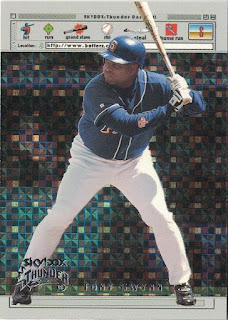
Card Number 952: Skybox Thunder www.Batterz.com, 1999; #4

That web address is part of the name of this 10-card insert series insert series from Skybox Thunder. It's all fancy and cyberspacey because it was 1999 and the Internet was going to change the world! In case you think I'm joking, look there is a vintage web page header on the card front!


On the back we get a pure trademark Skybox weird cardback write-up that kicks off with plagiarising 'Ghetto Superstar' by Pras. 


There is also another reference to 'Death, taxes and Tony Gwynn batting over .300' being the only certainties in life! This one predates the Fleer Focus card from 2000 that I blogged about a couple of days ago. Not content with plagiarising popular songs, Fleer also reused their own weird descriptions!

One day, when I run out of new cards to blog I am going to do a 'Best of Skybox Weird Write-ups' post. I promise. (Remind me of this and hold me to my promise!

That batterz.com web address is long dead by the way. But continuing on the Internet theme...

Card Number 953: Skybox E-ticket, 2000; #9

Back in 2000 just about every word had an "e" attached to make it internetty. Also, check out the hand cursor icon. 


On the back is a slightly more restrained write up. There is also another long-dead website that a keen fan could surf to and look at more photos. How many more photos? It feels to me that if Fleer had lots of photos they wouldn't have used the same photo on the front as they did on the back. That pixellation effect doesn't fool me!


I love these late 90s nostalgic reminders of the innocent days of the Internet when it was all shiny and exciting and the thought of seeing more photos would persuade people to type a web address into their computer. Who would have predicted it would have ended up where we are now?

Total: 953 cards

Friday, February 11, 2022

Friday Flair in Fleer Fortnight

Flair was Fleer's high brow range of cards for much of the 90s. I've accumulated a few in the collection and here are some that haven't appeared on the blog previously.

When I previously blogged about Flair cards, I posted the card from 1993 and the card from 1995, but didn't have the card from 1994. So, let's set that right.

Card Number 938: Fleer Flair, 1994; #436

This card is everything you might expect from a premium card in the mid-90s. Full bleed picture, gold foil tints, elaborate swirly fonts. It's also everything you would expect from a Fleer card in the mid-90s. Confusing juxtaposition of photos, cropped off feet...


There is a full photo background on the back, with a Topps-esque shot half showing Tony's face and with his butt pointing towards the camera! However, it is unusual to have an action shot with Tony wearing his trademark wraparound shades.

For the first few years that Fleer produced Flair, they were relatively uncomplicated sets. Then towards the end of the 90s they started getting more complex, with parallels, rebrands and strange numbering systems.

Card Number 939 Fleer Flair Gold version, 1996; #174

In 1996, every Flair base card came in either a silver version or a gold version. The silver versions had gold lettering, and the gold versions has silver lettering. The cards were all shiny, using the Fleer 'etched foil' approach that gave the cards a gritty sort of surface feel. 

As with other Flair sets, this card has a composited image of pictures of Tony on the front.


Despite the abundant use of photoshop on the card, the designers left the grass stain on Tony's knee. 

There are two photos on the back as well, and a huge stats box.


After 1996, Flair was rebranded as Flair Showcase. That was when things started to get weird with the brand. In 1998 Flair Showcase was released as a 'tiered product' with four different versions of each card released, numbered from Row 3 to Row 0, with 3 being the most common and 0 the most scarce. Furthermore, each row was divided into 30-card sections, which were also of unequal scarcity. It's all very complicated. Even Baseballcardpedia has difficulty explaining it.

Card Number 940: Fleer Flair Showcase (Flair), 1998; #Section 2 Row 3, Seat 19

I'm going to count this as a #19 card! Row 3 means it was the most common version of Tony's cards in the set.

This was a really difficult card to scan. This was captured using my overhead scanner and is slightly over-exposed.The line on it is in the etched foil coating.


At least when they made an unnecessarily complicated set, Fleer had the decency to add the word 'Flair' under the set name so collectors could instantly tell which bit of the set the card was from. Although, they could have been more original and used a different word than Flair, which was the brand!

The cardback looks a bit, well, creepy, to be honest. It's the combination of the colours and Tony's hyper-focussed facial expression.


The word 'showtime' on the back indicates which subsection this card is from. "Flair Showtime Flair Showtime" are the most commonly occuring cards in the set. You were more likely to get more than one of these cards in a packet than none at all (if I've worked out the ratios on Baseballcardpedia correctly).

Card Number 941: Fleer Flair Showcase (Style), 1998; #Section 2, Row 2, Seat 19

Another #19 card. Or the same one? These 'Row 2' cards were the second most common cards in the set.


This card looks better. There is a big 'e' on the red advertising hoarding behind Tony. It looks really familiar but I don't think it's the e in Budweiser. It might be the e from the word Coke. 

It's the same photo on the back. The entire background has been wiped but because the whole picture hasn't been tinted blue, it's less freaky looking. 


This card is in the Showstopper division of row 2 cards. Again, that makes it one of the most common of the Row 2 cards, with these cards appearing at a rate of 1 every 2 packs.

I don't have the rarer Flair Showcase cards from 1998. But Flair continued their weird numbering system the following year, although there were only 3 rows. (They dispensed with row 0.) They also dropped the number of subdivisions across each row down to 3. The reduction in complexity may be an indicator the range was having problems so it's no surprise that Flair went on hiatus after the 1999 set before being brought back in 2002 for a new run.

Card Number 942: Fleer Flair Showcase (Power), 1999; #Row 3, Seat 9

The 'power' cards are the most common version of the card - this is in the 'Showtime' subdivision, which was the most common subdivision, making it one of the most common cards in the set overall. 


Fleer seemed to like having a picture of Tony running towards the camera on the cardback as they used a picture of him like that for the second year running. 


The green bar for the factoid is very prominent. It's a good factoid too, retelling the story of Tony's draft day when he was also offered a place with the Clippers in the NBA.

That's all the flair I have available to blog at the moment. At some point I will have to go a-hunting for rare flair to share.

Total: 942 cards