Showing posts with label numbered cards. Show all posts

Thursday, March 31, 2022

Celebrating the Upper Dec(k)ade

To celebrate their tenth anniversary, Upper Deck released some special baseball cards that have one of my favourite things on the back - pictures of other baseball cards!

Card Number 990: Upper Deck 10th Anniversary Preview, 1998; #55

These shiny inserts appeared in the 1998 Upper Deck flagship set. Design-wise, they ape the design of Upper Deck's first set released in 1989.


On the back is a write-up about what a great batter Tony is, linked to a card that Upper Deck released in 1992, which was notable for being the first Upper Deck insert card with a full-bleed photo design. 

The card was in an insert series supposedly curated by Ted Williams - I blogged about it here.

Card Number 991: Upper Deck 10th Anniversary Team (Double), 1999; #X8

I received this card back in January from Riley in Nashville - thanks Riley! The X in the card numbering is the Roman Numeral for 10!

This insert series featured players who were active during the Upper Deck era, and the team selection was made through a popular ballot.

Upper Deck produced four different versions of their 10th Anniversary Team insert cards - there was a regular version, this version that was called a 'double' and numbered to 4,000, a 'triple' version numbered to 100 and a 'home run' version that had a print run of 1! All the versions are numbered X8 and it's only the serial numbering that really differentiates this from the vanilla version. The triples have silver foil stamps on the front. There are no reference pictures on Trading Card Database, but I imagine the home run versions had gold stamps on the front.


On the back is one of my favourite Upper Deck cards, featuring Tony fishing!


I blogged about that card showing Tony fishing way back in August 2020! The serial number is big and bold. I can't think of a meaningful link between Tony and the number 497.

Upper Deck had a hobby-changing impact when the first cards landed in 1989. I've written a bit about how the "UD asteroid" wiped out the cardboard dinosaurs that had ruled the hobby in the 1980s. By the end of the 1990s, the other card companies were no longer playing catch up. Almost all of Upper Deck's innovations became standard across the industry - from foil stamps, to parallels, to relic cards, to autographed cards inserted in packs. Even now, a couple of decades later, it feels really fitting to celebrate the decade of innovation that Upper Deck brought to the world of baseball cards. 

Total: 991 cards


Wednesday, March 2, 2022

Going Elite!

Shiny cards that don't scan as good as they look in hand! Welcome to the world of Elite cards by DonRuss...

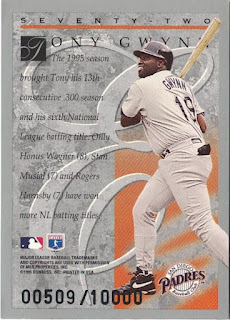
Card Number 980: DonRuss Elite, 1996; #72

There were 12 of these inserts in the DonRuss flagship set numbered from 60 to 72. These numbers followed on from previous 12-card sets since the first set of Elite cards in the 1991 set. Elite were reasonably rare, with 1 card in every 75 packs in series 1 and 1 in every 40 packs in series 2 of DonRuss cards. But card #72 only appeared in series 2. 

It's not very visible on the scan, but this card has a shiny border all around the card. Tony is jogging the bases in the photo with an apocalyptic mid-90s sky behind him.


A couple of things of note on the card back. Firstly, the card number is written out in full, 15 years before Topps started doing that sort of nonsense on Allen & Ginter cards. (But even Topps don't write out the card number in full!)

Secondly, these cards were numbered out of 10,000. There's always something a bit special about a numbered card, even when it's a five digit limited run. This particular one is #509 - I can't think of anything particularly special about that number. 


Card Number 981: DonRuss Elite, 1998; #9
by 1998, DonRuss was issuing 'Elite' as a standalone high end set of 150 shiny cards. This card is so shiny it was a real rascal to scan. 


Despite the shininess, and the price tag on packs to match, this is quite a boring card. The back isn't much better. I ding points for partial stats boxes. Ding!


Card Number 982: DonRuss Elite, 2001; #24
Another shiny card that doesn't scan to it's full potential.


The font for Tony's name and the title on the stats box has to be one of the schmanciest serif fonts ever used on a baseball card. It's pure font luxury.


This was from Tony's final season where he was probably an onlooker from the bench more often than he would have liked - so that's a fitting photo on the cardback there. 

Total: 982 cards

Thursday, September 16, 2021

Reach for the Stars

I'm running out of useable headlines about stars...

Card Number 730: Topps Stars, 1998; #75

All the base cards in this set were serially numbered to 9,799. I have previously blogged the silver parallel, which was serially numbered to just 4,399.


I really like this card design because it has actual stars in the background. 

Tony looks solemn, and dare I say it, even a little bit grumpy, in the photo on the cardback.


This is card number 1,168 of 9,799. I can't really think of anything significant linked to 1,168. If you want the answer to the quiz question, that got answered in the comments on the post about the silver parallel!


Card Number 731: Topps Stars, 2000; #170

Tony had two cards in this release - a regular one and this set from a series towards the end of the set. He's in the spotlight, and casting a large golden shadow.


The cardback sets off the BATTING DONUT KLAXON! Fuji has already included this card in his 'dozen doughnuts' post of Tony Gwynn cards. I am gradually collecting all the ones on that list.


The write up on the cardback is a succint summary of Tony's career up to the end of 1999. He barely played in the 2000 season and didn't really improve on any of these numbers in his final couple of seasons.

Total: 731 cards

Monday, February 15, 2021

A duo of mid-90s Diamond Kings

Here are two DonRuss Diamond Kings cards from the 90s. They are both numbered out of 10,000. When people complain about overproduction in the current hobby, ask them if any card companies bother serial numbering cards into five digits! How many regular cards were printed that 10,000 was regarded as low?

Card Number 586: DonRuss Diamond Kings, 1996; #DK-9


There's a little bit of damage on the gold border of this card.The 'gold' seems to be overprinted on the card rather than embossed foil. 

The artist is Dick Perez, who painted the portraits for DonRuss's Diamond Kings range from 1982 to 1996. There is a full gallery of his Diamond Kings portraits on his website. He had produced portraits of Tony before, in 1985, 1989, and 1994. It's to his credit that they are all look quite different.

The write-up on the back is a contender for most words squeezed onto a cardback ever. I counted 113 words (not including numbers) in this paragraph.

This was the 8,950th card in the sequence. I can't think of a statistical tie-in to that number. The copyright year is 1995, but this was definitely part of the DonRuss 1996 set.

Card Number 587: DonRuss Diamond Kings, 1998; #4


This card had a very different look, with a silver foil edging to the frame. There isn't an indication who the artist is, apart from what looks like the initials 'BG' or 'DG' - it's hard to tell.


I've googled it, but am none the wiser. The DonRuss brand was changing hands with frightening regularity around this point. In 1998, it was owned by Pinnacle but they went bust that year. Unlike Dick Perez, whoever drew this card hasn't got an easily findable online gallery of their work. If Pinnacle ever put the details online that would be long-gone now.

The back is more restrained in terms of word volume. It's still one of the bigger blurbs on a card back.


At 1,927, the serial number is 7,023 lower than the card from 1996. Again this is a card with a copyright date a year out from when the set was released.

And as a little bonus, here's a timeline of Tony's Diamond Kings appearances from 1989 to 2005. (I have yet to acquire his 1985 and 1994 cards!)


Total: 587 cards

Friday, January 8, 2021

Serially printed Stars

This card was in an eBay purchase. It was only when it arrived that I discovered it was serially numbered.

Card Number 569: Topps Stars (Silver Parallel), 1998; #75

The difference between this and the regular card is that Tony's name is printed in silver instead of red. The silver parallels were issued sequentially numbered to 4,399. The regular, red-letter versions were also all sequentially numbered to 9,799. There were bronze parallels also numbered to 9,799 and gold parallels that were only numbered to 2,299, and the rarest of all, "Gold Rainbows" numbered at just 99 of each card. So basically, five cards with the names in different colours. 


I really like the use of actual stars in the background of this card. That's an idea for a future blog post - cards that feature stars.

The back has an unflattering picture of Tony. His weight went up considerably at one point in the 90s and he seems to be carrying quite a bit in this photo, unfortunately.  


This card has the sequential number 4,202. Nothing particularly springs to mind as significant about that number. 

The cardback also gives aspects of his game star ratings. Whenever this sort of rating system is applied, I always wonder what they are basing it on. I doubt there are objective standards of comparison for each of these. Clearly he was a five-star hitter. The others are all more subjective. 

Unfortunately, I don't have card #76 to answer the quiz question. So, does anyone know which player hit more than 20 home runs in a season and scored more home runs than times they struck out?

Total: 569 cards

Tuesday, November 3, 2020

Hit Machine 3000 part deux

At the very start of September I blogged about receiving some cards in a giveaway from Jeff at Wax Pack Wonders. It included a numbered card from an insert series that Pacific released to celebrate Tony achieving his 3000th hit in the game.

I recently watched Tony's speech from his induction into the National Baseball Hall of Fame and he talked about how when he scored his 2000th hit his former team-mate Jerald Clark was on first base for their opponents, the Colorado Rockies. He said he remembered saying to Jerald, "I need to get another thousand hits." Six years to the day later, he snagged his 3000th.

The Pacific insert series was called Hit Machine 3000, which is such a turn-of-the-Millennium phrase it's almost comical. 

I said in my blog-post about Jeff's generosity that "It might not be easy tracking any more of these down." Then, strangely, two cards appeared from that set on eBay from a UK-based seller. I thought they were a bit over-priced at first and I watched them as they cycled through their first auction period. They got relisted at a slightly lower price and I rewatched them again. Then, 24 hours before the auction ended the seller made an offer to everyone watching, and I decided to buy them. 

Card Number 454: Pacific Omega Hit Machine 3000, 1999; #8

Pacific declared Tony an American Hero on this card. The picture would be slightly over the top, without the fireworks!


This is card number 482 in the 3000 print run. Perhaps I should have kept this for a few blog posts' time and it could have been card number 482 on this blog too!

The back shows Tony in a more natural pose - one of the back rooms in the stadium. There aren't many 'behind the scenes' photos on baseball cards. 


Card Number 455: Pacific Omega Hit Machine 3000, 1999; #9

On the 9th card in the insert series, Tony was described as a 'Fan Favorite'.

Although it a posed photo like the previous card, Tony looks much happier here than he looked when he was draped in the American flag. This card is numbered 681 / 3000.

On the back we have a photo of him signing autographs. One of my favourite kinds of photos of Tony 'in action'.


On the back it mentions Tony's humanitarian award in 1995 and also his charitable foundation. There is a moment in his Hall of Fame speech when he mentions the community service team at the Padres and just says, "We've done a lot of good work, haven't we?" That outward focus and care for others is part of Tony's lasting legacy.

Total: 455 cards.

Monday, August 31, 2020

Modern Monday - two from Topps

It's a bank holiday. Here are two cards from 2020 for you to enjoy today.

Card Number 310: Topps Decade of Dominance insert, 2020; #DOD-11

Dean from the Baseball Cards UK group on Facebook busted lots of Topps Flagship and sent me this.

It's a nice die-cut X.


Tony earns his place in the 1990s pantheon as a dominant batter because he rarely struck out at the plate. How rarely I hear you ask...

One in every 26.5 at bats, according to the cardback. Given that Tony would usually make around 5 plate appearances each game, that would mean you would only see him strike out one game in six. 

Card Number 311: Topps Decades Best insert, 2020; #DB-56 (#d Gold Parallel)

This was a whimsical purchase on eBay.

I didn't actually clock this was a gold parallel version of the card until it arrived. It has a slight gold sheen to it.


The way Topps have written 1990s in the coloured blocks there is probably the best bit of design in a Topps flagship product in the last five years. I'm happy to be corrected on that point, but I can't remember seeing anything else that was so bang on. It just screams "Now That's What I Call Music" albums from the start of the decade. (These were compilation albums released in the UK that featured chart-topping singles released over six months or so - everyone I knew had at least one "Now album" back when I was a teenager.)

There's a succinct summary of Tony's career in the 90s on the back. Note how his batting average for the decade was higher than for the previous decade.

You can also see there that this card is numbered out of 50. I doubt the person selling it realised it was a short print parallel because it didn't me cost very much. I like numbered cards so the numbering counteracts my usual disdain for parallels. 

Total: 311/394

Friday, July 3, 2020

Aztec Hero

Writing about my own university days in yesterday's blogpost reminded me of a few cards I own that feature Tony in his college playing days.

Tony earned a scholarship to San Diego State University, but to play basketball. He played Point Guard for the SDSU Aztecs for four seasons and still holds the following records for them:

  • Career Assists
  • Most Assists in a Season (with two other placings in the top ten)
  • Most Assists in a Game - first, second, and third place on the all-time list
Despite his scholarship, eventually Tony was allowed to represent the Aztecs at baseball as well. He was drafted to the NBA San Diego Clippers and the MLB San Diego Padres after college, and opted for baseball because he felt that would offer him a longer career.

There are trading cards with pictures of Tony as a basketball player. However, the ones in this post show him playing college baseball.

Card Number 147: Panini Contenders, 2015; #91
It should come as no surprise that Panini, the masters of licensing loopholes, found a way to produce interesting baseball cards without a MLB licence. This card is an "Officially Licensed Collegiate Product". Well, it's a bit of money for the alma mater. I'm sure none of the players would mind.


I think this is quite an attractive card, but as we will see they made the most of that photo.

Here it is again on the back.


There are 99 cards in the base set featuring contemporary players like Aaron Judge who had been drafted just two years previously and hall-of-famers like Tony, Dave Winfield and Ozzie Smith.

There were also several insert series in the set, including the next card.


Card Number 148: Panini Contenders, 2015; #O-14
I told you that photo was doing a lot of work for Panini. Here it is on a second card. This verson is less cropped and shopped than on the base card, but is also less crisp.


Guess what photo they used on the back of the card.


Yes, there it is again. I don't know if this is a record for numbers of times the same photo has been used in a card set, but it's got to be in there somewhere. There were 47 cards in the "Old School Colours" insert series. 

Panini weren't the first card company to use photos of famous players in their college days to get round licensing restrictions. The year before this Panini set came out, Upper Deck included Tony in their 'Legends' section of their 'College Colors' range.

Card Number 149: Upper Deck College Colors, 2014; #7
I think the choice of a black and white photo is deliberate to invoke feelings of 'it was a long time ago...'


One thing about this photo is that at least you can make out most of the word 'Aztecs' on Tony's uniform.

Like the Panini cards, the photo is re-used on the back.


This is another "Officially Licensed Collegiate Product". That licensing stamp is a new one on this blog and makes a change from the MLBPA or the National Baseball Museum and Hall of Fame, which are two other organisations licensing photos to baseball card companies while MLB restricts their official licence to just the one company. 

Incidentally, this 26-card set is listed as a 'promo' set on Trading Card Database and is a multi-sport set, not a baseball card set, with 13 legends and 13 'rookies' from various sports. Other "legends" with cards in the set include Michael Jordan, Peyton Manning and Tiger Woods. 

The craft of baseball card companies to find new ways to print 'official' cards of players using innovative licensing makes me wonder if eventually we will get cards with Little League photos of Major Leaguers. Panini have gone a step in that direction already.

Card Number 150, Panini Century, 2010; #34
Before he went to university, Tony went to Long Beach Polytechnic High School. Given that he is wearing a sweatshirt saying 'Poly' on it, I think it's a reasonable assumption this is a photo of him in high school.


Yes, the grey square is a small scrap of cloth. This is a relic card. The weird chunk of white space is because there were autographed versions of this card. This is the unmarked version but the space for the auto is still there.


It's a pretty dull cardback, although it is serially numbered. The blurb about the cloth patch says it is from a game-worn item, but there isn't any detail about the game. I don't know why card companies  don't specify in which game, or games, the items were worn. It seems like that would be information they would know if the items are as authentic as they say they are. 

That feels like a nice way to reach the 150 card mark on this blog!

Total: 150/394

Friday, June 19, 2020

Two really nice bat relic cards

Relic cards with a swatch of cloth in are all well and good, but when a player is known for their mastery of hitting, bat relics are just that bit more relevant.

These two bat relic cards are recent acquisitions (one only arrived earlier this week) and I'm finding it hard to decide which one I like the most.

The first bat relic I acquired was made by Upper Deck, and what really drew me to it was the way they had printed Tony's number like a watermark on the sliver of wood embedded in the card.

Card Number 117: Upper Deck SP Game Bat Milestone, 2001; #B-TGw
This card is part of the 'Piece of the Action' insert series.


I think this is really lovely looking card, complete with a wood-grain effect and the 'Bound for the Hall' motif. Tony has a grimace of concentration on his face, but other than that there is really nothing to quibble with regarding this card.


The back says CONGRATULATIONS! There's a facsimile signature from the CEO of Upper Deck authenticating the wood is from a bat used in a Major League Baseball game.

Of course, there's no real way of knowing whether the bat was genuinely used. It's not as if there's a photo of the bat they chopped up on the card, or anything. That would really be asking too much, wouldn't it? Well... not if you're DonRuss, no.

Card Number 118: DonRuss Classics Legendary Lumberjacks, 2002; #LL-25
They picked a really handsome colour scheme for this.


The piece of wood isn't particularly snazzy.

But on the cardback you can see where the wood came from.


Yes, that's the actual bat. It's a shame it doesn't detail which game it was used in, and also that they couldn't find a photo of him wielding a bat that colour for the card front.

This card is sequentially numbered 500. Some of the other cards in this range were numbered to 50, so they obviously sliced this bat up a bit more thinly to make more cards.

Total: 118/394