Showing posts with label 1997. Show all posts

Thursday, August 25, 2022

The legacy of Leaf

Leaf is a weird minor player in the card world now after the brand name was bought just over a decade ago, but back when Leaf was part of DonRuss there were lots of Leaf sets released. Some of them are still very nice, like this one from a quarter century ago.

Card Number 1032: Leaf Legacy, 1997; #356

The aesthetically pleasing shield motif on the front makes up for the photo where Tony's face is obscured. This could almost be an unlicensed card because of the very small amount of franchise logos on show. 


The cardback provides a great snapshot of Tony's career in the middle of the late nineties. The stats among active players are great records of where Tony stood with regard to his peers. These in-career stats are important career markers that don't often get mentioned on cardbacks. 


There's also a photo of Tony jogging in his fielding gear on the back juxtaposed with the write up about his batting average and hit total. 

Total: 1032 cards

Wednesday, August 24, 2022

Back to base: SP in the late 90s

A short run of base cards from the Upper Deck SP ranges. These days "SP" means "Short print". I've previously tried to discover what 'SP' meant when Upper Deck was using it, but haven't had any joy. The cards were a premium range for Upper Deck, which means some are printed on foil board... on both sides! That's fancy, and annoying to scan. 

Anyway, enough preamble, let's get back to base!

Card Number 1029: Upper Deck SP, 1996; #160

This is one of the cards that's printed on foilboard on both sides, so I had to use the overhead scanner twice for it. There's also double photo use on the front, although the head and shoulders photo is placed oddly in line with Tony's backside in the main photo.


The foilboard on the back gives the plastic coated outfield wall in the background an authentic sheen.


The write up amusingly describes Tony's sequence of batting title wins as a "habit". That's some habit!

Card Number 1030: Upper Deck SP, 1997; #155

This card has a shiny front and a matt back. The rather odd silver wedge on the left hand side gives this card an odd vibe. For some reason it reminds of the sets that card companies put out aiming at kids, like Triple Play or Fun Pack


This set has the head and shoulders photo on the back. It's a really good photo that has appeared on some other cards - like one of the Collector's Choice cards in this post.


The description is less amusing than the previous year, almost mundane in comparison.

Card Number 1031: Upper Deck SPx, 1999; #44

There were several different 'SP' sets in 1999, including SP Authentic, which was the new name for the main SP set. SPx was another range in the SP stable, with the first sets including holograms as chase cards  although there weren't any in the 1999 set.

This base card has a big embossed foil panel on it. And a design that reminds me of Meccano.


Having two photos on the back is less impressive when one of them is the same one that appeared on the front of the card, and is being used like a watermark.


This time it's the batting average above .300 that's "routine". Tony's run of batting titles had come to an end in 1998. But he did get to play in the World Series, and, as the card notes, he passed the 1000 mark for runs batted in. 

Total: 1031 cards

Tuesday, August 23, 2022

A star from California

This post was made possible by Casey who contacted me saying he wanted to send me a card. In fact, he sent a few, all the way from California. (Casey is a church pastor as well as a baseball card collector, and here is his blog.)
The card in this post isn't the card Casey originally got in touch with me about - I'm still researching that one. However, I wanted to say thank you to Casey for being such a star and what better way than with a card he sent me featuring Tony as a Star Attraction?

Card Number 1028: Upper Deck, 1997; #SA5

These insert cards are die-cut along the top and bottom edges. 


I like cards that use a cameo portrait on the back - especially if Tony is smiling. The silver grey stripes are reminiscent of Fleer in the late 80s, but the use of space makes the design look classy. 


The cardback references the 1997 season, which is unusual on a card released in 1997. 

These cards were only available in retail packs labelled 'Memorabilia Madness' - the Upper Deck set in 1997 was the first baseball product to include memorabilia cards, including the very first memorabilia cards for Tony! 

The Star Attractions cards were included at a rate of one per memorabilia madness pack as an extra perk for collectors trying to get their hands on cards with little swatches of cloth in them. I presume the cards were printed late in the year, which is why they reference the 1997 season. (I've cribbed these details from Baseballcardpedia.)

Many thanks again to Casey for being such a star and sending me this Star Attraction card!

Total: 1028 cards

Tuesday, April 5, 2022

Leading the league in the middle of the 90s

I like cards that show 'league leaders'. They are usually relatively easy to find, and they provide a bonus card of certain players if those players happened to trouble the leader boards. Tony often did, so that often meant he had an extra card in sets issued in the 1990s.

Card Number 993: Fleer (league leaders insert), 1995; #6

The base cards in the set issued by Fleer in 1995 are all kinds of mid-90s crazy- when I blogged about Tony's card in the set I called it "the most 1995 card ever". Fleer toned their hyperactive designers down a lot for these inserts.


The write up on the back is how Tony had to "settle" for winning the batting title in 1994 with .394. The writer notes that Tony's average was rising at the point the season was curtailed. 

A couple of years later and Tony was picking up another National League title...

Card Number 994: Upper Deck Collector's Choice, 1997; #56

Of the eight batting titles that Tony won, his title in 1996 was the only one when he wasn't the outright winner across both major leagues. In 1996 he missed out to a young buck who was in his third season in the majors, Alex Rodriguez. Whatever happened to him, eh?


The way Upper Deck positioned the two photos makes it look like A-Rod is about to swing at Tony who is distracted by something else. 

There are a few names on the back that instantly jump out. And several that I'd never heard of before. Bernard Gilkey? Kevin Seitzer? 


Tony's team-mate, Ken Caminiti was sixth on the list. Ken was integral to the Padres National League West pennant win in 1996 and was also an All Star that year. 

But it's not just batting average that produces leader boards. In baseball, every statistic has leaders and sometimes the card companies decided to highlight some of those.

Card Number 995: Fleer Ultra [On Base Leaders insert], 1996; #3

This seems to be a weird stat for an insert set to focus on because it's very similar to batting average. The designer maybe felt the same way and it doesn't look like much care has been taken on the photo placement on the front. 

The back is much better. 

I had a Twitter conversation with Tim from Pennsylvania recently about the decision by Major League Baseball to ban the defensive shift, and we agreed that it just showed the reduced quality of hitting in the modern game. Would Tony have been curtailed by the shift? Unlikely, and this Fleer card from 26 years ago agrees.

I never think of Tony being the kind of player to draw a lot of walks, but his on base percentage of .404 suggests he got a few in the preceding season. A few blog posts back, I noted a stat on a Topps Gold Label card about walks, so pitchers sometimes opted to intentionally put him on base rather than risk a hit. And I don't blame them!

Total: 995 cards
 

Friday, March 4, 2022

Back to Bowman Base

I think this is the final card in the run of Tony's base cards from Bowman to feature on this blog.

Card number 984: Bowman, 1997; #274

Black borders make this a sharp looking card, 25 years after it was printed. Stylistically, the way Tony's head breaks the border is nicely done.


Throughout Tony's career, Bowman was a subsidiary brand of Topps. However, Bowman cards tended to do their stats boxes differently to cards found in Topps sets. On this card, there is a "Team Breakdown" to show how Tony fared against different opponents in 1996. The statistical anomalies are against two teams he faced a handful of times each, the Rockies and the Marlins, racking up ridiculously high batting averages against both teams. 


The team with the best pitching record against Tony in 1996 was the Dodgers. Their pitching staff managed to keep Tony's average more than .100 lower than his season average. Considering Tony won the batting title that season, that was excellent work by the Dodgers.

Total: 984 cards

I am taking a break for a week and will be back blogging the week after next. See you then!

Saturday, February 26, 2022

Score gets gritty

Card companies seemed to struggle thinking up new names for subsets in the 90s. Today's card is an illustration of that.

Card Number 973: Score, 1997; #535

There's a photo of Tony fielding on the front. The partial beer advert in the background would qualify this for a list of cards featuring alcohol advertising.


"True Grit". There's no explanation what aspect of Tony's game that refers to. 

The subset logo seems a little bit unbalanced to me. It's because Tony's head is leaning, which throws off the symmetry, along with the lopsided alignment of his name and the different number of letters on the crossed bats.

The arrangement is repeated on the back, and still feels slightly wonky.


The way the cardback write up is divided makes it hard to read. The designer would have been better served putting the words into two columns. Otherwise, this reads like a checklist of things to include in a cardback write up in 1997 - a reference to Tony being in the Hall of Fame in the future, a comparison to a legendary player from long ago (in this case Honus Wagner), a comment about setting records (without saying what those records are) - these all make frequent appearances on cardbacks. 

However, this card was also released as fans started to really get interested in players hitting home runs. This peaked at the end of the 90s with several record-chasing power hitters trying to outdo each other in the race to blast as many homers as possible. On this card, Score decided to just list that statistic, which is one of the few batting stats that makes Tony look quite ordinary.

Ironically, 1997 turned out to be the season Tony set his personal best for home runs - 17 - so even he wasn't immune to the late 90s hype around hitting homers!

Total: 973 cards

Monday, February 14, 2022

A timely arrival for Fleer Fortnight

Fleer is out of commission as a card producer at the moment. I think the brand name is still owned by Upper Deck after Fleer went into liquidation in 2005. So there is no chance of doing a 'Modern Monday' post using a Fleer card. But, a couple of days ago some cards arrived through the mail. They were more cards from Glenn, who is winnowing his large collection. And one of the cards was a Fleer card. 

So, this card is brand new to me, even though it's 25 years old!

Card Number 946: Fleer Ultra Top 30, 1997; #12

This is a really nice insert card from one of the peak years of the Fleer Ultra range. 


I would argue with the use of the word "Possibly" to start off the write up on the back. At the time Tony was the best pure hitter in baseball. Especially in 1997 when he was about to win his fourth batting title in a row.


Whether he was the best ever is debateable. Ted Williams hit .406 in 1941. Some players before the Second World War achieved more. But I don't feel those are comparable eras. However, given that Ted Williams retired in the September of the year Tony was born, I would argue that Tony was the greatest active hitter of his own lifetime and since.

So a massive thank you to Glenn for this card - and also for making me smile before I had even opened the envelope!


Total: 946 cards

Monday, February 7, 2022

FFF - Sharing the Spotlight with Rickey and Griffey and Steve and Brett

Day three of the Fabulous Fleer Fortnight and today's theme is Tony sharing cards with other players.

Card Number 926: Fleer, 1994; #711

Tony poses with Brett Butler from the Dodgers on the front. 


This isn't the first card I've blogged where Tony is sharing the spotlight with Brett (read about the other one here).

Brett and Tony are the "Batmen" according to the cardback. 


Surely with a surname like Butler, the cardback writer should have made a reference to Alfred to keep in with the Batman theme?

Card number 927: Fleer All Star Game insert, 1995; #7

Breaking with convention and showing the back of the card first. Because that's the side with Tony on.


Technically the front of a card is the obverse. Ken Griffey Jr is on the obverse. He looks a bit worried in this photo as he tracks the flight of a baseball with his eyes. Where is that going to drop?


The Fleer set in 1995 was the most 90s card set of the 90s. These cards are positively boring in comparison. 

Card Number 928: Fleer Ultra Double Trouble insert, 1997; #19

I am pretty sure this is Fuji's ultimate base card of the 90s. 


Tony and Rickey played together in 1996 and for the first half of 1997 before Rickey got traded to Anaheim. They also were both on the Padres roster in 2001, Tony's final season before he retired.

The cardback has some trademark Fleer weird comments. It's hard to decide which player has the strangest description. (Have your say in the comments!)


Junior Circuit? Someone on the Fleer staff doesn't like the American League.

HOWEVER, 19 bonus points for this card for being card #19! Was that intentional? I hope so!

Card Number 929: Fleer Ultra Double Trouble insert, 1998; #12DT

Another 'Double Trouble' insert series. This time the cards are shiny!


One comment on the design of this card - if you had no idea who was who, would you know which player was Steve and which player was Tony based on the positioning of their names?

Steve Finley played in centre field for the Padres for four seasons from 1995, including 159 appearances in 1998, which is when this card was released and was the season the Padres last made it to the World Series. In the close season after the World Series he was traded to the Diamondbacks. 

The back is equally confusing design-wise. It looks like there are write-ups of Tony and Steve but in fact it's one write-up split over two columns. At least the names line up with the correct player.


Come back tomorrow as the Fabulous Fleer Fortnight continues!

Total: 929 cards


Friday, January 28, 2022

Base Metals

Here's a 'back to base' post, as I have acquired a run of Tony's base cards from the Skybox range called 'Metal Universe'. These were once high end cards sold by the Fleer Skybox conglomerate. There are probably people who love these cards. I find Skybox cards are almost always off-kilter in some respect, usually odd word choices (like on this insert card!) and sometimes the overall concept is uncanny. 

Metal Universe cards are all super-shiny so I had to use my overhead scanner on them.

Card Number 903: Skybox Metal Universe, 1996; #235


How could you tell that this garish, shiny card with a weird image of Tony mashing milk out of a giant blue sponge ball was issued in the mid-90s? Apart from everything? This is compter-generated imagery from the 90s... on acid. 

The photo on the back is strangely old-fashioned. The unflattering comparison that came to my mind was Joey Tribbiani's explanation of "smell the fart acting". Tony looks mildly troubled by something. 


The interlocking gear teeth image at the bottom is part of the 'metal universe' theme. There are worse ways to waste space on the back of a baseball card. 

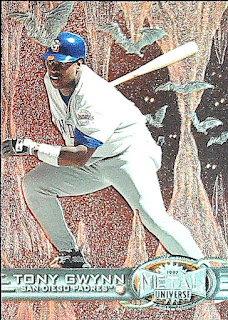
Card Number 904: Skybox Metal Universe, 1997; #219


I've over-exposed this scan slightly. But otherwise it just scans incoherently. Instead of making a dash for first base, Tony is running though a fantasy cave complex pursued by bats. I'd like to think the bats are because Tony was an extraordinary wielder of the baseball bat. But there could be a more mundane reason, like using up leftover graphics from a computer game.

There's a more natural photo on the back. The cardback design has a steampunk look. Props to them for giving Tony a number containing the number 19. (No bonus points though!)


Card Number 905: Skybox Metal Universe, 1998; #178


This is probably the nicest of the cards I'm showing in this post. The shiny front has Tony batting... on a sand dune... with the ocean in the background... and it looks very nice. Completely bizarre, but I'm always up for something a bit different. And this is a happy trigger for a digression.

Back in 2004, when I went on a road trip around California with my wife Cathy, we drove down Highway 1 all the way from San Francisco to San Diego, so photos of that Pacific coast bring back good memories. We went to Cardiff-by-the-Sea and sent postcards back to all our friends living in Cardiff. Because we like irony. 

Anyway, back to the card, and the cardback. Ho, boy! This would have looked five or six years out of date in 1998. That kind of graded background was from the beginning of the decade! And turquoise! That was the colour of 1993!


The stats boxes designed to look like a scoring chart are nicely done though. 


Card Number 906: Skybox Metal Universe, 1999; #47

A bonus scan this time to explain the difference the overhead scanner makes. First, here is the flatbed scan.


And here is the overhead scan. 


The rivet marks make this card look like it should be embossed. It's not embossed. Given their usual commitment to gimmicky stuff, this feels like a real missed opportunity for Skybox.

The rivets continue on to the back. It's an odd photo, with Tony looking frustrated. He looks like he is walking back to the dug out after a flyball was caught. I'd also ding this card a point for having unreadable stats information perpendicular to the card. 


And that's it for the Metal Universe. The range only lasted 4 years. There were cards released in 2000 with the brand name 'Metal', and that was the last hurrah for these shiny cards. The Metal cards in 2000 were also the end of cards being sold under the Skybox brand.

Total: 906 cards


Friday, December 10, 2021

Canned cards

There is a fine line between "innovatove" and "gimmicky". Today's cards cross that line because unlike almost every other baseball card ever, they weren't sold in a packet. They were sold in a can. 

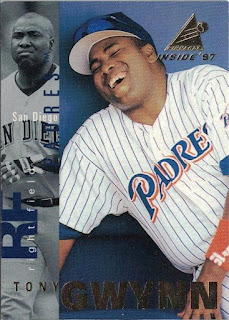
Card Number 874: Pinnacle Inside, 1997; #56

In 1997 Pinnacle Inside cards were sold in cans with 24 different designs on the outside. One of the cans had Tony printed on it. However this card would have been inside a can.


Tony is guffawing in the main photo. It really shows his fun-loving side. He has a more serious expression in the black and white photo to the side. The "TM" after the word Padres makes it look like he has a blue neck tattoo.


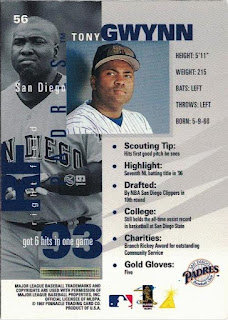
This could be a great cardback.  It has a nice lay-out with interesting info. The bullet points don't quite line up though. Also the factoid on the left about his 6-hit game is sort of marooned there. 

Pinnacle carried on canning cards the following year.

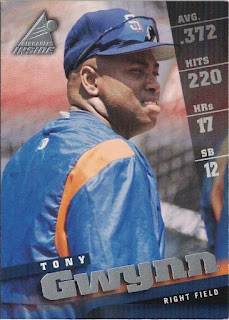
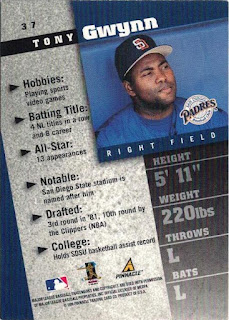
Card Number 875: Pinnacle Inside, 1998; #37

In 1998 there were 23 different cans, and again, one had a picture of Tony on the outside.


It feels like Pinnacle couldn't match the photo from the previous year, so they didn't try. The stats down the left hand side are from the previous season, but they don't explain that.

A slightly better photo on the back and a better lay-out for the tidbits of information.


There is some new information on the back including that Tony's hobby was playing sports video games. This seems to be a popular past-time among many professional sports players.

1998 was the last year that Pinnacle canned cards, because the company collapsed that year. Like Pinnacle Mint, this gimmick has yet to be resurrected by the current owners of the brand, Panini.

Total: 875 cards


Wednesday, December 8, 2021

Back to (Shiny) Base - Bowman's Best

Back in the 90s, Bowman was Topps's other, unassuming brand. But as sets proliferated and shiny cards became highly prized, Bowman's Best offered collectors with magpie tendencies another premium band to get their fix of shininess. (And if the base cards weren't shiny enough there were also parallel refractors to be had!)

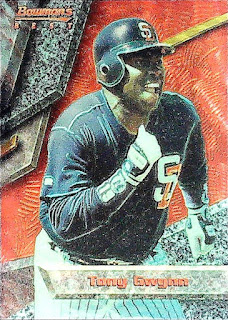
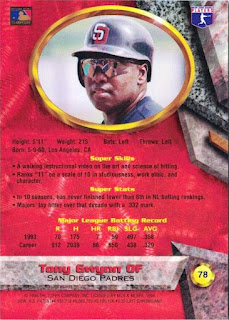
Card Number 864: Bowman's Best, 1994; #78


The red foil background on this card didn't scan very well, even using my overhead scanner. It's an aggressive looking photo of Tony. He looks cooler on the back.


Bowman cards are often a source of interesting cardback factoids. In tiny font this descriubes Tony as "A walking instructional video in the art and science of hitting." (That sounds a bit dull really.) Tony's other super skill is apparently that he "Ranks 11 on a scale of 10 in studiousness, work ethic and character." That makes him sound like Spinal Tap's special amplifier

If the "Special Skills" are a bit jokey, maybe the "Super Stats" will be better. The first one says that in the 10 preceding seasons he was never below 5th in the batting averages - that's a good stat. Then we have the arbitrary stat that in that 10-season selection his batting average was .332. That made him the top hitter in the Major Leagues, presumably among players who were also playing for those ten seasons.

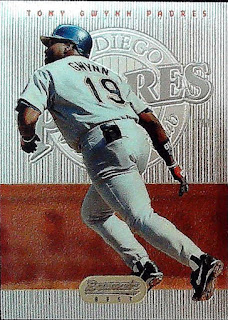
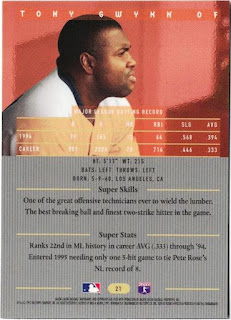
Card Number 865: Bowman's Best, 1995; #21


Shiny silver on the front. The card looks like it should be textured but it isn't.

Plenty of matt silver on the back as well.


The super skills and super stats are both more sensible and more readable. Tony went on to beat Pete Rose's record for five-hit games, finishing his career with nine 5-hit games in total. 


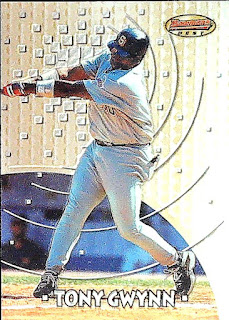
Card Number 866: Bowman's Best, 1997; #29


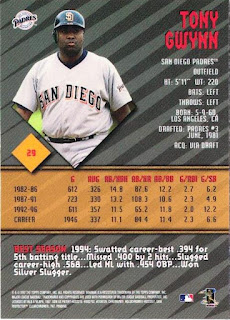
The swirls on this shiny card make it look like someone has added cartoon-style movement lines to Tony's swing. This is probably the most extreme example of bat-cropping in a card photo - practically the whole bat is out of the frame. There was an interesting cropping design choice for the photo on the back too.


The stats box separates Tony's career into five year chunks that really illustrates how his batting average improved as his career progressed. The most crucial stat in Tony's career is hidden in the account of his best ever season - he was just 2 hits off scoring .400 in the truncated 1994 season.

Annoyingly, I am missing Tony's Bowman's Best card from 1998. However, I have two from 1999 to make up for it.

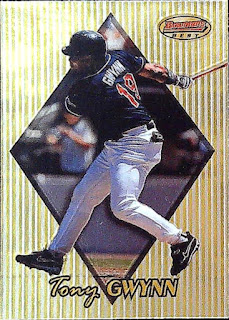
Card Number 867: Bowman's Best, 1999; #57


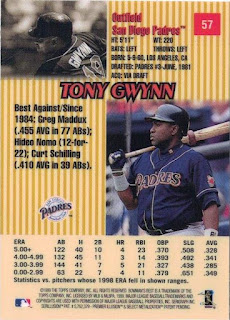
Super stripy golden shininess on the front. Lots of stripes on the back as well.


And look! In the second photo, there's a batting donut. Time to check out Fuji's list of Tony Gwynn cards featuring batting donuts aaaaaaaand..... this isn't on Fuji's list. There are two other Bowman cards there though. Whoever picked the photos for Bowman liked donuts. 

The factoid is about Tony's performance against certain pitchers. His best record was against Greg Maddux, who has been quoted as saying
“Sometimes hitters can pick up differences in spin. They can identify pitches if there are different release points or if a curveball starts with an upward hump as it leaves the pitcher’s hand. But if a pitcher can change speeds, every hitter is helpless, limited by human vision. Except for that f---ing Tony Gwynn.”

By the end of his career, Tony had faced Maddux 107 times. Maddux didn't strike him out once. 

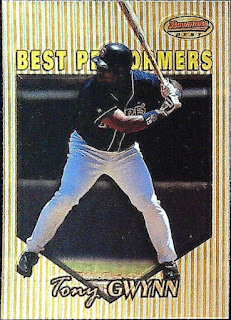
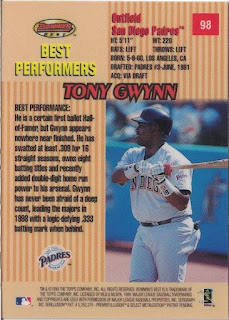
Tony had two cards in the 1999 set, appearing in the "Best Performers" subset as well. 

Card Number 868: Bowman's Best, 1999; #98


Stripy shininess again on the front. More stripes on the back and, wait, what's that? Another batting donut?


That's two pictures with donuts in the same set, with the pictures taken in different games judging by the uniforms. The picture lay-out guys at Bowman really loved their donuts!!

In the factoid, Bowman predicted Tony would be elected to the Hall of fame in his first year of eligibility. The prediction came true in 2007.

Total: 868 cards