Showing posts with label Score. Show all posts

Saturday, May 7, 2022

Score Summit

I am feeling a bit guilty at neglecting this blog, but life gets in the way sometimes. I had a very busy April, including working my notice before switching to a new job and various other activities that took up my time. I also haven't acquired many new cards - just one new one arrived in April. 

However, I do still have a little backlog of cards to work through. Today's post features a couple of cards from when Summit was a Score brand rather than a Pinnacle brand - although they were all the same company underneath anyway.

Card Number 1006: Score Summit Edition, 1995; #6


There were 200 cards in this 'hobby exclusive' set. 173 cards were 'base' cards like this. The foil team logos made them slightly fancier than regular Score cards that year. The Pinnacle companies love affair with foil on cards was only just starting. 

The back has a candid photo of Tony and a monthly breakdown of his 1994 season.The September / October column is full of zeroes because no games were played in those months due to the player strike that cut the season short.


I'm a fan of different ways of representing data on cardbacks, and so this card gets a bonus point for the way the back is laid out. 

In addition to cards like this there were two 'subsets' in the 200-card base set. The Bat Speed subset also featured Tony.

Card Number 1007: Score Summit Edition, 1995; #183


The white background blends into the card border on the front, which isn't particularly striking. However the way Bat Speed is written as if it's zooming in from the edge of the card is charming. 

On the back we get a photo of Tony swinging through.


Neither photo is particularly good, considering it's a subset about batting. The angle of both photos means Tony is looking down and his face is obscured by his batting helmet. 

In subsequent years Summit was the name of an actual set, rather than being linked to Score. So these cards come from an interesting evolutionary moment as the set emerged into the hobby.

Total: 1007 cards

Monday, April 11, 2022

Scoring a triple in 1995

Three cards from the same manufacturer released in the same year today! 1995 was right in the middle of Tony's mid-90s peak. 

Card Number 997: Score, 1995; #28

Let's start with the base card from the Score set that year.


Tony is wearing a batting practice top but has a dirt stain on his knee so has obviously been taking practice seriously. The 'ragged' edges of the photo and the blue box with Tony's name on are the kind of framing that I associate with the nineties, especially combined with the 'drop shadow' at the bottom. The green colouring on the borders adds a dash of colour without being overpowering. 


There is a full height portrait on the back. Tony looks relaxed in the outfield. Notice the batting gloves stuffed into his back pocket. I'm glad the designer found space for that factoid next to the giant stats box. I didn't know that Tony had never finished lower than sixth in the batting table up to this point. Even his less productive seasons were top ten material. 

Card Number 998: Score Hall of Gold, 1995; #HG14

This insert series was really just an excuse for Score to produce really shiny cards! The photo is a almost Toppsian masterclass in showing a player without showing any of their identifying features!


27 years after this card was released, it annoys me that Score didn't choose to use a photo where Tony's face was visible. If they were going to bother including him in the insert set it seems sensible to actually use such a photo. We know they had those photos available - because they used one on the back of the card!


As insert cards go, I don't mind shiny. But there are several design mistakes here on the back. Firstly they dropped his name onto the photo with an odd placement. Tony's name isn't placed centrally, making the whole thing slightly off-kilter.  Then they put white text on over Tony's white uniform, making it unreadable. Even the drop shadows on the font (so nineties!) can't make the letters legible. The borders are unequal too, and the black line chops off Tony's body on either side. Overall it's a poorly executed mess.

Card Number 999: Score Dream Team Gold, 1995; #DG8

And just to round off the post, an almost-unscannable hologram card. 


Holograms aren't particularly interesting to me. And they are impossible to reproduce in blog-friendly form. Although this scan does show some of the detail hidden in the hologram.

The back has a pure nineties colour scheme with it's gradated hot pink, teal and orange. This card is so nineties, I feel like staring at it for any length of time might give me time travelling powers so I can go back 30 years!


It's not really possible to understand nineties baseball card design without understanding how computers revolutionised the way baseball cards were laid out. Why else would you have one green letter in Tony's name? Or different kerning for his first name and his surname? Even the stars have a 3D effect drop shadow going on.

Although it seems like I am mocking the way cards were designed in the nineties, these are actually beautiful mementos of a long-gone decade. It was a time of hope and optimism - a new century was only a few years away, and who knew what wonders lay just over that millennial horizon? It maybe hasn't turned out as planned, which makes me feel wistful for the short window of history encapsulated in cards released in the 1990s.

Total: 999 cards


Saturday, February 26, 2022

Score gets gritty

Card companies seemed to struggle thinking up new names for subsets in the 90s. Today's card is an illustration of that.

Card Number 973: Score, 1997; #535

There's a photo of Tony fielding on the front. The partial beer advert in the background would qualify this for a list of cards featuring alcohol advertising.


"True Grit". There's no explanation what aspect of Tony's game that refers to. 

The subset logo seems a little bit unbalanced to me. It's because Tony's head is leaning, which throws off the symmetry, along with the lopsided alignment of his name and the different number of letters on the crossed bats.

The arrangement is repeated on the back, and still feels slightly wonky.


The way the cardback write up is divided makes it hard to read. The designer would have been better served putting the words into two columns. Otherwise, this reads like a checklist of things to include in a cardback write up in 1997 - a reference to Tony being in the Hall of Fame in the future, a comparison to a legendary player from long ago (in this case Honus Wagner), a comment about setting records (without saying what those records are) - these all make frequent appearances on cardbacks. 

However, this card was also released as fans started to really get interested in players hitting home runs. This peaked at the end of the 90s with several record-chasing power hitters trying to outdo each other in the race to blast as many homers as possible. On this card, Score decided to just list that statistic, which is one of the few batting stats that makes Tony look quite ordinary.

Ironically, 1997 turned out to be the season Tony set his personal best for home runs - 17 - so even he wasn't immune to the late 90s hype around hitting homers!

Total: 973 cards

Tuesday, February 1, 2022

Tuesday Twins - going gold with Score in 94

Card Number 912: Score, 1994; #12


Tony is swinging on this card. Even with a superspeedy camera shutter, the end of that bat is moving too fast to capture!

Tony is grinning on the back. I really like that photo.

This isn't a complicated cardback, but design-wise it is very well-balanced. Score always had a lot of text on their cardbacks. Here they squeeze in two paragraphs, a complete stats box, and that nice photo.

One thing this cardback chronicles is Tony's sticky patch in the early 90s, when his batting averages dipped to "just" .317. He had a couple of tough years with injuries and conflict in the team. Then, as the story goes, he had a chat with Ted Williams, started using a bigger bat, and went on to win 4 batting titles and post a higher batting average in the last 10 years of his career than in the first 10 years. 

Card Number 913: Score Gold Rush, 1994; #12

I think this is the first year that Score did shiny gold parallels. These cards were found at a rate of one per pack (or two in a "super-pack"). 


The entire front is foiled and the border is rendered in gold. It looks really impressive in real life.

On the back there is a 'Gold Rush' watermark.


The watermark earns the card a bonus point from me because it makes it easy to separate this from the regular version in my folder of scans! 

Total: 913 cards

Sunday, December 5, 2021

One Card Only - caricature All-Star

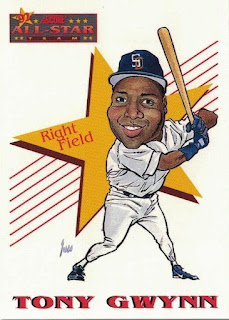
Card Number 860: Score, 1993; #525


This card is everything that was right about the baseball card hobby in the early 90s. It's cheeky. It's fun. It's different. It's just a great card.

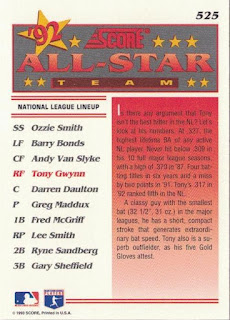
On the back we have the starting line-up for the national league team in 1992 and a nicely phrased summation of why Tony made the team.


Some of the names on that list need no introduction. Ozzie Smith, Barry Bonds, Fred McGriff, Gary Sheffield, Ryne Sandberg and Greg Maddux were dominant players at the time. Andy Van Slyke is less famous, but this was the second of three All-Star appearances for him. Darren Daulton was also a three-time All-Star and was part of the Marlins team that won the World Series in 1997. He passed away in 2017 at the age of 55. I wasn't familiar with Lee Smith either, but it turns out he held the record for the number of saves in Major League Baseball from 1993 until Trevor Hoffman passed his figure in 2006. He is currently third on the all-time list, behind Hoffman and the current record holder Mariano Rivera.

All in all, that was quite the All-Star team in 1992!

Total: 860 cards


Wednesday, October 20, 2021

3 from 96 - Score

1996 was the mid-point of Tony's second career. He had an impressive start to his career in the 80s, winning the batting title in his second full season as the Padres went to their first ever World Series. He then had a couple of years where he was affected by injury before winning a trio of batting titles from 1987 to 1989. His form then dipped a bit in the early '90s. There are stories of problems with team-mates and at one point he apparently almost left San Diego. 

However Tony re-emerged in the middle of the 1990s as a contact hitter without parallel, getting progressively more impressive towards the end of the century.

  • 1993 - batting title runner up (with an average that would have won him the title in several years) and recorded his 2000th hit
  • 1994 - posted the modern day record batting average of .394  and won his fifth batting title  
  • 1995 - sixth batting title
  • 1996 - seventh batting title and the Padres won the divisional pennant to play in their second ever post-season
  • 1997 - eigth batting title and 5th season in a row batting over .350
  • 1998 - Padres reached their second World Series
  • And, of course, in 1999, Tony recorded his 3000th hit.
Taken like that, 1996 is about the middle of Tony's dominance of 1990s batting. It was also the peak of the overproduction era in the baseball card industry. There were more card companies producing more insert sets with more sales gimmicks than ever before. Happily the combination of Tony's peak performing years and the peak of the baseball card hobby means there are lots of cards from this time period for me to collect!

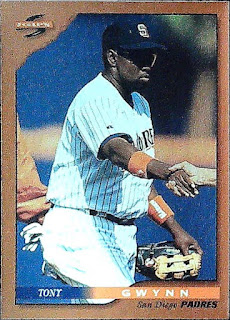
Card Number 790: Score Dugout Collection, 1996; #15
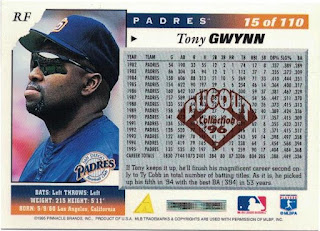
'Dugout Collection' were coloured parallels of a selection of Score's flagship set, in which Tony had card #464. These parallels appeared at a ratio of 1 in every 3 packs.

The card is a shiny bronze colour so I scanned it on the overhead which is why the picture looks a little grainy. The disembodied hand that Tony is shaking makes me smile. It makes the photo stand out.  

The back has a watermark saying Dugout Collection 96. Tony has a neatly trimmed beard in the photo on the back. It was a very fashionable style for facial hair in the mid-90s. 


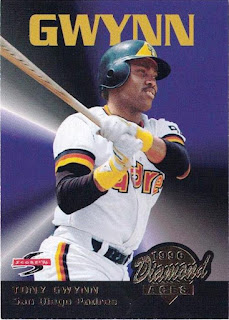
Card Number 791: Score Diamond Aces, 1996; #23
This is another insert series. These cards were only found in jumbo packs of cards and at a ratio of 1 in 8 packs. 

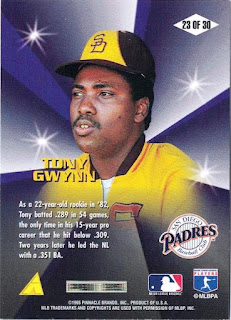
That cardfront is both very 90s and incredibly modern. It might be the font, it might be the timeless photo of Tony in a 1984 uniform, but I wouldn't be surprised if this was actually a Topps insert from the last couple of years. It's a cracking retro photo.

The back is an equal to the front in terms of looking like it could have been released much more recently instead of 25 years ago.


My only, very minor, criticism of this card is that I'm not sure that is a photo from Tony's rookie season which is mentioned in the little blurb. It's close though, with that old school yellow jacket. 

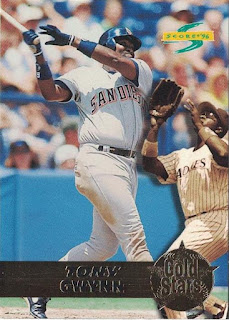
Card Number 792: Score Gold Stars, 1996; #6
The Gold Stars insert cards appeared in Series 2 of Score's flasghip set at a rate of 1 in 15 packs. 

Two photos on the front with a sepia photo of Tony catching that is awkwardly juxtaposed with his backswing at the plate. 

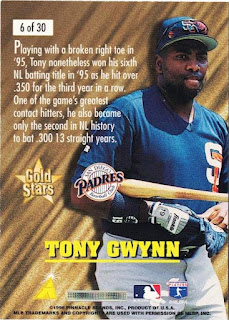
An 'underarm' use of the bat on the back! 

The cardback mentions Tony playing with a broken toe in the 1995 season. Somewhere there must be a list of all the injuries Tony suffered in his career. It seems like he was playing through pain more often than not. 

More cards from 1996 tomorrow.

Total: 792 cards - this is a bit of a milestone. The big Topps sets of the late 80s went up to 792 cards so I have literally blogged the equivalent of an entire Topps set now.


Sunday, September 12, 2021

One Card Only - PG rating

I might need to explain the post title for any readers based outside the UK. Basically, 'PG' means 'Parental Guidance' and it's used for films that might have a few scary scenes in, so parents should be aware of that before letting their kids watch the movie. 

There's no parental guidance needed for this post though, as the PG in question is Proctor & Gamble, a huge multinational corporation that mainly produces chemical products from cleaning products to shampoo. In 1992 they also produced some promotional baseball cards in partnership with Score.

Card Number 725: Score Proctor & Gamble All-Stars, 1992; #16


There were 18 cards in this set, featuring all the players in the starting line-ups for the 1992 All Star Game. Sets were received in return for proofs of purchase from Proctor & Gamble products (which included Pringles back in 1992 so if snacking was more of a priority than cleaning, then the mailaway was still achievable!). Score printed 2,000,000 sets (according to Baseballcardpedia) and I'm guessing most were claimed.

The back has a stats box and some information about Tony's contributions to the All-Star Game. There's also an endorsement from the then Cardinals manager, Joe Torre.


This card should probably be classed as an 'oddball' but it was produced by a fully licensed card manufacturer in the era when lots of companies could legitimately produce cards. It has the Proctor & Gamble logos on either side, so acts as a historical marker to a time when baseball cards were so popular just about every company wanted to use them to help shift their products.

The 1990s were an exciting time for Proctor & Gamble as the company became one of the first victims of a chain-email hoax. The email revived an old rumour that the corporation's profits went to the Church of Satan. This was compounded by claims that the company's main logo included Satanist imagery, which was part of the deal struck with Satan to ensure the company's success. Whoah, maybe there is a PG element to this post after all!

It turned out this hoax was started by a competitor trying to encourage a boycott of Proctor & Gamble products by earnest (and slightly gullible) Christians. This persistent rumour led to a multi-million dollar pay-out for Proctor & Gamble in 2007 against a competing company whose representatives had repeated the claims.

I remember reading an amusing book by someone who grew up in a fundamentalist Christian home where he wrote about his parents believing the rumour about Proctor & Gamble and throwing away all the products made by the company. It makes me wonder how many sets of baseball cards might have ended up in the trash by people worried about being contaminated by evil. 

Fortunately this particular card has survived the purges caused by the hoax and now has a safe and loving home in my collection.

Total: 725 cards


Friday, April 30, 2021

Playing the Numbers Game

Card Number 661: Score Numbers Game, 1996; #9


A very 90s design with the colours and the swirl and the photo composition.

What do I love on a cardback? Factoids and stats! These are golden.


I know that pitching has changed in the 20 years since Tony retired, but the sheer number of strike outs in games this season does make me wonder if anyone will ever rack up numbers like this for successful swings again. I imagine most players miss at least 50 times a month these days, let alone 50 times a season.

I'm particularly struck by the stat that he could have decided not to hit a ball in his next 859 at bats and still have a career average of .300. I doubt he would have become a Padres legend if he had adopted that tactic. Anyone who saw Tony have a hitless game then saw a rare occasion - he had one hitless game in every 5 or 6 games during 1994. No wonder he attained an average of .394!

Total: 661 cards


Thursday, March 4, 2021

Score shows some heart

It's been a while since I last blogged about a Score card.

Card Number 607: Score Hobby Reserve Heart of the Order insert, 1997; #25


So, this gets a bit confusing. There were 18 'Heart of the Order' insert cards in Score Series 2 in 1997, and another 18 'Heart of the Order' in Score Hobby Reserve. According to Trading Card database, Hobby Reserve was "a hobby release that paralleled 1997 Score Series 2. Cards are slightly thicker than the Retail version and have white fronts with a "Hobby Reserve by Score" gold stamp." Hobby Reserve cards have 'HR' in front of the numbers.

The card shows Tony photoshopped over a virtually empty Jack Murphy Stadium. The arrangement makes it look like Tony is swinging in the top deck of the stadium. The red foil squiggle is a stylised ECG line with the word 'Heart' written above it. 

Tony's sleeve patch is the Jackie Robinson 50 years commemoration, so this is a photo from 1997 on a card issued in 1997.

On the back the stadium in the background has a lot more people in it. There's also a rare photo of Tony wearing glasses with regular lenses in.


It was easier to find these inserts in Hobby Reserve then in the Score Series 2. The ratios respectively were 1 in 15 packs for Hobby Reserve and 1 in 23 packs for Series 2. That meant you had mildly better odds of finding a card of Tony than for any of the players on the 18 cards inserted in Series 2... as long as you could find packs of Hobby Reserve to buy.

Total: 607 cards

Wednesday, December 2, 2020

Tidying up my mistakes!

I was perplexed recently because the number of cards left to post on the blog combined with the number of cards I had blogged didn't tally with the number of cards I had recorded on Trading Card Database. I was missing two.

I decided to try and find them, thinking I might have misfiled the scans. After a few different false starts I looked on an Excel spreadsheet I'd started compiling in an idle moment and soon discovered my mistake. I had two cards numbered 48 and two cards numbered 253.

In one sense it doesn't matter what arbitrary numbers I apply to cards on this blog. On the other hand it was very annoying!

I felt I had a couple of options to fix this. One was to go through and renumber every single card in every single blogpost since the 26th May. That would be well over 450 cards in about 190 blog posts. I really didn't want to do that. It would also mean every card I'd specially selected as my 100th, or 300th or 394th(!) card would be wrong.

The other option would be to remove one of the #48s and one of the #253s and renumber them. I decided to do that instead. So this post features two cards that have been on the blog before but with new, higher numbers. One of the cards is my favourite card made by Score, and the other is a fun 'oddball', so in a sense it works out.

I have left the references to the cards in the original posts, because otherwise some of the comments on those posts wouldn't make sense. If you are one of my regular commenters, then thank you for keeping me honest!

Card Number 514 (originally misnumbered as 253): Score, 1996; #378

I originally blogged this card in a Monday Mixer on 10 August

There have been enough baseball card insert series featuring stars, as in the astronomical objects, that someone could put together a decent-sized collection. They would look lovely all together as well. (On this blog, I've already blogged about star-themed cards by Allen & Ginter and Topps!)

The fielding photo on the front is made by the dirty smudge all over Tony's shirt. 

On the back we get a solemn portrait shot.

There's another entry into my collection of adjectives applied to Tony Gwynn on the cardback. Here he is "a class guy". It certainly reads as if the cardback writer was "star struck".

ADDITIONAL NOTE: I've just recognised the portrait photo! It's the same one used on Tony's Pinnacle card in 1997. Here's the Pinnacle card for reference:


'Card' Number 515 (originally misnumbered as 48): Fantastic Sam's Disc, 1988; #18

This was originally included in my very first post about "oddballs".

There are almost 1,000 franchises of Fantastic Sam's Hair Salons across America (or at least there were before the pandemic; hair salons have been hit bad).

These discs are similar to discs given away by several other businesses in the late 80s. They were printed by Michael Schechter Associates (MSA), who produced cards for a number of companies to use as freebies in the 80s and early 90s. They are about the same size as a poker chip (or a pog, if you remember pogs).

The discs open up like a tiny booklet, so you get a front...


...a middle (with a few pertinent player stats)...


...and a back.


The disc advertises a 'Superstar Sweepstake' where you could "Win a pro player for a day!" I'm intrigued by this. Which pro player had they roped in for this? What would you do with them? Could you send them to run errands for you? So many questions!

You have to scratch off the little foil panel to see if you won a prize. Whoever received this one wasn't particularly bothered about winning a prize. The foil is pristine.

So, there we go. My collection is tidied up. My numbering is now correct! Was it all worth it? Have your say in the comments!

(REVISED) Total: 515 cards

Saturday, November 7, 2020

A snapshot of cards from 1996

For some reason I have a few cards from 1996 that missed out on other posts. So, here are a few cards from the middle of the 1990s that were all released that year.

Card Number 464: Score, 1996; #16

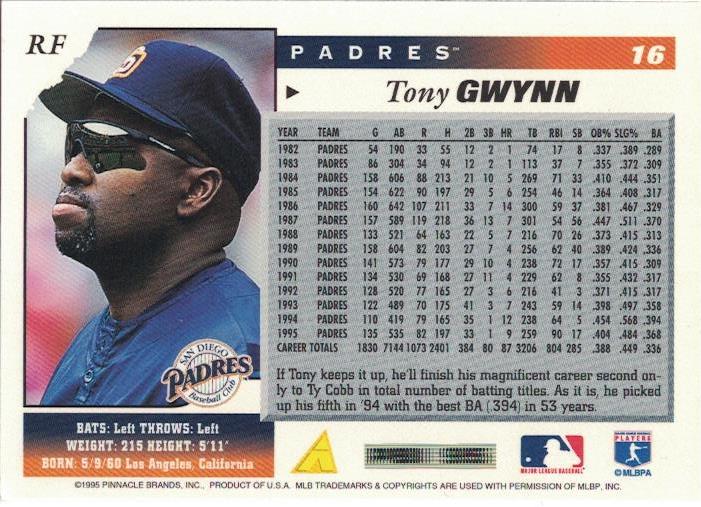
I'm not sure why this card got left out of my previous posts about Score, but anyway, here's Tony's Score base card from 1996. On the front we have a handshake with a disembodied hand, which opens a number of questions - is this at the end of a game? Is Tony glum because the Padres have lost?


On the back there's a cool head and shoulders shot obviously taken at a different time. From the front to the back of the card Tony has gone from clean-shaven to sporting a Van Dyck beard.

There's a big grey stats box as well, and a prediction that Tony would finish second to Ty Cobb in the list of batting title winners. Turns out they were right!

Card Number 465: Leaf Signature, 1996; #98
There really isn't much to say about this card, which might be why I haven't blogged about it before now.


The cardback design opts for minimal statting. And I mean minimal. It's nice, though.


Card Number 466: Bowman Best, 1996; #38
And a nice shiny Bowman card to end the post. This isn't the shiniest yellow card in my collection, but it's close. The scan has dulled it a bit.


On the back there's something called the Bowman Best Stat-Scan. I'm always interested in different ways of showing player stats. This one seems to have separated Tony's career stats into three sections, which does highlight how prolific he became in the early 90s. Not many players improve so markedly in the latter half of their career.


His all-time ranking, and career batting average, actually improved between 1996 and his retirement. The "Super Skill" is a good summary of Tony's attitude towards his game - in his Hall of Fame induction speech he said he didn't have enough natural talent to make it just on the basis of his ability, and he had to work hard. I think he was being modest there, but he certainly augmented his talent with hours of studying video footage and preparation for games. 

Total: 466 cards


Friday, October 2, 2020

Neither rookie or traded

A short while ago I found a very old Excel Spreadsheet from 2008 that catalogued my collection of Padres cards. I checked how many Tony Gwynn card I owned back then. Twelve years ago I owned 16 cards featuring Tony.

Fifteen of them have already been blogged. They were:

  • 9 Topps cards - 1986, 1987 (base & All Star card), 1988, 1989, 1993, 1999, 1999 Opening Day, 2005 All Times Fan favourites (which was a reprint of the Topps 2000 card, which caused me some confusion)
  • 2 DonRuss cards - both from 1988
  • 2 Fleer cards - 1991 and 1993
  • 2 Upper Deck cards - 1991 and 2001 (Black Diamond)

and the card I'm about to show you now...

Card Number 387: Score Rookie & Traded, 1998; #RT9


Tony was an odd choice for a "Rookie & Traded" set because in 1998 he was a long way past being a rookie, and throughout his career he was never traded.


I can't remember how I had acquired this card back in 2008, but I remember buying a mixed job-lot of Padres cards off eBay that arrived in a box because there were so many of them and I think it was probably in there. 

It's strange to think this card was only 10 years old when I listed it in my spreadsheet back in 2008. I wasn't to know that over a decade later I would be writing about it on my blog as my 387th card featuring Tony Gwynn!

The stats box is a bit odd because it starts with the number of runs that Tony scored instead of games or at bats, which are usually the first figures listed. It also includes his "Total Bases", which doesn't usually feature in a cardback stats box.

Tony had a card in Score's regular release as well.

Card Number 388: Score, 1998; #50

Of all the photos of Tony at the plate on baseball cards, there aren't many that show him with the bat in front of his head like that, just before he draws it back into the hitting position.


The back is virtually identical to the Rookies and Traded card, except this one mentions him playing in his 13th All Star Game in 1997. It also has a drop shadow effect on his surname, which is a bit of a cheesy nineties desktop publishing flourish, and yet looks alright. 

Total: 388/394

Wednesday, September 23, 2020

Know the Score Part 2

This is a sequel of sorts to "Know the Score" which I published way back in May. In that first post I said that Score cards tended to have more interesting card backs than fronts, and I feel the same is true of the cards in this post. So I am going to show them back to front.

Card Number 365: Score Baseball's Hottest 100, 1989; #40

Even though he had spent 1988 dogged by injury, Tony Gwynn was included in the 100 players featured in this set from Score. It was sold as a complete set along with a book and some "magic motion trivia cards" that were about Hall of Famers rookie seasons. (Checklist)


There's a solid portrait photo on the cardback. The way the write up is phrased makes it sound like he had just two gold gloves and batting titles at this stage in his career, but in fact he had three batting titles by 1989 (and he earned his fourth in 1989).

The front is fairly run-of-the-mill. The red border is nice and there is a presage of 90s card design with the different font for the T in Tony compared to the rest of his name.


But red border apart, I think this is still one where the back is better than the front. 

Card Number 366: Score, 1990; 685
This is one of the "Dream Team" subsets within the Score base series. You may well be thinking there is no way that this cardback is more interesting than the front. 


But this is the front.


The photo on this card is bizarre. Recently I read a Facebook post from someone who busted a box of Score '90 and they raved about the Dream Team subset cards, which all looked like this. But I can't see the appeal. It's kind of fuzzy and washed out and has no context to it. If they were going for trying to capture waking up from a confusing dream, then they succeeded.

The write up on the back about Tony's scrutiny of video replay as a use of cutting edge technology feels amusingly quaint now. It doesn't mention how he bought the first VCR for the club to use because they wouldn't shell out for it. The descriptions of him compiling his own highlight reels against certain pitchers intrigues me. I wonder where those video tapes ended up.

Also, there's an amusing typo. Four lines from the bottom it talks about Tony winning his third straight "battling title". Now, I'm guilty of my own fair share of typos, but it is funny to see one on a card. And it's another reason why the cardback overcomes its plain-ness and is more interesting than the front.

Card Number 367: Score 100 Superstars, 1991; #94
Tony isn't quite looking down the lens in the photo on the back, but it's still a nice card. This is from another one of the sets that Score sold as a complete unit. 


I'm going to add the description by his team-mate Joe Carter to my list of unique descriptions on cardbacks: "He's on a cloud by himself!" Joe Carter, incidentally, was playing for the Blue Jays in 1991, having only been a team-mate of Tony's in San Diego for one year in 1989. Score didn't reference Joe being Tony's former team-mate, or give a date or context for that quote. How long were they sitting on it before they used it?

The front features Tony fielding. It almost looks like he's pitching in the photo. The whole pose is so ungainly and the composition of the photo, with a team mate behind him, is awkward. The designer didn't help by plopping the Padres logo in the corner up by his hand, when there is loads of dead space below it.


And now a pop quiz.
a) Which powerful hitter travelled the other way in the trade that took Joe Carter from San Diego to Toronto?
b) What did Joe Carter do in the last game he played in 1993 that contributed to his induction in the Canadian Baseball Hall of Fame (despite not being Canadian)?
c) Both Joe Carter and Tony Gwynn were born in 1960, but who was older by two months and two days?

I'll pop the answers in tomorrow's post!

Total: 367/394