Showing posts with label 1990. Show all posts

Wednesday, August 31, 2022

Blue DonRuss

Have you ever bought a complete set just to get one card? A couple of months ago, I did.


The 1990 set by DonRuss is one of those incredibly common junk wax sets that I quite like. I think it's the red borders. I have a few cards from it (which I blogged about in the very early days of this blog) but I hadn't seen blue versions of the cards before (even though Fuji had mentioned them in a comment on that post from the early days of this blog!) Some junk wax is harder to find, especially here in Wales.

But then this sealed factory set of the 'Best of the National League' turned up in the UK collectors group on Facebook. Adrian, the seller, had three of them. I had a think about it and then decided to take one off his hands. Mainly because when the player you collect is listed on the back, you kind of have to, right?


Opening up the box, there was an inner tray with three blocks of shrink-wrapped cards.


The 'puzzles' that are mentioned on the outside of the box were underneath the blocks of cards. Does anyone care about puzzles?


Anyway, I had to open all three shrink-wrapped blocks to find Tony's card, but here it is!

Card Number 1039: DonRuss Best of the National League, 1990; #11


It's not the greatest photo of Tony at the plate, but it's a close up cropped shot rather than the photos that were used on the cards in the regular set released by DonRuss that year. The photo clearly shows the Mimsbandz anti-drugs wristguards that Tony wore.

The back is a bit dull, but the yellow means they look very different to cards from the regular release. 


I have taken this card out of the set and put it in my binders. I have no plans for the rest of the cards. I know a few people who collect other players from that era, so I might send a few cards out. In the unlikely event that any regular readers want one (or more) of these cards, please let me know!

Total: 1039 cards


Friday, April 15, 2022

1990 randomness

Today's post features three cards from 1990 that are completely unrelated to each other. Just for fun, like. 

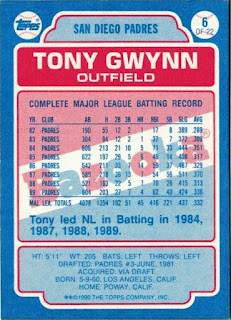
Card Number 1003: Topps Batting Leaders, 1990; #2

These cards were inserted into blister packs of 100 cards from Topps flagship set that were exclusive to K-Mart. 


The cartooney drawn baseball bat makes this look quaint, even considering it's from way back in 1990.

The politest way to describe the cardback is that it doesn't look like the designer made too much of an effort but did just enough to earn their paycheck.


Tony's final career batting average went up from this point. In terms of hitting baseballs, he was an absolute monster in the decade after this card was released.

Card Number 1004: Sport's Collector Digest, 1990; #37

This isn't a baseball card, it's a pocket price guide! (Oh, okay, sure thing, Sport's Collector Digest.)


This is the second 'pocket price guide' to feature on this blog (here's the other one). It's fair to say that if more price guides looked as good as the front of this card, more people would collect price guides!


These guides provide an insight into the expansion of the collecting bubble in the early 1990s. Comparing these prices to the valuations SCD put on cards in 1993, shows how much a collector could have made by investing in rookie cards in 1990.


SCD reckoned that mint Topps rookie cards had doubled in price from $20 in 1990 to $40 in 1993, while the five hundred per cent growth in value for a mint 1984 Fleer card (from $2 to $12) was a huge jump for a second year card.

All this is a casual reminder that card values are always inflated by the companies doing the valuations. The real value of a card is not what a company claims it to be - the real value is the price it actually sells for. This is true regardless of whether the price is listed on a magazine or on a nice baseball-card sized 'pocket price guide'. 

Card Number 1005: Sportflics, 1990; #98
Sportflics are lenticular cards that show player in three different poses. I am not keen on them for a number of reasons. They don't scan well. They are thick plastic and the plastic yellows with age. And they warp because of the plastic coating. 

But apart from that, they're OK.


Sporflics are reasonably important in the history of baseball cards because they were the entry product for the Pinnacle company who then produced Score cards before releasing sets under the Pinnacle brand name. The back of this card shares a lot of design aesthetics with contemporary Score cards, particularly the use of a colour photo, the lettering and presentation.


On top of all the other issues with Sportflics cards, I'm going to ding this a point for having Tony's squad number more obvious than the card set number, and ding it another point for having a set number that looks like a different number. It's not #88, it's #98! However, I will give it a point back for the quirky photo showing Tony with his glove half-on, half-off. 

Total: 1005 cards

Saturday, January 29, 2022

Play your cards right

Some oddball cards today. And I mean, literally, some oddball cards today.

Card Number 907: US Playing Card Company Baseball Major League All-Stars, 1990; #NNO (Jack of Diamonds)


Yes, this is from a set of playing cards with colour pictures of baseball players on. This is a very intriguing photo. My guess is that Tony is scrutinising the play while doing some stretches in the on deck area.

The back is a boring card back. It has to be if anyone is going to actually play cards using this set.  I've played a lot of card games in my time - whist, canasta, pinochle. Novelty card sets don't tend to get used for games in my experience. However, judging by the playwear, this card was used in a few hands of some card games.


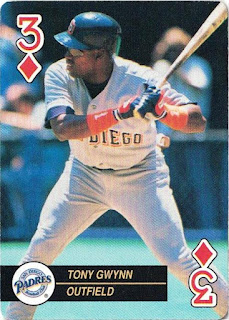
Card Number 908: US Playing Card Company Major League Baseball Aces, 1992; #NNO (3 of Diamonds)

Tony is still in the diamond suit in this deck, but seems to have been demoted from one of the face cards to a lowly number. 


This photo has been cropped to chop off Tony's feet and the end of his bat. I know that might annoy one of my regular readers!

The back looks more stylish than the cardbacks from the deck released in 1990.


And a bonus "card".

Card Number 909: Cartwright's Aces, 1992-3; #9

This was from a 12-card series issued with the short-lived Cartwright's Journal of Baseball Collectibles, which included trading cards in each issue. The Journal lasted for five issues in 1992 and 1993 and somehow released 9 card series, many with parallels. There is more information in this Wrigley Wax blog post.

The card is rather nicely done.


Despite the playing card imagery in the word 'aces' and the design of the set logo on the back, this isn't actually a playing card.

There is a minimal write up on the back. 


Something that stands out to me is there is no licensing information on this card at all. That's also true of the US Playing Card Company cards as well - but they were licensed and had the relevant logos on the box containing the cards. I suspect Cartwright's didn't have an agreement in place otherwise there would have been some very small print on the card. 

Total: 909 cards

Wednesday, October 13, 2021

A brace of Bazookas

Bazooka is a funny word. It's an odd name for a bubblegum brand, given its military meaning. Bazooka gum first appeared on the market in 1947, so it feels like there must be a link to the weapon. I suppose a soldier blows things up with a bazooka and a gum-chewer could blow something up too - a bubble. 

As a side-note, my local post office has just started selling packets of Bazooka gum, complete with Bazooka Joe comic strips inside. No baseball comics yet, though.

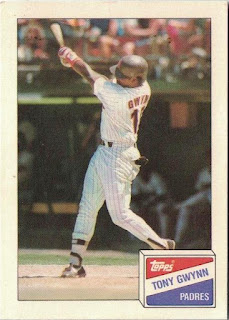
Card Number 778: Topps Bazooka, 1988; #9

These cards were available in boxes of specially marked Bazooka gum, which was a Topps brand of confectionary. There were 22 cards to collect.


This design is mediocre even for a card from the 1980s. However, true to form, Topps managed to find a photo where Tony's face was obscured and his name is barely legible.

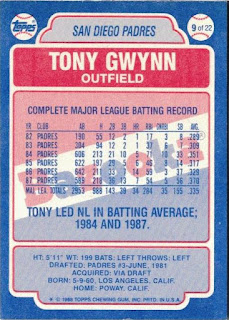
The back is simple, but looks more interesting than the front. There's even space for a relevant factoid that isn't about Tony's minor league achievements from many years previously. (Unlike Topps's regular cards issued around the same time.)


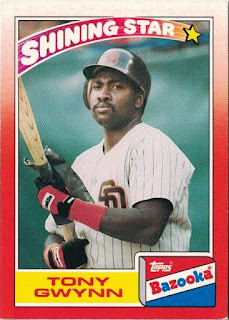
Card Number 779: Topps Bazooka, 1990; #6

Design-wise this is a much better effort from Topps.


It's an interesting photo, with Tony absent-mindedly prepping his bat while watching something else - probably another player at the plate. Also, cards with red borders always look good, 

The cardback is in the same Bazooka brand colour scheme. Tony had added two batting titles since the card that was issued in 1988!

If you want to fill in the gaps in this gum-based post, then you can read about the 1989 Bazooka card here!

Total: 779 cards

Saturday, October 9, 2021

Sharing the (oddball) Spotlight

I have a few cards that feature another player alongside Tony. Here are a couple of examples of Tony sharing the spotlight on 'oddball' issues.

Card Number 771: French's, 1992; #16

These cards were a giveaway linked to French's Mustard. This condiment debuted at the St. Louis World's Fair in 1904, and is still sold today. Each card in this set featured two top players. Tony shared his card with Joe Carter, who was playing for the Blue Jays at that time. 


Joe was born in March 1960, almost two months before Tony arrived in the world. He was in the 1981 draft with Tony and was selected by the Cubs. After a spell with the Indians he played alongside Tony at the Padres before being part of the deal with the Blue Jays that brought Fred McGriff and Tony Fernandez to San Diego. Roberto Alomar also moved to Toronto with Joe in that deal.

That move worked out better for Joe and Roberto as both of them won back-to-back World Series titles with the Blue Jays - the first one was the year this card was given away with French's Mustard, 1992.

Depsite being the same age as Tony, Joe retired in 1998. He was inducted into the Hall of Fame in 2003, which was the first year he was eligible for entry. Being a first year inductee is yet another thing he has in common with Tony. 

There is a short write up about each player on the cardback. 


Design-wise, I like this card for several reasons. I like cards that are green. I also like the bat and ball drawings in the background of the cardback. The photos are quite small so the player's features aren't very easy to make out. But this is still a nice card featuring two Hall of Famers.

Card 772: Classic Blue, 1990 (NL Hit Kings); #87 

Are Classic cards really 'oddballs'? I think they kind of are.


There are two versions of this card. This one that says NL Hit Kings on the front, and another version that says Clark / Gwynn on the front. Trading Card Database lists this version as 87b.

That's Will Clark next to Tony. "Will the Thrill" made his major league debut for the Giants in 1986. Before that he was in the USA baseball team at the 1984 Olympics in Los Angeles, part of the squad that included Tony's brother, Chris, and several other players who later had major league careers. In 1994 Will moved to the Rangers, and after five seasons in Arlington, had brief stints with the Orioles and Cardinals before retiring. He is on the Giants Wall of Fame and the Giants have announced plans to retire his shirt number (#22) in 2022.

This photo is slightly awkward because Will is looking at the camera and Tony isn't. Given the logos of other baseball clubs on the wall behind them (the Brewers and Phillies logos are visible) I conclude this was taken at an All Star Game with the players getting papped by multiple photographers (or at least two!) at the same time. 

Classic cards were marketed as board games rather than baseball cards - which seems to have been a clever way of subverting licensing arrangements -  so along with a few stats, there are trivia questions to ask as part of the game on the back of the card.


The stats compare Will and Tony's seasons in 1989. Will was .003 behind Tony in batting average so not far off winning the batting title! He had seven fewer hits than Tony but also had fewer At Bats, possible because he drew more walks. A mathematician could probably work out what the true differential of .003 would be in terms of hits. Maths isn't my strongpoint, but it feels like he was literally just a couple of hits away from taking the title. 

The other thing I noticed from the stats comparison is that Will struck out over three times as often as Tony did - 103 strike outs to Tony's 30. The mind-boggling bit of that is that Tony only struck out 30 times in 158 games. I often bring this up, but on average you would have had to go to six games in 1989 to be guaranteed seeing him strike out. It always astonishes me how rarely he struck out.  

Total: 772 cards

Friday, October 8, 2021

Giveaway Gwynns

These cards had a logo saying Starline on them, but on Trading Card Database, they were listed as Starline Long John Silver. I couldn't find any details of where this set originated from until, on the second page of Google results, there was a blogpost by Fuji, who often comments on my blog, all about them. 

I regard Fuji as a reliable authority on Tony Gwynn cards and baseball cards in general. So, this is what he had to say about these cards:
These cards were distributed by the Long John Silver restaurant chain back in 1990 over an 8 week period. Each week, the restaurant would hand out a different cello pack that contained 6 cards: a header card plus 5 player cards.

There is a great picture of the entire set, complete with all the header cards on Fuji's blog [relink], but I'm just interested in the two cards that I recently acquired. (Incidentally, that blog post by Fuji is from 2011 - thank goodness the Internet never forgets!)

Card Number 769: Starline Long John Silver, 1990; #4

These would have been given out in the packet distributed in week one of the two month promotional period. 


At first glance I thought the picture on the front had been airbrushed to remove any logos from Tony's uniform.

However, the photo on the back includes the SD logo on Tony's hat and the word Padres on his training top.


This is a decent cardback for an oddball giveaway, with some bullet pointed factoids and a full-sized stats box. As early as 1990, Tony was the all-time leader for the Padres in hits. Nobody else has come close to his totals since. 

Card Number 770: Starline Long John Silver, 1990; #29

This card was in the set given out in week 6 of the promotion. 


The white mark above Tony's name is a scuff mark. These were giveaways in restaurants. Some minor marks on the cards are to be expected. The Padres logo on Tony's helmet and shirt are clearly visible. 

The photo on the back includes a recognisable member of the crowd pulling a slightly goofy face just behind Tony. Imagine making it onto a baseball card and then realising that you had a funny expression!


The biodata and stats box are the same as the other card in the set, but the four bullet point factoids are all different. The bullet about Tony's hitting with runners in scoring position is a neat little statistic.

The cards also include the Coca-Cola logo on the back, so presumably Coke contributed towards the production of these cards.

Long John Silvers is still going with over 700 locations in the USA. It's a seafood restuarant named after the famous character from Treasure Island, that looks to serve UK-style fish and chips (battered deep-fried fish with chipped potatoes). They also do "lobster bites". Sadly it doesn't seem that baseball cards are still on the menu!

Total: 770 cards


Friday, June 25, 2021

Classic reminders of the baseball card bubble

How do you get a license to produce baseball cards without getting a licence to produce baseball cards? Get a licence to produce a tabletop game... that's composed of baseball cards. That's what Game Time did with their Classic Baseball game during the explosion of interest in baseball cards during the late 80s.

The first Classic cards were produced in 1987. 100 cards were shipped with the game and the company then sold expansion packs containing more cards. Tony had a card in the original set, which I blogged about here.

Classic released two more expansion sets in 1988, and the cards were sequentially numbered on from the original game. 

Card Number 698: Classic Baseball (blue expansion set), 1988; #220


This photo is at a slightly odd angle but features what looks like a batting cage and a prominent advert in the background for Jack in the Box resturants.

The back isn't particularly inspiring. There is a bit of player data, but the majority of the space is saved for the questions that would be used as part of the game. There is also a space for an autograph.


Trying to reverse engineer what the game looked like, I'm guessing it was a bit like Trivial Pursuit and questions were in different categories. That's an interesting factoid about Hall of Fame pitcher Warren Spahn.

Game Time carried on producing expansion sets each year for a few years into the early 90s. Having a limited checklist meant that only a few players from each team featured. However, Tony had a card in the 1990 set as well.

Card Number 699: Classic Baseball, 1990; #17

The three expansion packs released by Game Time in 1990 were different sizes - 150 cards, 99 cards, and 50 cards respectively. This card is from the first set released. Tony's brother, Chris Gwynn, was also in this set of cards.


With it's hot pink scribbles, I don't think the designers could make this card could look more like it was from 1990 if they tried. It's a great bunt photo of Tony, which makes it a bit special. I'm blogging this in quick succession to another bunt photo on an oddball card.

The trivia questions on the back includes a reminder of a time when Montreal had a baseball team. 

The Lou Brock Award is still given out every year. I have to admit, I hadn't heard of it. Vince Coleman won it six times in a row in the 1980s. No wonder he was labelled "the thief" on a baseball card. 

Given the restrictive monopoly on licenses for baseball cards at the moment, I'm surprised nobody has used a similar loophole to produce baseball cards that are ostensibly part of a game. That could be a way for another company to produce baseball cards that aren't really baseball cards.

In terms of this blog, I am tantalisingly close to blogging my 700th Tony Gwynn card. However, I am taking some much-needed time out next week. I'm also planning to watch some more games in the UEFA European Championships (which is another reason my blogging has been erratic of late!) 

I will be back blogging in early July to reveal card number 700 and also the few remaining cards in my yet-to-be-blogged folder. See you next month!

Total: 699 cards

Tuesday, December 15, 2020

Tuesday Twins - a corrected error

Way back in May when I did a post about the cards DonRuss released in 1990, I included Tony's All-Star card, which was the uncorrected error version. I didn't remark on that at the time, although I did notice that the stats box contained his stats from the All-Star game, even though the header said 'Recent Major League Performance', and noted the juxtaposition. What I didn't know then, but realised soon after, was that this was a known error and a corrected version was also released.

A few weeks back I took delivery of a joblot of 80s and 90s Tony Gwynn cards, which I knew contained a DonRuss 1990 All-Star card. It didn't have a photo of the cardback, so when it arrived, I crossed my fingers and flipped it over.

It was the corrected version!

Card Number 534: DonRuss (corrected version), 1990; #705

The front is exactly the same.

But on the back you can see that the stats box is headed 'All-Star Game Performance'.


It's not the most exciting variation in my collection, but...

a) I'm pleased to have both versions as it gives me a sense of completeness, 

b) it's a genuine error and correction unlike the silly fake 'errors' that are deliberately put into sets as parallels these days, and 

c) it gives me another card with a red border for when I put together my sub-theme collection of Tony Gwynn cards with red borders.

So, that's three reasons why it's a welcome addition to the collection.

Total: 534 cards

Friday, December 11, 2020

Dancing with Bill Doran

Back in May I did a run down of Tony's Upper Deck cards, including this one from 1990.


Back then, I wrote this: "Tony is trying to avoid getting tagged out at a base there. I think he looks like he is dancing. I'd love to be able to identify the baseman. I think that orange stripe on his arm is an Astros uniform, and his name seems to end RAN. The Astros second baseman in 1989 (when this photo was most likely taken) was Bill Doran, so maybe he is Tony's dance partner here."

Well, I think I've answered this question, based on this other card from the 1990 Upper Deck set that has recently come into my possession.


Yep, that's Tony sliding into second base ...and almost taking Bill out at the knees!

Bill's card was #198 in the set. 


I'm not counting this as a Tony Gwynn card, in the same way I didn't count the Greg Vaughn card where he is obscured by Tony, when I blogged about it.

I'm fairly sure both these photos are from the same game, given the uniforms. Which would be cool if true. They certainly seemed to be competing!


It is fun to have Tony appear on other player's cards and for that appearance to be reciprocated. 

Total: 530 cards (same total as yesterday)


Friday, October 30, 2020

Back to Base - sweeping up the Leafs

It's autumn. There's no more apt time than to show some Leaf cards. I've been patchy in my posting about Leaf, unlike other card makes where I've shown all the base cards in order. Today's post is just posting the ones I've somehow missed up to now.

Card Number 445: Leaf, 1990; #154

In 1988, Leaf cards were just DonRuss reprints. I don't think there was a set in 1989. Then in 1990, Leaf came back with a bit of a bang. 


I've talked about the UD-boundary when the Upper Deck asteroid collided with the baseball card planet and basically wiped out the pre-existing fauna. The card sets that appear after that boundary soon take on the appearance of Upper Deck cards. This is one of the most obvious early transitional designs, with its white borders and a photo on the back.


Cardbacks from the time between Tony's first four and second four batting titles are always interesting because they capture a moment when his career could have gone either way. He could well have left the Padres due to the toxic atmosphere in the clubhouse towards him in 1990. He was yet to have his conversation with Ted Williams that would cause him to change his bat, and his batting. And his career batting average was lower in 1990, midway through his career, than ten years later when he retired. He went from second among active major leaguers in 1990 to breaching the all time top twenty - the only player to play after 1960 in that illustrious group.

I was curious who Tony was second to in 1990. I am relatively confident that the one player with a better career batting average than him at that point was Wade Boggs. Unlike Tony, Wade's batting average declined after 1990, with a few seasons below .300. His final career total when he retired in 1999 was a very respectable .328, which puts him 33rd on the all-time career average list.

Card Number 446: Leaf, 1997; #17
Fielding photo!


Just in case you wanted a batting photo, though, here is Tony in mid-swing in a full bleed photo on the back. Bonus point for having the year in the shiny foil set logo on the front.


There's a one year stats box and no room for any factoids. I'm a little bit disappointed this is card number 17 in the set instead of #19. So close!

Total: 446 cards


Thursday, October 15, 2020

A couple more oddballs

'Oddballs' are cards that aren't released by the big manufacturers (although they might be made by the big manufacturers for another company). They aren't often that odd, but they are hard to categorise and file so they all end up getting lumped in together. I have put some up on the blog before, way back in May!

Card Number 413: Post, 1990; #5

These cards were available in packs of 3 inside boxes of breakfast cereal (like Marshmallow Alphabits, pictured here.)


It's a close up photo with no recognisable team logos. That's because these cards weren't licensed by Major League Baseball. However, they did include the team name, unlike logoless cards released in 2020.


The card was produced for Post by Michael Schechter Associates (MSA), who produced cards for a few different companies. I can't find the company online now so I think it has ceased trading.

Card Number 414: K-Mart Superstars. 1990; #5

This was produced by Topps as an exclusive for K-Mart. The 33 "super glossy" cards were sold in a box like a deck of playing cards.


The back of the card is fairly dull, with a stats box and a one line factoid.


I like this card because it reminds me of visiting a K-Mart in Brooklyn on one of my trips to America. This may sound ludicrous to American readers (and I know there are a few of you), but wandering around a K-Mart, Target or Wal-Mart is always something I look forward to when planning a trip to the USA. Give me ten minutes in a card aisle in Target and I'm usually a very happy bunny.

Total: 414 cards


Wednesday, September 23, 2020

Know the Score Part 2

This is a sequel of sorts to "Know the Score" which I published way back in May. In that first post I said that Score cards tended to have more interesting card backs than fronts, and I feel the same is true of the cards in this post. So I am going to show them back to front.

Card Number 365: Score Baseball's Hottest 100, 1989; #40

Even though he had spent 1988 dogged by injury, Tony Gwynn was included in the 100 players featured in this set from Score. It was sold as a complete set along with a book and some "magic motion trivia cards" that were about Hall of Famers rookie seasons. (Checklist)


There's a solid portrait photo on the cardback. The way the write up is phrased makes it sound like he had just two gold gloves and batting titles at this stage in his career, but in fact he had three batting titles by 1989 (and he earned his fourth in 1989).

The front is fairly run-of-the-mill. The red border is nice and there is a presage of 90s card design with the different font for the T in Tony compared to the rest of his name.


But red border apart, I think this is still one where the back is better than the front. 

Card Number 366: Score, 1990; 685
This is one of the "Dream Team" subsets within the Score base series. You may well be thinking there is no way that this cardback is more interesting than the front. 


But this is the front.


The photo on this card is bizarre. Recently I read a Facebook post from someone who busted a box of Score '90 and they raved about the Dream Team subset cards, which all looked like this. But I can't see the appeal. It's kind of fuzzy and washed out and has no context to it. If they were going for trying to capture waking up from a confusing dream, then they succeeded.

The write up on the back about Tony's scrutiny of video replay as a use of cutting edge technology feels amusingly quaint now. It doesn't mention how he bought the first VCR for the club to use because they wouldn't shell out for it. The descriptions of him compiling his own highlight reels against certain pitchers intrigues me. I wonder where those video tapes ended up.

Also, there's an amusing typo. Four lines from the bottom it talks about Tony winning his third straight "battling title". Now, I'm guilty of my own fair share of typos, but it is funny to see one on a card. And it's another reason why the cardback overcomes its plain-ness and is more interesting than the front.

Card Number 367: Score 100 Superstars, 1991; #94
Tony isn't quite looking down the lens in the photo on the back, but it's still a nice card. This is from another one of the sets that Score sold as a complete unit. 


I'm going to add the description by his team-mate Joe Carter to my list of unique descriptions on cardbacks: "He's on a cloud by himself!" Joe Carter, incidentally, was playing for the Blue Jays in 1991, having only been a team-mate of Tony's in San Diego for one year in 1989. Score didn't reference Joe being Tony's former team-mate, or give a date or context for that quote. How long were they sitting on it before they used it?

The front features Tony fielding. It almost looks like he's pitching in the photo. The whole pose is so ungainly and the composition of the photo, with a team mate behind him, is awkward. The designer didn't help by plopping the Padres logo in the corner up by his hand, when there is loads of dead space below it.


And now a pop quiz.
a) Which powerful hitter travelled the other way in the trade that took Joe Carter from San Diego to Toronto?
b) What did Joe Carter do in the last game he played in 1993 that contributed to his induction in the Canadian Baseball Hall of Fame (despite not being Canadian)?
c) Both Joe Carter and Tony Gwynn were born in 1960, but who was older by two months and two days?

I'll pop the answers in tomorrow's post!

Total: 367/394