Showing posts with label #1. Show all posts

Thursday, February 10, 2022

FFF - late career random Fleer

2001 was Tony's final season as a player. It was also a year when Fleer were releasing sets that are now long-forgotten. One of the glorious aspects of collecting a player who was active during so many card hobby bubbles is finding cards from sets that nobody ever talks about!

Card Number 935: Fleer Platinum, 2001; #140

These retro cards deserve more recognition in my opinion. The set recreates the Fleer 1981 design and yet somehow this card looks like they could have been pulled from a pack today - even though we are 20 years on from the 20 year anniversary these cards were celebrating!


The back is glorously retro too, with the proper Fleer 80s look.


And graphs along the bottom! A bonus point per graph, so that's 4 bonus points for this card!

Card Number 936: Fleer Authority, 2001; #79
This set name makes me think of Cartman insisting "You will respect my authority!"

I think this is the only card I have with a picture of Tony wearing a camo uniform. It was around about this time that the Padres started wearing their uniforms in tribute to men and women serving in the military.


The foil stamp says 'Baseball Authority', but the set was just called Fleer Authority. Like most cusp-of-the-century Fleer ranges, this set mainly served as a vehicle for memorabilia cards. There was a hit rate of 1 relic per 36 packs, and the list of what was cut up and stuck into cards includes the usual shirts and bats, but also includes gloves, pants, shoes, hats, wristbands and even actual bases from the diamond.

The way Tony's face is framed on the back is a little odd, and somehow accentuates his heavy stature in his final year in the game. It doesn't help that he has relaxed in his seat so isn't sitting upright. Fleer weren't afraid to guesstimate Tony's weight at 225 pounds as well - that is one of the highest weights printed for him on a baseball card. 


The stats box would win the 'extreme minimalist stats box award, if such an award existed. It's a bit quirky. I kind of like it. 

Card Number 937: Fleer Showcase, 2001; #1
A shiny card to finish off the post - and it's the first card in the set! On the front Tony is pictured in the middle of a full bodied throw from the outfield. 


The back of the Fleer Authority card above was an exercise in stats box minimalism, but this cardback manages to look full of stats and yet strangely it only goes back to 1988. 


Tony's expression in the photo makes me think of the word 'peeved'. Like he's just spotted a photographer taking a photo of him and isn't best pleased. 

This isn't all the Fleer cards from 2001 that are waiting to be blogged, but I am saving some for a special post in the second week of Fabulous Fleer Fortnight!

Total: 937 cards


Wednesday, October 27, 2021

Oddballs in the key of R

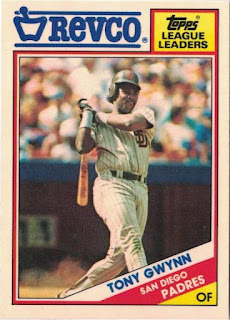
Both these oddballs were produced by Topps and sold in little packs of 33 cards through specific retailers in 1988.

Card Number 805: Topps Revco League Leaders, 1988; #1


It's not the most exciting picture on the front. I think the Revco logo is meant to be a little shopping basket. There is a history of Revco in this blog post by Fuji from earlier this year. One thing I learned from that is the regional nature of these sets. If you didn't live near a Revco store then you couldn't buy these cards. 

Tony's stats in 1987 made him worthy of being the first card in the set. 


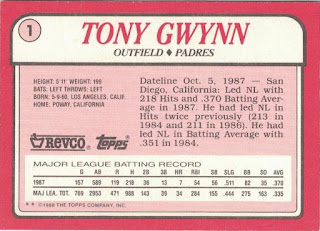
I am always learning new things from cardbacks. In this case, that Tony led the National League in hits in 1986, but didn't win the batting title. 

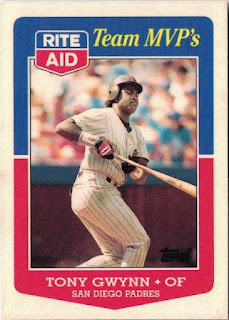
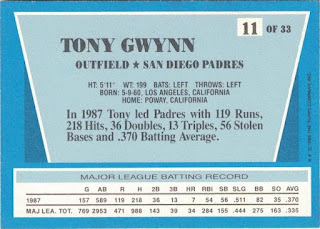
Card Number 806: Topps Rite-Aid Team MVPs, 1988; #11

Unlike Revco, I've actually been in a Rite-Aid. On one of my visits to America, I needed a sticking plaster and bought a box of them in a Rite-Aid store. I'm not sure why, but I ended up bringing them home and had Rite-Aid sticking plasters in my first aid box for years.


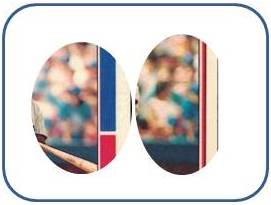
The photo on the front is very similar to the photo on the front of the Revco card. The dug out in the background looks the same. There is a fan in a blue baseball cap standing up near Tony's right shoulder and the same fan is in the crowd on the Revco card on the edge of the picture, possibly talking to another fan. 


The back of the Rite-Aid card is more boring than the Revco card. Tony was relegated to number 11 in this set. 


Based on those figures for 1987, we can work out that Tony was left on base, forced out or picked off 99 times during the season. 1987 was the career high point of Tony's base-stealing as well, with 56 successful steals. 

Rite-Aid had a major part to play in the baseball card hobby about a decade later, when the founder of Rite-Aid, Alex Grass, bought Fleer and ran it for six years from 1999-2005. Alex had retired from Rite-Aid by then, and ran Fleer with one of his sons, Roger. Unfortunately, Martin Grass, the son who took on running Rite-Aid after Alex retired, got arrested for an accounting scandal that almost destroyed the company and ended up in federal prison. Alex and Roger dclared Fleer bankrupt in 2005 and sold the company's intellectual property to Upper Deck.

Although both these card sets were printed by Topps, I still class them as oddballs because of their limited availability and the way they were supplied in small complete sets. 

Total: 806 cards

Tuesday, September 28, 2021

Tuesday Twins - Pinnacle's sneaky variations

In a follow-up email, Richard also gave me some notes on the cards he sent me. He pointed out that two of the cards he had included were variations that perhaps weren't obvious. He was right, because I had totally missed them when I looked through the cards!

The cards in question were the #1 card in the Pinnacle set from 1998. They look like this.


I already had this card in the Pinnacle folder, so put it to one side in the little pile of cards that I knew were duplicates. (There was some crossover between Richard selecting cards to send me and the parcel with over 100 cards in arriving from France, so there was a small overlap in contents.) 

If I had thought about it, though, I would have realised that I blogged this card along with Tony's other Pinnacle base cards back in July last year. Richard had checked my list on Trading Card Database, so he would have known I had this card already. I should have realised he would have sent me these for a reason. (Lesson - never doubt a supercollector!)

The differences are in the cardbacks!

Card Number 749: Pinnacle, 1998 (Home Stats parallel); #1


Card Number 750: Pinnacle, 1998 (Away Stats parallel); #1


One card has Tony's stats in the games  played in San Diego and the other has his stats when on the road with the Padres. Pinnacle produced these parallel variations for all the players in the set.

Overall it didn't make much difference to Tony whether he was batting at home in the Jack Murphy Stadium or in ballparks all over the country. His career batting average differential at the end of the 1997 season was .002, from about the same number of games. He travelled well and hit well anywhere he faced a pitcher.

Thanks Richard for pointing this out and reminding me to always check the back of the card!

Total:750 cards


Thursday, September 9, 2021

A trio of Topps parallels

Today I'm going to be blogging cards that have been on this blog before in a different guise. These three parallels came in the recent parcel from France

Card Number 716: Topps Gold (Winner), 1992; #270


Tony's name and the word 'Winner' are in embossed gold foil on the front, which differentiates this from the normal Topps Gold card. 

The 'Winner cards' were sent out in return for "runs" collected on 'Match the Stats' game cards inserted in packs. Unfortunately it was apparently easy to cheat and use a torch to reveal the answers on the game cards, so Topps were inundated with redemptions. Topps printed 'Winner' on the cards they sent out because they wanted to preserve the rarity value of the Topps Gold cards that were randomly inserted in packs. According to Baseballcardpedia, these 'Winner' cards are a lot more common than the pack-pulled cards.

There's a nice variation on the cardback with the Topps Gold logo watermarked behind the stats box. This was the last year Topps did a plain stats box on the back.


Tony's son mentioned on the back, was, of course, Tony Gwynn Jr, who went on to have a Major League Baseball career himself. 


Card Number 717: Topps Gold, 1994; #620


There is a little Topps Gold logo top left and Tony's name is printed in gold foil. These cards were parallels inserted into lucky packets. 

There is no difference in the cardback from the regular base card. The factoid is about Tony joining various baseball legends in achieving four five-hit games in a season. He is the only one of those players to have played in anything approaching the modern era.


Card Number 718: Topps Opening Day, 1998; #1

Topps went silver for their Opening Day set in 1998.


Tony was #1 in the flagship set, so it's not a surprise that he was also #1 in the Opening Day set as well. It's still cool that he was on the first card in the set, though. There's also a silver foil stamp celebrating Opening Day.

The back is exactly the same as the base card, even down to it's hard-to-locate set number!


I feel there is enough variation in all three cards to keep these parallels interesting. I now need to add them into my Topps binder, which may result in me moving a few cards around accomodate them. But that's a nice problem to have!

Total: 718 cards

Tuesday, March 9, 2021

Tuesday Twins - from rookie year to sunset season

I've acquired a third brand new card released in 2021. It's another Topps insert, and another reprint appearance for Tony's rookie card, this time combined with his final base card proper. This card arrived via Greg, who recently joined the Facebook group for UK card collectors.

Card Number 611: Topps Double Header, 2021; #TDH1

Tony was the lead-off hitter in this insert series.

The front of the card is a straight up reprint of Tony's rookie card from 1983, with the additions of a silver foil Topps 70th anniversary logo.

On the back is Tony's 2002 card, with a grey surround - this means Topps avoided putting all their boilerplate legalese onto the card image.


This is a reprint I can really support, as it shows the length of Tony's career in a novel way. 

The 1983 card has been reprinted several times, reimagined 20 times in Project 2020, and even turned into somewhat dubious manufactured relic cards.

However, the 2002 template doesn't feature as often in my collection at all. In fact, I think Topps missed a trick here because they gave Tony the 1974 template in their throwback cards last year when they were also using their 2002 template for retired players. He is in the 1974 template again this year in the 70 years of Topps insert set.  It would be more fun to have the 2002 template with a different photo of Tony in it.

Back when I reviewed this card along with other cards from 2002, I noted that this picture could almost be an unlicensed DonRuss or Panini card, given the lack of prominent logos. There is just an arm patch that could be easily airbrushed off. 

The lack of care when it comes to photography is almost the defining feature of Topps cards. In Tony's first card you mainly see his bum. In his final card you can't see his face either.

At least Topps were consistent, is about all you can say.

I think there are actually nine different Tony Gwynn cards in Topps Series 1 this year. Beside the three I have, there is a short print in the base card design, a 1986 template insert, a chrome parallel of the 70 Years of Topps insert, a patch card, a cloth card (!) and a 1/1 cut signature. 

As I have three cards from Series 1, I am technically a third of the way through! Short prints are really hard pulls this year, apparently. So, with the exception of the 1986 insert, I think it's doubtful I will add any more. 

Total: 611 cards


Thursday, February 25, 2021

My 600th card - glittering stars

Another blogging milestone today as I list my 600th card. I know this definitely is my 600th card unlike other milestones on the blog that were affected by a miscount. (I blogged about that here.

It has taken me a little while to get here, with more blog posts to cover the 100 cards since my 500th card than for previous centuries. That's mainly because I am now blogging cards as they arrive rather than working through a backlog so there are a lot more single card posts (and, shockingly, even some posts with no new cards at all!)

Today's card was in the recent eBay lot that arrived. I decided to save it for this blog post as it's a bit special.

Card Number 600: Topps Power Boosters, 1996; #1


The plain, non-glittery version of this card featured on the blog in June last year. I noted then that the font for 'Star Power' was the same font used in the film Demolition Man. It's a very 90s font. 11 of the first 12 cards in the Topps 1996 set were in this 'Star Power' theme, and all 11 got the 'Power Booster' parallel treatment, along with 14 draft pick rookie cards that were numbers 13-26 in the base set.

The back is exactly the same as the non-glittery version. There's something about Tony's jawline in that photo that reminds me of Brad Pitt every time I see it.


This feels like as relevant a point as any for a self-indulgent look at some of the other "star" cards in my collection so far. 

Starting with one of my all-time favourite cards...


"Stars" include actual astronomical objects...


...and little design motifs!


And how about this star hidden in the background of the photo?


Well I found looking at them fun! Thank you to everyone who has played a part in helping me to reach the 600-card mark!

Total: 600 cards (obviously!)


Wednesday, February 3, 2021

All Time Diamond King

Dean sent me this card alongside the Gypsy Queen card I blogged about yesterday. My wife, Cathy, remarked that the combination of green background and Tony's pose made him look more like a golfer.

Card Number 580: Panini All-Time Diamond Kings, 2020; #ATDK-1

Tony was given the first card in this 25-card insert series.

0

It's a very green card, but I like green so I'm not complaining. I can't find any reference to an actual artist on this card, or online, so I'm guessing the 'art' has been done by a Panini staffer.

The back is understated. But it's also turquoise, which is a happy colour and reminiscent of the early 90s. I'm going to add the description of Tony as a "sweet-swinging lefty" to my selection of cardback descriptions. There's a bonus phrase as well - "the San Diego standout".


I know Panini cards aren't to everybody's taste, given they don't carry team logos, but this card isn't bad at all. I now have 3 Diamond Kings cards from 2020 in my collection, and the overall total of cards from 2020 is now 32!

Here are the 3 Diamond Kings cards from 2020 together. They are all regular versions of the insert cards. Parallels exist, but I don't have any. (Yet!)


A big thank you to Dean for sending me this and completing my triptych of Diamond Kings cards.

Total: 580 cards


Monday, October 26, 2020

Modern Monday - Panini (yes, Panini) Diamond Kings

Since 2009, Panini have owned all the DonRuss-associated brands. I've seen these referenced as "Zombie brands" because they are issued as DonRuss or Leaf or Pinnacle, with a small Panini logo on the back. Panini have issued their own cards as well and this year I noticed they have taken one of the most well-known DonRuss spin-off sub-brands - the Diamond Kings - and branded them as a Panini range. 

So, after almost 40 years of DonRuss Diamond Kings, today's cards are ultra-modern. I present to you two Panini Diamond Kings cards. I'd like to thank Andrew S and Drew O from the UK Facebook collectors group, for sending me these cards.

Card Number 438: Panini Diamond Kings In the Zone Insert, 2020; #INT-1

A #1 card, albeit in an insert series.


Panini don't have a Major League Baseball license, but having illustrated cards rather gets round the logo issue. They just don't draw them in! The guy sitting on the bench in the background has a suggestive smudge that looks like a Padres shirt-front, though!


The write-up on the back explains why Tony was "In the Zone", in his case, the strike zone, and talks about his career batting average and his .394 season.

This card is as colourful on the back as it is on the front. My one criticism would be that they don't name the artist, although I suspect this artistic look has been created by the Panini design team putting photographs through a computer program.

Card Number 439: Panini Diamond Kings The 3000 Insert, 2020; #3000-14
If I ever built a "frankenset" (cards arranged in numerical order taken from numerous other sets) I don't know how I would count this number. 3000 is probably the highest numbered Tony Gwynn card that I've got. But really it's number 14.

The 3000 insert series honours 15 players who have reached 3000 hits.


It's another colourful card-front.

The same image of Tony is replicated on the back, combined with an amusing account of Tony scoring his 3000th hit.


That's a new metaphor to me - "golfed a single". I've never heard a hit in baseball being described as "golfed" before. The choice to paint him in a brown uniform is slightly odd, considering he was wearing the grey road uniform when he golfed that single, but it doesn't really detract from the impact of the card. And at least they got the date right! (Unlike Topps!)

Total: 439 cards


Sunday, July 12, 2020

Number One Card Only Redux

Today's one card only post is another #1 card. Two years after Tony's 'Star Power' card kicked off the 1996 Topps set, he was allocated the #1 card in the Topps flagship set again.

Card Number 175: Topps, 1998; #1
It's not a particularly inspiring card front.


Topps made it very hard to spot the number on the cardback. Can you find it?


Of course, Topps didn't know that the player leading off their card set in 1998 would also be leading his team to their second, and to date most recent, World Series. There was a long season ahead before the Padres played the Yankees in the Fall Classic. But it is sort of cool that Tony got honoured with the #1 card in such a notable season.

He was also the #1 card in the Pinnacle set for 1998. Doubly cool!

Total: 175/394

Friday, July 10, 2020

Back to Base (Camp) - Pinnacle base cards

I've blogged a few Pinnacle cards before. I was trying to work out the relationship between Pinnacle and Score, because the first Pinnacle cards are copyrighted to Score, but then later Score cards are copyrighted to Pinnacle brands. A brief sojourn to Wikipedia later and I now know that the company that made Sportflics lenticular cards changed their name in 1988 and released the first Score sets, and then later launched Pinnacle as a premium brand of cards.

This is all moot now because Pinnacle and Score are just sub-brands of the Panini conglomerate, but it's interesting tracing the connections between these card families.

Pinnacle released their first baseball series in 1992 and that's where this Back to Base post starts.

Card Number 168: Pinnacle, 1992; #400
Black borders. Classy!


I like this photo. The ball's moving. The bat's moving. Tony's swinging. The lay-out is really clean and effective.

But, the thing with Score is, they did really nice cardbacks!


Look at that smile! What a great cardback photo. Score also included a decent length summary of the player on the back, which Pinnacle continued. It's a very positive write up of a season which was ultimately very frustrating for Tony and was cut short because of injury. There's an amazing stat included in there, that in 530 at bats during the season, he struck out just 19 times. That's less than 4% of the time! The number 19 is forever associated with Tony of course, so there's an added irony.

Card Number 169: Pinnacle, 1993; #98
Black borders again. Every card imperfection shows up on the scan. Those marks aren't noticeable when the card is in hand.


The photo on the front isn't as good as in 1992, and it's not a particularly flattering photo of Tony as you can really see his tummy. Fortunately we know there's going to be a decent reverse side to the card.


And there it is! Another cracking portrait photo. The summary notes that for the second season running Tony's knee injury denied him the chance to finish the season.

I appreciate the simplicity of the season stats line on both this card and the preceding one. It give it that 'premium card range' vibe.

Card Number 170: Pinnacle, 1994; #4


Pinnacle dispensed with borders in 1994, copying the other premium brands of the time by going full bleed on the image. Tony seems to idly swinging the bat in this picture. He might be tracking the path of a foul ball because if that had been a hit he would already be halfway to first base. The name and team design element is pleasantly understated but looks like what other card companies like Leaf were doing at the time.

The photo on the front gets reused on the back, along with a three quarters close up of Tony's face.


There's no write-up, just a run-of-the-mill stats box. They pull out one extra stat, that Tony's batting average was higher if he had runners in a scoring position. That really underlines his value for the team.

This is also the first Pinnacle card not to mention Score. It's copyrighted to Pinnacle Brands.

Card Number 171: Pinnacle, 1995; #93
So, every card company in the 1990s had one card set where they tried something different. This is Pinnacle's and, without being too harsh on whoever had this idea, the photo montage is the stuff of nightmares.


You can see Pinnacle's origins as Sportflics in what they tried to do with this card. Three superimposed images of Tony at the bat and swinging. But it really doesn't work if it's not a lenticular card and it's turned Tony into a three-headed, six-armed monster.

Also, the large block of foil is an indicator of the excess to come in future Pinnacle sets.

The back is comparatively fine. Two photos, no hideous Nineties design choices, and the write up is back - this time focusing on Tony's feat of achieving a batting average of .394 in 1994.


Card Number 172: Pinnacle, 1996; #205


Apart from the pyramid of foil at the bottom of the card, this looks very much like a Studio card. And there is nowt wrong with that! If I had one quibble, they could have moved the card set logo a fraction to the left so it didn't overlap his cap.

The back is similarly very clean. It looks like a card that could have been pulled in the last couple of years.


The write up mentions Tony's average in 1994 again, even though he had won the batting title in 1995 as well.

I included Tony's 1997 base card in my previous blog post about Pinnacle cards. For the sake of completeness, here it is again.


(That's peak base card gold foil usage!)


(This is as bad as Nineties design gets on a Pinnacle cardback)

Card Number 173: Pinnacle, 1998; #1


Tony had the very first card in the 1998 Pinnacle set. He was also #1 in Topps's range that year as well. Although it says All Star on the card, Pinnacle didn't do All Star and regular base cards in their 1998 set, so this was his only card.


This was also Tony's last Pinnacle base card. Despite acquiring DonRuss in 1996, Pinnacle went bust in September 1998. They were bought by a company called PlayOff who revived the DonRuss brand in 2001 before being bought by Panini in 2009 and rebranded as Panini America.

I know this has been a long post, but it is the entire run of Tony's Pinnacle base cards, tracking the boom and bust cycle of baseball card production in the 1990s. Pinnacle also produced a load of other sets and, of course, Tony features in those. But I'm going to save those for future posts.

Total: 173/394