Thursday, October 14, 2021

Diamond Kings - from insert series to standalone set

I thought Panini had started releasing Diamond Kings as a range in itself in the years after the company acquired the rights to various DonRuss ranges. I've now discovered that DonRuss started doing it at the start of the millennium before being swallowed by the Panini empire.

However, the first card in today's post comes from the 90s, when the Diamond King cards were an insert series in the DonRuss flagship set.

Card Number 780: DonRuss, 1994; #DK-11


This is a very bold artwork with Diamond Kings emblazoned in red foil above it. The painting is by Dick Perez, who also painted Tony for the 1985, 1989 and 1996 Diamond Kings cards. It's to Dick's credit that his paintings looked quite different to each other. This is a very effective portrait.

The back is a little bit dull in comparison. It also gets dinged for gratuitous use of justified text. That's just one of my personal dislikes, but my justification for not liking justified text can be seen at the end of the second line where 'arthroscopic' is split over the two lines and the last two letters appear on the line below. 


For the record, Andres Galarraga won the batting title that year with .370. Tony's total of .358 would have won him the title in 1990, 1991 and 1992, so being runner up in 1993 showed how he was coming into form. He won four in a row from the following season. 

Card Number 781: DonRuss Diamond Kings, 2002; #145

In 2002, DonRuss released a 200-card Diamond Kings set. It was the first time Diamond Kings had been used as a standalone brand.


This is printed on a high quality, canvas-effect board. The way Tony's name is arranged it looks like 'Tony Gwynn of Padres', but the 'of' is actually OF, denoting his position as an 'outfielder'. 

DonRuss had moved on from commissioning art from Dick Perez. The cardback credits this to Mark Turnes. A Google search turns up several examples of his sports artwork, but he doesn't seem to have a website.


The cardback also has a handy line up of Tony's Diamond King appearances, which acts like a mini checklist. I will round out the set when I add his 2001 card to my collection!

Total: 781 cards


Wednesday, October 13, 2021

A brace of Bazookas

Bazooka is a funny word. It's an odd name for a bubblegum brand, given its military meaning. Bazooka gum first appeared on the market in 1947, so it feels like there must be a link to the weapon. I suppose a soldier blows things up with a bazooka and a gum-chewer could blow something up too - a bubble. 

As a side-note, my local post office has just started selling packets of Bazooka gum, complete with Bazooka Joe comic strips inside. No baseball comics yet, though.

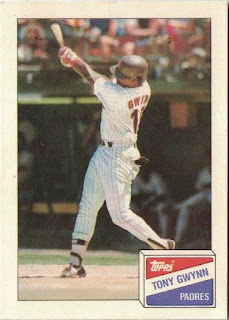
Card Number 778: Topps Bazooka, 1988; #9

These cards were available in boxes of specially marked Bazooka gum, which was a Topps brand of confectionary. There were 22 cards to collect.


This design is mediocre even for a card from the 1980s. However, true to form, Topps managed to find a photo where Tony's face was obscured and his name is barely legible.

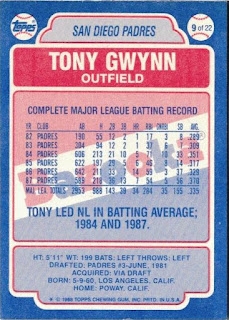
The back is simple, but looks more interesting than the front. There's even space for a relevant factoid that isn't about Tony's minor league achievements from many years previously. (Unlike Topps's regular cards issued around the same time.)


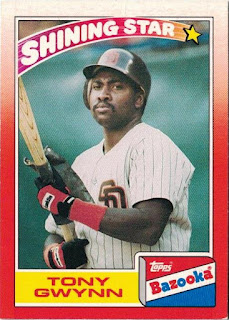
Card Number 779: Topps Bazooka, 1990; #6

Design-wise this is a much better effort from Topps.


It's an interesting photo, with Tony absent-mindedly prepping his bat while watching something else - probably another player at the plate. Also, cards with red borders always look good, 

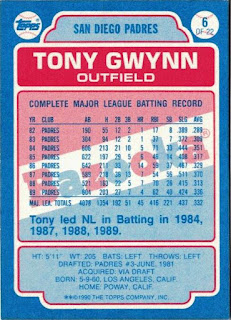
The cardback is in the same Bazooka brand colour scheme. Tony had added two batting titles since the card that was issued in 1988!

If you want to fill in the gaps in this gum-based post, then you can read about the 1989 Bazooka card here!

Total: 779 cards

Tuesday, October 12, 2021

Tuesday Twins - Pacific variations from 1999

Here are some cards that have already been on the blog. Sort of.

Card Number 775: Pacific, 1999 (batting photo); #368

In 1999, Pacific messed with the heads of collectors by having cards with the same number and different photos in their flagship set. I've previously blogged the portrait version of this card. 


Last time I blogged about this I noted the quirkiness of the factoid on the back - about Tony hitting his 2,900th hit in the preceding season. That would be eclipsed in 1999 by his 3000th hit!


I really like the shade of blue on that cardback.

Card Number 776: Pacific Aurora, 1999; #SAMPLE

This is a sample card given away to promote the Aurora range. The front looks like the regular card... at first glance.


But when they are next to each other in the binder they look quite different.


It's a bit like a spot the difference picture. The background colour has changed. Background Tony is bigger. Foreground Tony has moved further away. 

And in case of any doubt, the cardback has SAMPLE written across it.


And, now a bonus third Pacific card from 1999!

Card Number 777: Pacific Private Stock, 1999; #7


Different card companies have different 'giveaway' design tics. One of Pacific's giveaways was outlining players with a glowing aura. It's really evident on this card.

The free-floating logo behind Tony's knees feels like an on-screen graphic from a highlights show.

The cardback is committed to presenting all the detail of a particular game - Tony's eighth game where he recorded five hits.


In addition to the box score from the game in question, there is a well-arranged stats column that puts Tony's figures for 1998 into context against his career figures. I would award an extra bonus point for that if I was scoring this card. 

1999 was a busy year for Pacific. I have 21 Tony Gwynn cards issued by Pacific in 1999 and there are even more yet to be added to the collection!

Total: 777 cards

Monday, October 11, 2021

Modern Monday - green border zombie

2018 is three years ago now, but nothing screams 'modern baseball card' more loudly than a parallel produced by Panini.

Card Number 774: Donruss, 2018 (Green Border Parallel); #165


Shiny green foil around the outside of this card differentiates it from the regular base cards, or the Optic version (which are all in this 'Triple Tuesday'post from May 2020!) It's also not the first green parallel card from 2018 DonRuss to feature on the blog. Here is a green parallel retro card. These green parallels were exclusive to blaster boxes, but only 110 cards in the set were also issued as green parallels. Tony was on two of them.

There is no indication this is a parallel on the cardback.


I refer to these DonRuss cards as "zombie cards" because Panini keep the brands alive in an unlicensed limbo. This cardback in particular is a masterclass in describing events without using any proprietary franchise names or trademarks of Major League Baseball. 

Total: 774 cards

Sunday, October 10, 2021

One Card Only - Focus Pocus

This card arrived in the mail from Jeff at Wax Pack Wonders. It combines a lot of things I appreciate about baseball cards on the cusp of the new millennium. A long-forgotten set range, a name for an insert set that feels borne out of creative deaperation, and shininess! So much shininess!

Card Number 773: Fleer Focus, 2000; # FP2

Somebody was tasked with thinking up a name for a shiny insert series and really struggled. The best they could imagine up was Focus Pocus. Like the magic words Hocus Pocus but with an F. Maybe the Fleer employee in question was a fan of the film from 1993 starring Bette Midler and Sarah Jessica Parker.  

Anyway, here is the card, which got focuspocussed up on my flatbed scanner.


My flatbed scanner (a Brother DCP-L25000 for reference) really likes picking up the blue part of the spectrum in shiny cards. Because the card looks nothing like that scan.

My overhead scanner (made by Kinghun and bought off Amazon) captured it more accurately.


The back isn't shiny. It's very colourful though. And so is the write-up, which references Tony using his baseball bat like a "magic wand" and hexing opposing pitchers. (Which I'm pretty sure would contravene some rules!)


As I've collected several cards produced by Fleer towards the end of the 90s, I've noticed some very florid descriptions on cardbacks. Mainly they appear on Fleer cards released under Skybox branding, but sometimes the copywriting staff were let loose on cards in other ranges too, especially after Fleer was bought by the owners of the Rite Aid chain of pharmacies in 1999. (Fleer had a turbulent time at the end of the decade. They were owned by Marvel before being sold off when Marvel went bankrupt!)

I just want to say thanks again to Jeff for sending me this little bit of magic from the beginning of the millennium. 

Total: 773 cards (and 400 blog posts!)

Saturday, October 9, 2021

Sharing the (oddball) Spotlight

I have a few cards that feature another player alongside Tony. Here are a couple of examples of Tony sharing the spotlight on 'oddball' issues.

Card Number 771: French's, 1992; #16

These cards were a giveaway linked to French's Mustard. This condiment debuted at the St. Louis World's Fair in 1904, and is still sold today. Each card in this set featured two top players. Tony shared his card with Joe Carter, who was playing for the Blue Jays at that time. 


Joe was born in March 1960, almost two months before Tony arrived in the world. He was in the 1981 draft with Tony and was selected by the Cubs. After a spell with the Indians he played alongside Tony at the Padres before being part of the deal with the Blue Jays that brought Fred McGriff and Tony Fernandez to San Diego. Roberto Alomar also moved to Toronto with Joe in that deal.

That move worked out better for Joe and Roberto as both of them won back-to-back World Series titles with the Blue Jays - the first one was the year this card was given away with French's Mustard, 1992.

Depsite being the same age as Tony, Joe retired in 1998. He was inducted into the Hall of Fame in 2003, which was the first year he was eligible for entry. Being a first year inductee is yet another thing he has in common with Tony. 

There is a short write up about each player on the cardback. 


Design-wise, I like this card for several reasons. I like cards that are green. I also like the bat and ball drawings in the background of the cardback. The photos are quite small so the player's features aren't very easy to make out. But this is still a nice card featuring two Hall of Famers.

Card 772: Classic Blue, 1990 (NL Hit Kings); #87 

Are Classic cards really 'oddballs'? I think they kind of are.


There are two versions of this card. This one that says NL Hit Kings on the front, and another version that says Clark / Gwynn on the front. Trading Card Database lists this version as 87b.

That's Will Clark next to Tony. "Will the Thrill" made his major league debut for the Giants in 1986. Before that he was in the USA baseball team at the 1984 Olympics in Los Angeles, part of the squad that included Tony's brother, Chris, and several other players who later had major league careers. In 1994 Will moved to the Rangers, and after five seasons in Arlington, had brief stints with the Orioles and Cardinals before retiring. He is on the Giants Wall of Fame and the Giants have announced plans to retire his shirt number (#22) in 2022.

This photo is slightly awkward because Will is looking at the camera and Tony isn't. Given the logos of other baseball clubs on the wall behind them (the Brewers and Phillies logos are visible) I conclude this was taken at an All Star Game with the players getting papped by multiple photographers (or at least two!) at the same time. 

Classic cards were marketed as board games rather than baseball cards - which seems to have been a clever way of subverting licensing arrangements -  so along with a few stats, there are trivia questions to ask as part of the game on the back of the card.


The stats compare Will and Tony's seasons in 1989. Will was .003 behind Tony in batting average so not far off winning the batting title! He had seven fewer hits than Tony but also had fewer At Bats, possible because he drew more walks. A mathematician could probably work out what the true differential of .003 would be in terms of hits. Maths isn't my strongpoint, but it feels like he was literally just a couple of hits away from taking the title. 

The other thing I noticed from the stats comparison is that Will struck out over three times as often as Tony did - 103 strike outs to Tony's 30. The mind-boggling bit of that is that Tony only struck out 30 times in 158 games. I often bring this up, but on average you would have had to go to six games in 1989 to be guaranteed seeing him strike out. It always astonishes me how rarely he struck out.  

Total: 772 cards

Friday, October 8, 2021

Giveaway Gwynns

These cards had a logo saying Starline on them, but on Trading Card Database, they were listed as Starline Long John Silver. I couldn't find any details of where this set originated from until, on the second page of Google results, there was a blogpost by Fuji, who often comments on my blog, all about them. 

I regard Fuji as a reliable authority on Tony Gwynn cards and baseball cards in general. So, this is what he had to say about these cards:
These cards were distributed by the Long John Silver restaurant chain back in 1990 over an 8 week period. Each week, the restaurant would hand out a different cello pack that contained 6 cards: a header card plus 5 player cards.

There is a great picture of the entire set, complete with all the header cards on Fuji's blog [relink], but I'm just interested in the two cards that I recently acquired. (Incidentally, that blog post by Fuji is from 2011 - thank goodness the Internet never forgets!)

Card Number 769: Starline Long John Silver, 1990; #4

These would have been given out in the packet distributed in week one of the two month promotional period. 


At first glance I thought the picture on the front had been airbrushed to remove any logos from Tony's uniform.

However, the photo on the back includes the SD logo on Tony's hat and the word Padres on his training top.


This is a decent cardback for an oddball giveaway, with some bullet pointed factoids and a full-sized stats box. As early as 1990, Tony was the all-time leader for the Padres in hits. Nobody else has come close to his totals since. 

Card Number 770: Starline Long John Silver, 1990; #29

This card was in the set given out in week 6 of the promotion. 


The white mark above Tony's name is a scuff mark. These were giveaways in restaurants. Some minor marks on the cards are to be expected. The Padres logo on Tony's helmet and shirt are clearly visible. 

The photo on the back includes a recognisable member of the crowd pulling a slightly goofy face just behind Tony. Imagine making it onto a baseball card and then realising that you had a funny expression!


The biodata and stats box are the same as the other card in the set, but the four bullet point factoids are all different. The bullet about Tony's hitting with runners in scoring position is a neat little statistic.

The cards also include the Coca-Cola logo on the back, so presumably Coke contributed towards the production of these cards.

Long John Silvers is still going with over 700 locations in the USA. It's a seafood restuarant named after the famous character from Treasure Island, that looks to serve UK-style fish and chips (battered deep-fried fish with chipped potatoes). They also do "lobster bites". Sadly it doesn't seem that baseball cards are still on the menu!

Total: 770 cards