Showing posts with label French. Show all posts

Tuesday, November 9, 2021

Tuesday Twins - lookalikey Leafs

In the 1980s Leaf was DonRuss's imprint for the Canadian market. Leaf cards were near-identical 'twins' of DonRuss cards.

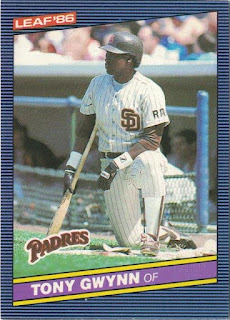
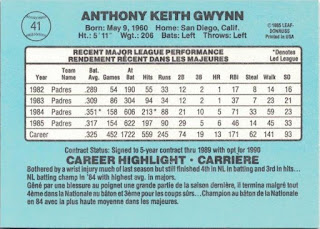
Card Number 839: :Leaf, 1986; #41


Tony is watching his team-mates batting to try and suss out the pitcher's arsenal of throws. His look of concentration here would translate into a tendency to swing and make contact with the first pitch he faced when he went up to the plate. 

The back of the card also follows the DonRuss template, but with some French on there for the bilingual Canadian market.


There is mention of a wrist injury in 1985 that hampered Tony's attempt to defend his 1984 batting title. DonRuss / Leaf liked to mention this wider context to explain the figures. Tony had quite the list of injuries catalogued on their cardbacks. 

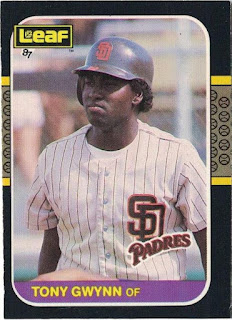
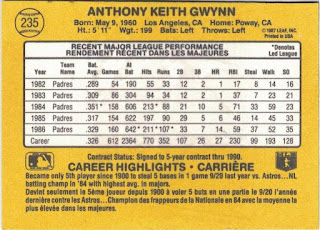
Card Number 840: Leaf, 1987; #235
The famous "tyre tread" design got reused North of the border.


This card illustrates something called "poor centering". This is very common in cards from the 80s.


The cardback doesn't have all the same information at the DonRuss cards because of the space needed for the French translation. Some of the career highlights carried over from one year's card to the next. It's always interesting to see what they dropped and what they felt was worth repeating.

Total: 840 cards

I am very busy at the moment so will be taking a short break from blogging. I hope to be back in action before the end of the month!


Sunday, November 7, 2021

One Card Only - penultimate O-Pee-Chee

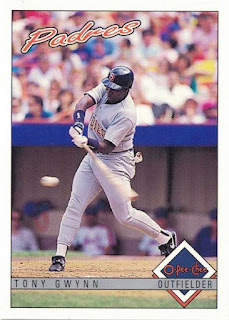
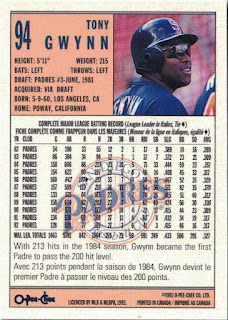
Card Number 836: O-Pee-Chee, 1993; #94

For many years O-Pee-Chee reprinted Topps cards, but then for a couple of years in the early 1990s they produced their own sets. This was the penultimate set O-Pee-Chee produced before they ceased printing cards after the 1994 season.


Tony is about to hit that ball that is flying towards him in the photo. The players sitting in the dug-out behind him look like they are in Mets uniforms. 


As this card is "Inprime au Canada", the factoid on the back is in French as well as English. O-Pee-Chee borrowed a Topps approach to factoids, by talking about a season 10 years previously. 

The player to Tony's right, with just his shoulder in the picture, has a name beginning with H and the top of a 4 visible. It's the same blue uniform. In 1992. Tony's team-mates included Greg Harris (46) and Bruce Hurst (47). They were both taller than Tony, so the fact he is looking up at them isn't a clue as to which one it might be. 

Total: 836 cards

Wednesday, October 6, 2021

Toppeechee cards from the 80s

I was surprised when I first researched O-Pee-Chee cards that the name came from an Ojibwa word meaning 'robin' . The Ojibwe are Canada's second largest First Nations tribal people and a large number live in the USA as well. In Canada they tend to live in a large area that stretches from Quebec to British Columbia. 

In my ignorance, I just assumed it was a way of phonetically spelling 'Oh, peachy!' But, no, it has a much deeper meaning, and in terms of languages on baseball cards, it has to count as another one along with English, French, Spanish and Chinese characters. Technically, the Ojibwe people speak one of the Algonquian languages, but for the purpose of this blog, I'm just going to count it as Ojibwe. 

For most of the 1980s, O-Pee-Chee had a licence to reprint Topps cards. They often released smaller sets, added their logo on the front and changed the cardbacks so they had information in English and French. The cards were sold in Canada but seem to have travelled reasonable quickly to collectors in the USA.

I've blogged a few of these "Toppeechee" cards before - here is Tony's rookie card, and also his card from the 1986 set. Richard included a few more in his recent parcel, which I mentioned in the box opening video, and here I am, blogging about them today.

Card Number 762: O-Pee-Chee, 1985; #383


As I noted when I blogged about the Topps release of this card, Tony has a visible wad of chewing tobacco in his cheek. Tony started 'dipping' when he was in the minor leagues at Walla-Walla, and was never able to shake the habit although he apparently tried several times. This card foreshadows his early death from oral cancer. 

In terms of being bilingual, most stuff on the back is translated. However, this would not pass the requirements for translation in my workplace where everything has to be fully bilingual.


Card Number 763: O-Pee-Chee, 1987; #198

This is my favourite ever Topps set (for sentimental reasons!) and the Topps version of this card was the very first card on this blog.


Even though this is my favourite card set, this is one of the worst photos of Tony ever used by Topps on a card. And that is a very low bar to clear!

The back is very crisply printed. The 'On this Date' factoid is also in French as 'Une Date Memorable'.


Card Number 764: O-Pee-Chee, 1988; #360


There is something about the way Tony's stance perfectly frames whoever that person is sat in the dug out that makes me chuckle every time I see it. Tony's pinstripes look absolutely pristine in this photo as well.

The little baseballs in the background make the top of the cardback a bit hard to read, but it's a nice design. 


I am pretty sure I have pointed out Topps's obsession with recycling factoids about Tony's minor league achievements on their cardbacks. On this card they don't mention that Tony was batting champion the previous season, with an outstanding .370 batting average - the highest so far in his career. Instead, we learn about how Tony won the MVP in the Northwest League in 1981, in both English and French.

From 1989 O-Pee-Chee started releasing the full Topps sets complete with the Topps logo on the front and bilingual cardbacks. They did that for three years, then started releasing their own flagship sets. In 1994 they released their last set of Major League Baseball cards. Since then the brand has been through a few different owners and now is licensed out to other companies for use when releasing trading cards. 

Total: 764 cards


Friday, May 14, 2021

Friday French Lesson

Have you ever bought a job-lot of cards for just one card? I have. Dan put a little pile of cards up for sale on the UK Facebook group at a fair price and I spotted two Tony Gwynn cards in it. They were both fairly common cards that, no, wait a minute, that's an O-Pee-Chee card!

Card Number 673: O-Pee-Chee, 1986; #10


Apart from the O-Pee-Chee logo in a big white box on the front, there isn't really anything to distinguish it from the Topps card of the same year.

But when you turn it over, there's a lot of differences because most of the content is replicated in French.


"Parlons Baseball!"

"Premier coup de circuit!"

"Fiche complete comme frappeur dans les Majeures!"

I had an interesting discussion in work a couple of days ago about trying to produce genuinely bilingual resources and one thing we talked about was how pedestrian translated material becomes. The same thing happens on card backs. In English Tony "belted" his first major league home run on August 22nd 1982. The French just notes his first home run was on the 22nd August 1982. (Also, how weird is it that in French they put the dates the correct way round, instead of putting them the American way!)

This cardback is from the era where an unrelated factoid makes its appearance on the back as well. I noticed the French text is about 25 percent longer than the English. We have exactly the same issue in work when we have resources translated into Welsh. English is a language that is very easy to pare down and convey meaning with minimal words and grammar. Languages like French and Welsh have less forgiving syntax and are more precise. 

By the way, that premier coup de circuit was against the Chicago Cubs in an 8-7 defeat for the Padres at Wrigley Field. Tony hit it off Bill Campbell in the sixth inning. It was a solo home run, but Tony had already hit a triple in the second inning, batting in a run.

A big thanks to Dan for making this post possible.

Total: 673 cards


Tuesday, September 29, 2020

Tuesday Twins - is it DonRuss or not?

A couple of 'twins' to show today, that illustrate how the boundaries between DonRuss and Leaf were blurred.

DonRuss's 1988 set is ubiquitous in 'lots' of cards from the 80s. It is possibly the junkiest of 'junk wax' sets. But just in case you can't remember what it looks like, here is Tony's base card from 1988.


Recently another version of this card tipped up in a joblot.

Card Number 380: Leaf, 1988; #90


Exact same card, but with a different manufacturer's logo and the frame reversed. 

On the back, we have a bit more of a clue as to what is going on. The card is bilingual in English and French, meaning it was sold in Canada. (Well, it's sort of bilingual - this wouldn't pass muster in Wales in terms of meeting the legal requirements for bilingualism. And,yes, I know the main reason for that is that it's in English and French not English and Welsh!)


The main things to notice are the lower set number and the changes to the career highlights. For comparison, here is the DonRuss cardback.


They basically dropped the last highlight so they could fit in the French translation. There were 264 cards in the Leaf release, compared to 660 in the DonRuss version, hence the renumbering.

Fast-forward a few years and Leaf and DonRuss took turns in claiming the "Studio" brand. In 1997 when it was issued as DonRuss Studio. Tony's card looked like this:


(I blogged about this back in July) Well, as was often the case back in the 90s, cards like this had parallel version released as well. 

Card Number 381: DonRuss Studio Silver Press Proof, 1997; #124


There are shiny silver foil tramlines down either side of the card, and the other lettering is picked out in silver too.

The back is exactly the same as the regular release. 


As I noted previously about this card, his entire career in baseball to this point (6 batting titles, 1 world series, 5 gold gloves, the modern record for batting average) is summarised in one throwaway line at the end of the paragraph. I've also just noticed that this could be a recent Panini-era DonRuss card photo as there are no easily recognisable club logos anywhere.

This card looks nice sat next to the regular base card. There were also gold press proofs as well, but they were harder cards to find. The set of three would look pretty sweet.

Total: 381/394

Monday, August 3, 2020

Voltigeur!

Soon after I started this blog I posted about a Pacific card that listed Tony as Jardinero! Literally this means a gardener in Spanish; in baseball terms it's an outfielder. Voltigeur is the French word used for outfielder, although its literal meaning is an acrobat or tumbler. (Fun fact: a voltiguer was also a member of a lightly armed skirmishing unit in the French army during the Napoleonic Wars. In Canada is also had a semi-military application meaning a ranger.)

Anyway, as you can probably guess, this is a prelude to my post today featuring cards that call Tony a voltigeur. That means, of course, Canadian cards, and if there is one card manufacturer that springs to mind when Canadian baseball cards are mentioned, it is O-Pee-Chee. 

Like a lot of card producers, O-Pee-Chee started out as a candy manufacturer. Candy and cards were a natural fit and soon the cards were just as important - perhaps more important - than the candy. For most of the 80s, O-Pee-Chee reprinted Topps cards, with the O-Pee-Chee logo and sometimes other minor variations. But in the  early 90s, they also produced a premium range called, fittingly, Premier. They then diverged from Topps and released their own flagship sets for a couple of seasons.

In 1996 O-Pee-Chee was bought by Nestle, and O-Pee-Chee became a card publishing brand with various licences that it could sell on to other card companies. After the Nestle takeover, Topps printed O-Pee-Chee cards under licence, but since 2007 O-Pee-Chee cards have been produced by Upper Deck. 

Card Number 233: O-Pee-Chee Premier, 1991; #59


The Premier range was designed to compete directly with Upper Deck. It was printed on a decent card stock and was full colour front and back, unlike the Topps flagship that O-Pee-Chee reprinted. 

There is a tokenistic amount of French on the back


Living in a country where it is a legal requirement to ensure published materials are fully bilingual, I find bilingual cards particularly interesting. This card would most definitely not meet the requirements of the legislation regarding linguistic representation to which I have to adhere in my day job.

It's a very cute little company logo on the back though.

Card Number 234: O-Pee-Chee Premier, 1992; #106
One thing that O-Pee-Chee inherited from Topps - they really didn't believe it was important to show much of the player's face. (Also, is Tony looking to bunt there?)


They make up for the poor photo on the front with a portrait shot on the back


In fairness, there is limited information on the back of the card, but again the commitment to two languages is the bare minimum.

Card Number 235: O-Pee-Chee, 1994; #100
This was the regular card set that O=Pee-Chee produced.


For a flagship product, this is high spec. Full bleed on good card stock and a ball-on-bat photo!

Tony is jogging on the back. Sadly the cute logo with the little kids has gone.


But the cardback has some blurb in both English and French. The columns on the stats box are single-language but this is a much better effort at providing bilingual information. 

This was actually the last home-grown baseball card set that O-Pee-Chee produced as the company began to struggle, and two years later it was acquired by the giant Nestle corporation for whom cards were not a priority. 

Total: 235/394